Celebrity and Influencer Impersonation Rates in Online Romance Scams
· 11 min read
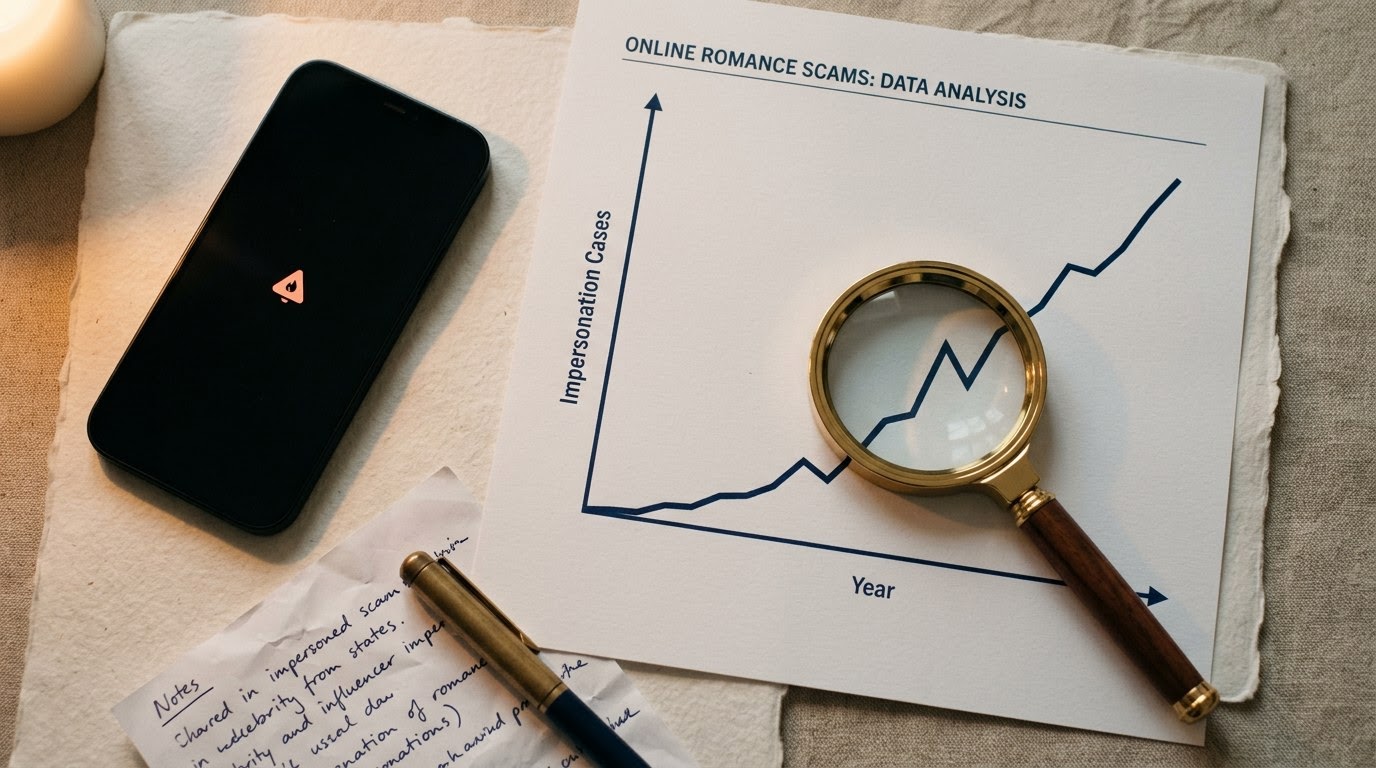
As of November 2026, federal enforcement records show that online romance fraud remains one of the costliest consumer threats in the United States, with FTC data confirming annual reported losses between $1.1 billion and $1.3 billion from 2022 through 2024. While federal databases do not isolate celebrity and influencer impersonation into its own statutory line item, cross-referencing FTC imposter reports with FBI complaint data reveals how public-figure personas amplify victim trust, accelerate off-platform migration, and drive high-value losses across irreversible payment rails.
The data
Empirical reporting from federal agencies and consumer protection bodies shows that celebrity and influencer impersonation sits at the intersection of romance fraud and broader imposter scams. Although national complaint databases classify most of these incidents under general romance or imposter categories, tracking social-media origin rates, median victim losses, and payment rail breakdowns exposes the financial scale and behavioral mechanics behind public-figure romance lures.
You can see the divergence most clearly by comparing agency tallies across report volume, dollar loss, and contact channel. The Federal Trade Commission captures high-volume consumer complaints across all dollar tiers, whereas the FBI Internet Crime Complaint Center captures fewer total reports with substantially higher average losses per victim. Together, these datasets establish reliable baselines for evaluating celebrity impersonation trends without relying on unverified industry estimates.
| Metric | Reported Range or Trend | Primary Source | Timeframe |
|---|---|---|---|
| Total annual romance scam losses | $1.1 billion to $1.3 billion per year | FTC Consumer Sentinel | 2022–2024 |
| Confidence and romance fraud losses | Exceeded $650 million annually | FBI IC3 | 2023–2024 |
| Total imposter scam losses (all types) | $2.7 billion to nearly $3.0 billion annually | FTC Consumer Sentinel | 2023–2024 |
| Romance scams starting on social media | 35% to 40% of reported cases | FTC | 2023–2024 |
| Median loss per romance scam report | $1,500 to $3,000 per victim | Better Business Bureau and FTC | 2023–2024 |
| Share of dollar losses borne by adults 60+ | 40% to 50% of confidence fraud losses | FBI IC3 | 2023–2024 |
| Fraud victims reporting to law enforcement | Fewer than 15% of victims | Bureau of Justice Statistics | 2021–2023 |
Examining these figures side by side highlights four empirical patterns that distinguish celebrity and influencer impersonation from conventional catfishing:
- Social platforms outpace dating apps as the primary funnel: FTC Consumer Sentinel reporting from 2023 and 2024 shows that roughly 35% to 40% of romance scams began on social media platforms rather than dating apps, giving public-figure impersonators direct access to fan comment sections and follower lists.
- Imposter and romance categories overlap heavily: FTC imposter fraud figures indicate that overall impersonation scam losses surpassed $2.7 billion in 2023 and approached $3 billion in 2024, driven by scammers who blend romantic grooming with false authority or celebrity exclusivity.
- Median losses vary sharply by narrative complexity: Better Business Bureau data from 2023 and 2024 places median romance scam losses between $1,500 and $3,000 per victim, while multi-month celebrity-management and investment hybrids routinely push losses into the tens of thousands.
- Official totals capture only the visible tip: Because fewer than 15% of fraud victims file police reports according to Bureau of Justice Statistics findings, celebrity impersonation incidents frequently remain invisible in local crime tallies unless victims contact federal portals or their banks.
Why do social platforms fuel celebrity and influencer impersonation?
Social platforms fuel celebrity and influencer impersonation because algorithmic engagement turns every public fan interaction into a visible target for fraudsters. Unlike closed dating apps that require mutual matching, open comment threads on Instagram, TikTok, Facebook, and YouTube allow automated bot networks and human scam syndicates to identify responsive admirers, scrape profile details, and initiate private messages within seconds of a user liking or commenting on a public post.
Once you interact with a verified creator or musician, lookalike accounts exploit platform naming conventions to impersonate the figure's "private personal page" or "tour management team." Scammers copy profile photos, mirror recent video clips, and add subtle character variations such as extra underscores, periods, or phrases like "officialprivate" to bypass automated impersonation filters.
Consider how a typical music-fan lure unfolds in practice. A user leaves a supportive comment on a touring country singer's verified video, and within minutes receives a direct message from an account using the singer's headshot and a handle ending in "_private_chat." The impersonator claims the verified account is run by a publicist, asks the target to switch to an encrypted messaging app like Telegram or WhatsApp for privacy, and establishes daily emotional contact before introducing a financial request.
Four structural features on major platforms make these lures effective against careful users:
- Algorithmic fan-targeting: Fraudsters monitor high-engagement posts and live streams to spot lonely, generous, or heavily invested commenters who already express admiration for the public figure.
- Verification badge confusion: Paid subscription checkmarks on major social networks have eroded the signal value of blue badges, making it harder for you to distinguish verified public figures from paid lookalike accounts at a glance.
- Multi-account triangulation: Syndicates often run two linked fake profiles simultaneously, with one posing as the celebrity seeking private companionship and a second posing as a strict business manager who handles scheduling, fees, and non-disclosure agreements.
- Rapid off-platform migration: Moving conversations quickly to WhatsApp, Signal, or Telegram strips away the social platform's safety warnings, spam detection, and account-suspension history before the first payment request arrives.
How do demographics and reporting gaps shape victim outcomes?
Demographics and reporting gaps shape victim outcomes by dividing celebrity impersonation losses along age, channel preference, and emotional stigma. Older adults experience higher per-victim financial losses when targeted through long-form companionship lures, while younger adults face higher contact volume through influencer-branded lifestyle and cryptocurrency schemes. Across every age bracket, embarrassment and disbelief suppress formal reporting and delay bank recovery efforts.
Federal complaint breakdowns illustrate clear generational differences in how impersonators extract money. FBI reporting from 2023 and 2024 shows that adults aged 60 and older accounted for roughly 40% to 50% of all reported confidence and romance fraud dollar losses, reflecting larger retirement savings and home equity reserves. By contrast, FTC age-band trends from 2023 and 2024 show adults aged 20 to 39 filing high counts of social-media-originated fraud reports with lower median dollar losses per incident.
Stigma compounds these financial disparities when victims realize the person they trusted was a fabrication. Bureau of Justice Statistics survey findings published between 2021 and 2023 show that fewer than 15% of identity theft and financial fraud victims report the crime to law enforcement. Similarly, AARP fraud research in 2024 estimated that roughly 25% to 35% of targeted older adults withhold reports of romance or imposter outreach due to embarrassment, often hiding losses even from adult children.
Real-world case patterns reflect how scammers tailor public-figure personas to each demographic segment. A retired widower is far more likely to be approached by an impersonator posing as a veteran television actor, classical musician, or military-charity spokesperson seeking quiet companionship and emergency travel funds. Meanwhile, a 28-year-old fitness enthusiast is more likely to be groomed by an impersonator using a micro-influencer's stolen gym reels to pitch romantic exclusivity alongside a fraudulent digital asset trading platform.
Which payment rails do celebrity impersonators exploit most?
Celebrity impersonators overwhelmingly exploit payment rails that settle instantly, mask recipient identity, and limit chargeback protections once funds leave your account. Instead of asking for traditional credit card payments or traceable domestic checks, fraudsters steer victims toward cryptocurrency wallets, prepaid gift cards, peer-to-peer payment apps, and international wire transfers, framing each unusual payment method as a confidentiality requirement for a high-profile public figure.
Payment data from federal regulators shows a sharp shift toward irreversible digital transfers. FTC payment breakdowns from 2023 and 2024 show that cryptocurrency accounted for roughly 30% to 35% of reported romance scam dollar losses, making digital assets the leading channel by total value stolen. At the same time, Federal Reserve consumer payment studies from 2023 and 2024 show that more than 70% of U.S. adults now use digital or instant payment tools, expanding the pool of reachable targets.
Consumer protection reviews highlight why recovery remains rare once an impersonated celebrity convinces you to hit send. CFPB oversight findings from 2023 and 2024 documented more than $100 million in annual consumer fraud losses across major peer-to-peer payment networks, noting that consumers who authorize transfers under false pretenses face steep legal hurdles when seeking reimbursement. Scammers exploit that friction by inventing urgent, status-specific pretexts that make asking a bank teller questions seem like a breach of trust.
Impersonators rely on four distinct payment rails, each paired with a tailored celebrity excuse:
- Cryptocurrency transfers: Scammers claim their management company freezes public bank accounts during divorce proceedings or album rollouts, instructing you to send Bitcoin or stablecoins to preserve privacy.
- Retail and gaming gift cards: Fraudsters posing as traveling influencers ask for Apple, Steam, or Razer Gold codes to pay for "private flight Wi-Fi," fan-club membership cards, or security-team expenses, since card numbers can be liquidated overseas within minutes.
- Peer-to-peer payment apps: Scammers use mule accounts registered under unrelated personal names on Zelle, Cash App, or Venmo, claiming the recipient is a "personal assistant" or "security driver" handling logistics on their behalf.
- Domestic and international wires: High-loss celebrity lures instruct victims to wire tens of thousands of dollars for fake "VIP meet-and-greet clearances," non-disclosure deposits, or charitable foundation matching pledges.
Which verification checks expose fake celebrity and influencer profiles?
Verification checks expose fake celebrity and influencer profiles by separating fabricated social signals from independently verifiable public records and payment realities. As of November 2026, generative voice cloning and short-loop synthetic video mean you can no longer rely on a brief video wave or a familiar voice note to confirm someone's identity. Running structured provenance, platform-history, and financial-boundary checks consistently breaks the illusion before money changes hands.
- Inspect account provenance and verification trails: Check when the profile was created, how many times the username has changed, and whether the public figure's official website, record label, or talent agency links directly to that exact handle. Lookalike accounts frequently show recent creation dates, recycled captions lifted from fan pages, and sudden shifts in language or posting hours.
- Run reverse image and video frame checks: Take screenshots of profile photos, behind-the-scenes clips, and supposedly "exclusive" selfies sent to you in private messages, then run them through reverse-image search tools. Scammers routinely crop frames from public interviews, paparazzi archives, or a real influencer's older Instagram Stories and pass them off as real-time updates sent only to you.
- Test third-party management claims independently: When an account claims to be a star's private page or refers you to a "manager" for a fan card or meetup fee, look up the celebrity's legitimate agency or publicity firm through a clean browser search and contact that office directly. Real talent agencies do not sell private romantic access, waive non-disclosure fees via gift cards, or ask fans to wire travel funds.
- Apply an absolute off-platform and financial firewall: Refuse to move conversations from public platforms to encrypted apps until identity is verified through official channels, and treat any request for cryptocurrency, gift cards, P2P transfers, or bank details as conclusive proof of fraud. No legitimate celebrity or influencer relies on a stranger online to cover frozen accounts, tour logistics, or management clearances.
- Demand live, unscripted verification with independent confirmation: Because AI-assisted video loops can mimic a celebrity's face during low-resolution calls as of November 2026, treat poor lighting, dropped connections, and refusal to speak coherently in real time as disqualifying red flags. Pair any behavioral red flag with independent identity checks on the phone numbers, email addresses, or mule payment accounts the contact asks you to use.
Practicing these five checks shifts the burden of proof back onto the sender, where it belongs. Scammers rely on urgency, flattery, and artificial secrecy to prevent you from pausing long enough to verify a handle or trace a payment destination. Taking ten minutes to confirm provenance through an independent channel eliminates nearly every public-figure impersonation script before it escalates.
Methodology and caveats
This analysis synthesizes published complaint summaries and survey findings from the FTC, FBI Internet Crime Complaint Center, Better Business Bureau, Bureau of Justice Statistics, AARP, Federal Reserve, and CFPB. Two caveats apply. First, federal reporting agencies do not isolate celebrity and influencer impersonation as a standalone category, requiring researchers to evaluate it through overlapping romance and imposter datasets. Second, FTC and FBI figures measure self-reported complaints rather than total victimization; because most victims never report, true financial losses are estimated to be several times higher than recorded totals.
What this means for you
If someone claiming to be a celebrity, influencer, or their private representative reaches out to you online, treat unverified exclusivity and off-platform secrecy as immediate warning signs. Never send cryptocurrency, gift cards, peer-to-peer transfers, or personal banking details to anyone you have not verified through independent, official channels, regardless of how convincing their photos or voice notes appear.
Before you trust an unfamiliar contact, share personal photos, or send a single dollar, run a TrustCheck through TrustMatch to verify the phone numbers, email addresses, or user details behind the profile. Independent identity verification gives you objective facts before emotional pressure turns into an irreversible financial loss.
Frequently asked
Do federal agencies track celebrity impersonation romance scams separately?
Federal agencies do not publish a standalone category for celebrity or influencer impersonation. Instead, the FTC and FBI group these cases under romance scams and broader imposter fraud. Researchers estimate their scope by examining social-media-originated romance complaints, which represented roughly 35% to 40% of FTC romance reports in 2023 and 2024.
Why do scammers impersonate celebrities and influencers instead of ordinary people?
Impersonating a recognizable public figure gives a scammer instant credibility and emotional leverage. Victims often believe a star needs discretion, which makes secrecy requests, private messaging apps, and non-disclosure agreements seem plausible. That perceived exclusivity discourages victims from consulting friends or family before sending money.
What payment methods do celebrity impersonation scammers demand most often?
Impersonators overwhelmingly demand irreversible payment rails that bypass bank fraud protections. According to FTC reporting from 2023 and 2024, cryptocurrency accounts for roughly 30% to 35% of romance scam dollar losses, while gift cards, wire transfers, and peer-to-peer payment apps account for high volumes of individual complaints.
Can a live video call prove that a celebrity account is genuine?
No, a short video call or voice note no longer confirms identity as of November 2026. Fraudsters increasingly use synthetic voice cloning and pre-recorded or AI-assisted video loops during brief calls, then blame poor tour Wi-Fi when asked to interact normally. Always verify identity through official management channels.
How common is underreporting in celebrity and influencer romance scams?
Underreporting is widespread across all romance and imposter fraud categories. Bureau of Justice Statistics surveys from 2021 to 2023 show fewer than 15% of financial fraud and identity theft victims report to police, and AARP research in 2024 found roughly 25% to 35% of targeted older adults hesitate due to embarrassment.
More in Research
- The Rise of Financial Sextortion on Online Dating Platforms
November 19, 2026
- How Common Is Chargeback Fraud in Private Online Sales
November 17, 2026
- Statistical Analysis of Fraud Rates in Peer to Peer Tool Sales
November 14, 2026