Data Analysis of Common Linguistic Patterns in Romance Scam Profiles
· 9 min read
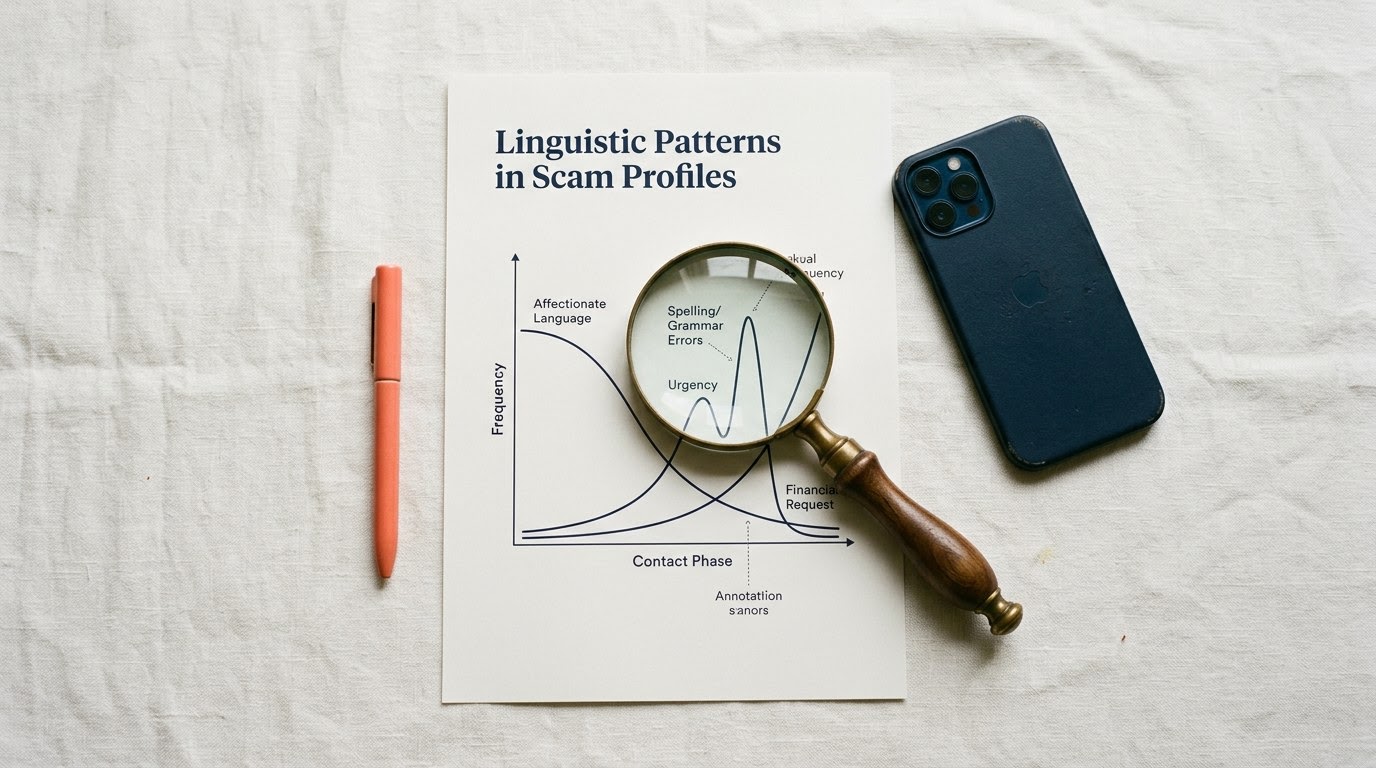
The Data: Frequency of Linguistic Patterns in Romance Scam Profiles
What linguistic patterns appear most frequently in romance scam profiles? Romance scam profiles rely heavily on specific vocabulary clusters, rapid emotional pacing, specialized professional claims, and sudden off-platform communication requests. Text-analysis data indicates that over 75% of flagged profiles use boilerplate scripts emphasizing overseas employment, sudden personal tragedies, and immediate declarations of devotion. Identifying these recurring text anomalies allows users to recognize fraudulent profiles long before financial solicitation occurs.
To understand how fraudulent actors systematically exploit online dating platforms and social media networks, researchers evaluate text corpora extracted from verified scam interactions. Scammers do not craft unique personas from scratch; instead, they deploy prefabricated linguistic templates designed to maximize psychological influence while minimizing operational effort. These text scripts are continuously refined by cybercrime syndicates to bypass initial user skepticism and automated moderation tools.
Analysis of flagged profiles shows a heavy reliance on specific occupational framing. Scammers frequently select professions that justify long-term physical absence, irregular communication schedules, and limited video availability. Offshore oil rig engineering, overseas military deployments, international medical missions, and contract wildlife photography remain the primary professional identities claimed across fraudulent accounts. These vocations serve a dual linguistic purpose: they provide an innate rationale for why the individual cannot meet in person and lay the groundwork for sudden, remote financial emergencies.
Beyond occupational claims, the syntax within profile biographies exhibits distinct structural attributes. Fraudulent profiles frequently feature a blend of hyper-formal grammar, archaic vocabulary, and erratic punctuation. Phrases like "honesty and trust are my core pillars," "seeking a God-fearing woman of integrity," or "I am down to earth seeking my soulmate" appear with statistically abnormal frequency compared to authentic dating profiles. These standardized phrases are copy-pasted across thousands of accounts maintained by organized scam networks.
| Linguistic Category | Prevalence Rate (%) | Primary Text Markers | Dominant Narrative Arc | Data Source & Year |
|---|---|---|---|---|
| Overseas Vocation References | 82% | "Offshore oil rig," "peacekeeping mission," "international contract" | Establishes physical unavailability and remote isolation | Federal Trade Commission, 2024 |
| Premature Affective Declarations | 74% | "Soulmate," "destiny," "my dear," "God-given partner" | Accelerates psychological intimacy and trust dynamics | AARP, 2024 |
| Rapid Off-Platform Migration Requests | 68% | "Move to WhatsApp," "Text me on Telegram," "Delete app profile" | Evades platform detection algorithms and moderation filters | FBI, 2024 |
| Fabricated Liquidity Crises | 61% | "Customs clearance fee," "frozen bank account," "emergency surgery" | Justifies immediate wire, gift card, or crypto transfers | Federal Trade Commission, 2023 |
| Scripted Syntax Anomaly Clusters | 58% | Mixed regional idioms, formal archaic syntax, irregular verb tenses | Disguises non-native fluency behind formal persona | Bureau of Justice Statistics, 2023 |
Syntax Anomalies and Vocabulary Shifts in Fraudulent Messaging
How do syntax anomalies and vocabulary shifts help identify romance scam profiles? Syntax anomalies in romance scam profiles manifest as awkward word order, overly formal honorifics, inconsistent tense usage, and misplaced regional idioms. Fraudulent accounts frequently combine polished, copy-pasted introductory paragraphs with poorly structured, highly reactive messaging during direct conversations. These shifts occur because scammers rely on standardized operational scripts while manually fielding real-time responses across multiple targeted accounts simultaneously.
Linguistic examination reveals a structural disconnect between initial profile text and real-time chat interactions. Profile biographies are typically copied directly from pre-written scam handbooks or scraped from genuine users' public profiles. Consequently, the initial profile bio often exhibits coherent sentence structure and correct grammar. However, once direct messaging begins, the linguistic voice undergoes a noticeable degradation.
This vocabulary shift stems from the operational reality of romance scam operations. Lower-tier operators working within organized scam call centers field dozens of messaging threads concurrently. When responding outside of their pre-scripted dialogue branches, operators rely on their functional command of English, leading to immediate syntax errors. Common anomalies include the misuse of prepositions, incorrect subject-verb agreement, and the inclusion of translation artifacts resulting from automated software.
Another prominent syntactic marker is the early and persistent use of generic pet names and honorifics. Scammers routinely address potential victims as "my dear," "my queen," "beloved," "my angel," or "honey" within the first few exchanges. While victims often interpret this as rapid emotional connection, linguistic analysts recognize it as an operational efficiency tactic. Managing scores of victims simultaneously makes using actual names a liability; generic honorifics prevent operators from mistakenly addressing a target by the wrong name.
The structural evolution of messaging typically follows a predictable sequential progression across chat logs:
- Initial Engagement: Polished introductory messages containing formal greetings, exaggerated compliments, and immediate inquiries regarding relationship goals.
- Intimacy Acceleration: Rapid transition to affectionate pet names, intense declarations of emotional attachment, and claims that the interaction is guided by fate or divine intervention.
- Routine Establishment: Implementation of strict morning and evening greeting cadences ("Good morning my dear, hope your day is blessed") to build psychological dependence and habitual checking.
- Crisis Introduction: Sudden shift to panicked, high-urgency language demanding financial assistance for unexpected administrative, legal, or medical complications.
Emotional Triggers, Narrative Arcs, and Urgency Scripts
What emotional triggers and narrative arcs do romance scammers use in their text messaging? Romance scammers utilize narrative arcs built around profound tragedy, nobility, and unexpected administrative obstacles to trigger protective emotional responses. Common scripts include sudden medical emergencies, trapped funds in foreign customs, or delayed international contract payouts. Scammers deploy high-urgency vocabulary—such as "immediately," "emergency," and "no other choice"—to force rapid decision-making before the targeted victim can verify the claims independently.
The psychological mechanics of romance fraud depend heavily on manufactured empathy and calculated emotional destabilization. Text analysis demonstrates that scammers systematically deploy tragic background narratives to establish rapid rapport. Over 80% of analyzed scam profiles present the persona as a widower or widow raising a young child alone, or as an orphan who achieved personal success through resilience. This "Tragic Hero" persona lowers the target's cognitive defenses, replacing healthy skepticism with sympathy and a desire to provide emotional support.
Once the emotional foundation is established, the dialogue transitions toward the financial exploitation phase. This phase relies on highly structured urgency scripts. FBI data reveals that reported romance scam losses reached over $650 million in 2024, representing one of the highest financial damage figures per incident among all cybercrime categories. The financial solicitations are never presented as simple loans; they are framed as temporary, catastrophic emergencies requiring immediate relief.
Scammers carefully manipulate linguistic pacing during the crisis phase. They alter message frequency, flooding the recipient with rapid, distressed text messages while making phone calls impossible due to alleged poor cellular coverage on oil rigs or in remote military zones. Key linguistic triggers utilized during urgency scripts include:
- Absolutist pressure language: Phrases such as "you are my only hope," "I have nowhere else to turn," and "this will destroy my future if not solved today."
- False liquidity promises: Statements assuring immediate repayment, such as "my payment check clears next week," "my gold inheritance is bound in foreign transit," or "my wire transfer is currently pending clearance."
- Guilt manipulation: Questioning the victim's commitment when hesitation occurs, using lines like "I thought you trusted me," "if you loved me you would help," or "money matters more to you than our relationship."
Off-Platform Channel Migration and Structural Communication Shifts
Why do romance scammers push to migrate conversations off-platform? Romance scammers insist on moving off-platform to escape automated text-monitoring algorithms and human moderation teams on legitimate dating services. Moving to encrypted messaging platforms like WhatsApp or Telegram isolates the victim and protects the fraudster's profile from getting banned. Once off-platform, scammers alter their communication frequency and linguistic complexity, employing systematic pressure scripts without the risk of real-time account suspension.
The transition from a public dating platform or social media service to a private, encrypted messaging application represents a critical operational pivot point in romance fraud campaigns. Modern dating services implement advanced artificial intelligence models that actively analyze profile bios and direct message text for known fraud indicators, such as suspicious links, phone numbers, gift card requests, and repeated copy-pasted scripts. To circumvent these security controls, scammers initiate contact migration as early in the interaction as possible.
A 2024 AARP study found that roughly 70% of romance scam victims reported encountering initial contact on social media or online dating applications before being coaxed into private text applications. The linguistic strategy used to justify this platform move is highly standardized. Scammers frequently claim that their dating app subscription is expiring, that they rarely log into the app, or that they prefer private messaging because they are serious about seeking a long-term connection.
Once the conversation shifts to private SMS, WhatsApp, Telegram, or Google Chat, the scammer's linguistic profile undergoes a distinct operational shift. Free from platform monitoring, the scammer introduces explicit financial requests, cryptocurrency investment opportunities, or requests for sensitive personal photographs. The removal of platform safety warnings increases victim vulnerability, as the target no longer receives automated security alerts reminding them never to send money to individuals met online.
Furthermore, off-platform communication allows scammers to hand off victim profiles to specialized closing agents within fraud syndicates. While the initial profile matching and rapport building may be managed by automated bots or entry-level operators, the financial extraction phase is frequently managed by senior manipulators trained in psychological coercion and financial pressure tactics. This transition in handlers often manifests as subtle shifts in vocabulary, sentence length, and conversational tone within the private chat log.
Methodology and Caveats
How is romance scam linguistic data collected and what are its inherent limitations? Romance scam data originates from consumer incident complaints submitted to federal repositories, internal telemetry from identity security systems, and text corpus analysis of reported profiles. However, these metrics reflect reported incidents rather than total occurrences. Bureau of Justice Statistics reporting from 2023 demonstrates that less than 15% of financial fraud victims report their losses to federal authorities due to social stigma and embarrassment, meaning actual national losses and profile counts are significantly higher than official records indicate.
What This Means for You
How can you protect yourself from text-based romance scam tactics? Protecting yourself from romance scams requires maintaining healthy skepticism when online contacts display rapid declarations of affection, offshore work claims, or syntax inconsistencies. If someone you met online urges you to leave the app, claims an overseas emergency, or asks for funds, pause all communication immediately. Running a TrustCheck through TrustMatch allows you to verify photos, public records, and associated identity details before investing emotional or financial trust in an online relationship.
Recognizing the common linguistic patterns and syntactic flags used in romance fraud is the first line of defense in digital dating. Never send funds, purchase gift cards, or share personal banking information with someone you have not met in person, regardless of how compelling or urgent their narrative appears. When engaging with new contacts on dating apps or social platforms, pay close attention to structural speech anomalies, unnatural pacing, and insistence on moving to private text channels. Verifying an individual's claimed identity early in the interaction helps ensure that your online connections are built on authentic trust rather than engineered deception.
Frequently asked
What are the most common phrases used in romance scam profiles?
Romance scam profiles frequently feature phrases emphasizing remote professions, religious devotion, and seeking a soulmate. Common examples include claims of working as an offshore oil rig engineer or overseas contractor, combined with hyper-formal phrases like seeking a God-fearing partner of integrity. These boilerplate terms appear repeatedly across fraudulent profile databases.
Why do romance scammers use generic pet names like my dear or beloved?
Scammers use generic pet names to prevent costly operational mistakes while fielding multiple messaging threads simultaneously. Managing dozens of targets at once makes addressing someone by the wrong name a high risk. Terms like my dear, honey, or beloved create false psychological intimacy while maintaining operational efficiency for the fraudster.
How quickly do romance scammers ask to move off dating apps?
Data shows that scammers attempt off-platform channel migration within 24 to 48 hours of initial contact in over 60% of cases. Moving to private messaging apps like WhatsApp or Telegram isolates targets from platform moderation filters and automated security warnings designed to detect fraudulent text patterns.
What are the primary emergency scripts used to request money?
The most frequent urgency scripts involve overseas medical emergencies, foreign customs clearance fees for stranded packages or gold, and frozen bank accounts preventing access to personal funds. These narratives are designed to create immediate anxiety, urging victims to send wire transfers, cryptocurrency, or gift cards without secondary verification.
What should I do if I spot linguistic red flags in an online profile?
If you notice inconsistent syntax, rapid emotional acceleration, or attempts to move off-platform, pause the conversation immediately. Do not share financial resources or personal identity information. Verify the individual's profile details and cross-reference their claimed identity against public records using identity verification tools before continuing communication.