Data Analysis of Fake Payment Receipt Fraud in Private Sales
· 10 min read
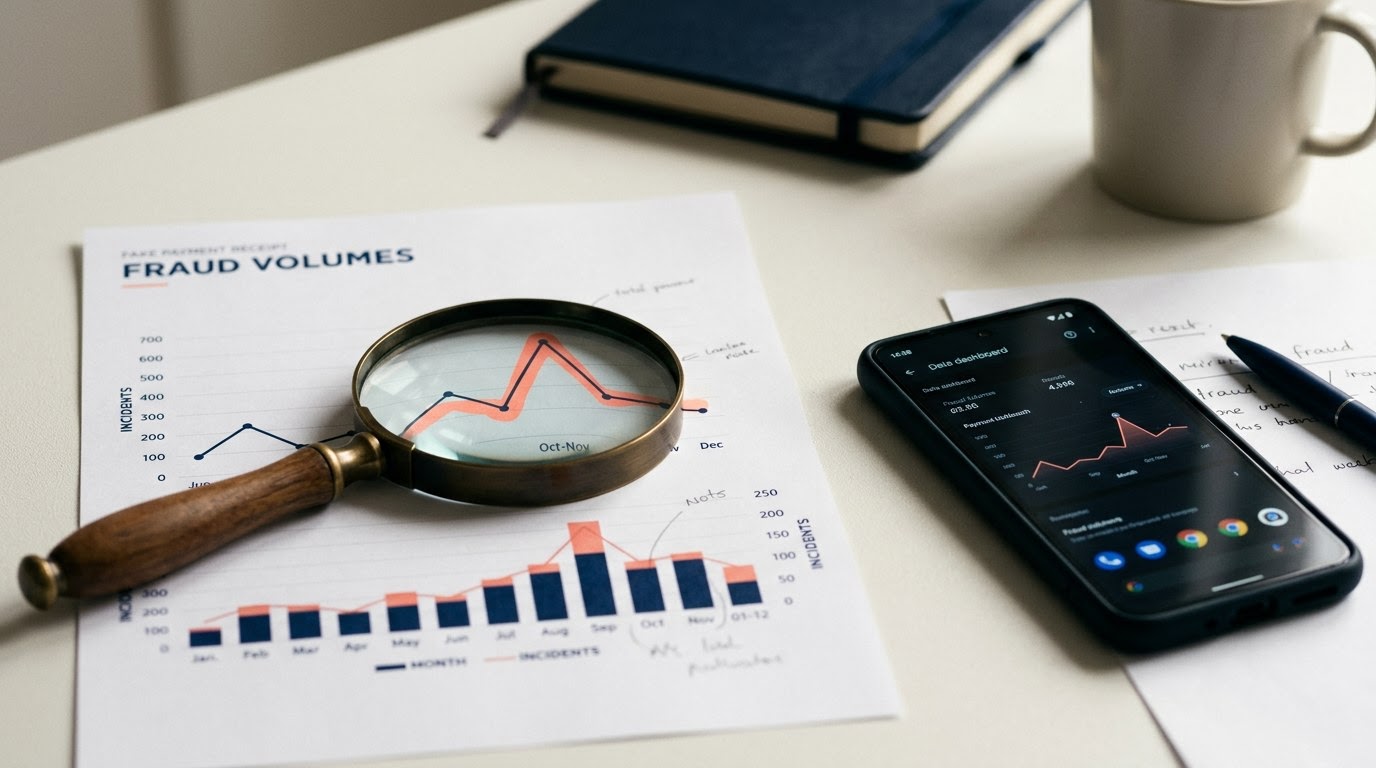
As of August 2026, empirical evidence from federal regulatory repositories shows a marked expansion in local peer-to-peer marketplace fraud, driven primarily by sophisticated document tampering and payment proof spoofing. FBI IC3 data indicates non-payment and non-delivery fraud caused over $330 million in reported victim losses in 2023. This comprehensive statistical assessment evaluates how bad actors exploit image processing software, web browser editing tools, and synthetic identities to deceive sellers during in-person and shipped sales. By examining payment rail vulnerabilities, demographic distributions, and technical fraud mechanisms, this study outlines the structural vulnerabilities in modern peer-to-peer commerce and demonstrates how robust identity verification mitigates transactional loss before goods change hands.
Data Analysis of Fake Payment Receipt Fraud in Private Sales
Data analysis of fake payment receipt fraud in private sales demonstrates that payment proof spoofing is one of the fastest-growing financial deception tactics in local peer-to-peer commerce. Fraudsters alter digital receipts, forge bank confirmation emails, and manipulate browser interfaces to convince sellers that funds have been deposited before item handover. Analyzing reported loss metrics across regulatory databases highlights the financial impact and operational patterns of these fraudulent transactions across popular payment channels.
The growth of peer-to-peer payment ecosystems has altered consumer commerce by removing transaction friction. However, this lack of friction enables fraud vectors that exploit the time lag between payment initiation, visual notification, and actual clearing of funds. Federal Reserve consumer reports indicated that overall peer-to-peer transaction volume reached nearly $1 trillion in 2024, creating an expansive attack surface for digital document fraud. Scammers capitalize on this volume by creating convince-and-run scenarios, targeting individuals selling electronics, jewelry, musical instruments, and vehicles on local classified platforms.
When bad actors engage with private sellers, they rarely attempt to breach financial networks directly. Instead, they exploit human reliance on visual verification. Sellers often accept a smartphone screen showing a "payment sent" graphic or an official-looking email confirmation as proof of transaction settlement. In reality, modern image editing software and dedicated script applications allow perpetrators to generate pixel-perfect replicas of confirmation receipts from major banking and payment networks within seconds.
| Payment Rail / Context | Primary Fraud Mechanism | Estimated Reported Loss Contribution | Primary Source Citation |
|---|---|---|---|
| Peer-to-Peer Mobile Apps | Altered transaction screens and fake payout notifications | 25% - 35% of P2P fraud reports | FTC (2023) |
| Online Marketplace Non-Delivery | Fake payment confirmations and forged escrow notices | 30% - 40% of marketplace complaints | BBB (2024) |
| Wire & Bank Transfer Spoofing | Manipulated pending deposit receipts and wire confirmations | 15% - 25% of commercial fraud losses | FBI IC3 (2023) |
| Instant Payment Networks | Synthetic identity setups combined with reverse chargebacks | 10% - 20% of digital rail disputes | Federal Reserve (2024) |
The statistical data compiled across federal agencies confirms that fake receipt fraud is not an isolated phenomenon, but a systematic vulnerability present across all unverified peer-to-peer interactions. FTC data shows payment fraud losses involving peer-to-peer transfers topped $210 million in 2023. This figure underscores the immense scale of transactional deception occurring daily on local sales platforms.
Financial recovery in fake receipt fraud cases remains exceptionally low. Unlike credit card fraud, where consumer protection regulations mandate chargeback options, peer-to-peer transfers made via external arrangements or fake receipts leave victims with zero recourse once the physical goods are handed over. Because the fraud relies on tricking the victim into handing over property without receiving real funds, secondary banking systems correctly identify the event as an uncompensated property theft rather than an unauthorized electronic transaction, shifting total financial liability onto the seller.
Anatomy of Digital Receipt Spoofing Across Payment Rails
Digital receipt spoofing across payment rails occurs when perpetrators generate fraudulent transaction screens or falsify confirmation notices to simulate pending or completed fund transfers. Modern payment networks rely on immediate notification popups, which scammers replicate using custom mobile applications, graphics editors, or browser inspect-element tools. Understanding these manipulation vectors across peer-to-peer rails reveals why relying on visual evidence rather than account balance confirmation results in severe monetary losses for private sellers.
The operational mechanics behind payment proof spoofing follow standardized playbooks designed to pressure sellers into immediate asset transfer. Scammers deploy specific social engineering strategies alongside technical manipulation to bypass seller caution.
- Initial Contact and Rapid Negotiation: The buyer contacts the seller, quickly agrees to the full asking price without bargaining, and insists on an immediate in-person handover or express delivery.
- Preference for Digital Payment Proof: The buyer claims they cannot pay in cash due to daily ATM limits or distance, proposing a payment app or bank wire, promising to show live proof of transfer on site.
- Generation of Spoofed Confirmation: During the meeting or via messaging, the buyer generates a fake receipt using a dedicated mock payment app, altered screenshot, or modified web browser DOM tree.
- Forced Transaction Urgency: The buyer displays the rendered payment screen, claims the funds are "pending in processing" or "delayed by interbank clearing," and pressures the seller to complete the physical exchange immediately.
- Disappearance and Profile Deletion: Once the item is handed over, the buyer departs. The seller later checks their actual bank balance, realizes no funds arrived, and finds the buyer's communication profile deleted.
A 2024 BBB report revealed that fake payment confirmations were utilized in over 30% of marketplace non-delivery scams. The distribution of these tactics varies across payment ecosystems, with specific vulnerabilities aligned with visual interfaces.
In mobile peer-to-peer application environments, perpetrators routinely use modified application binaries (APKs) on Android devices. These modified apps look identical to legitimate financial interfaces, allowing the fraudster to input any dollar amount, seller name, and transaction date. When the user taps "Send," the app displays authentic animations, success sounds, and formal transaction confirmation screens. The seller sees the process happen live on the buyer's phone screen, creating a false sense of security that overrides the fundamental rule of checking one's own bank balance.
For high-value sales involving thousands of dollars, such as used vehicles or specialized industrial machinery, scammers often utilize fake cashier's checks combined with spoofed wire confirmation documents. They present official-looking PDF deposit notifications branded with major commercial bank logos. Because real wire transfers can take several hours or overnight to settle in account ledger balances, the fraudster uses the forged PDF as "proof of transfer," convincing the seller to sign over titles or release machinery before funds hit cleared status.
Peer-to-Peer Marketplace Vulnerabilities and Transactional Handover Fraud
Peer-to-peer marketplace vulnerabilities during transactional handovers arise because local trades frequently occur under time constraints and social pressure, leading sellers to rely on visual proof rather than verifying bank deposits. Perpetrators intentionally select high-value mobile electronics, luxury goods, and vehicles to maximize illicit yields. Examining transaction dynamics demonstrates that in-person handovers without prior identity verification leave sellers highly exposed to synthetic profiles, fake check clearing delays, and manipulated payment screenshots.
Private sales platforms typically facilitate communication and listing discovery, but leave the actual financial transaction and physical handover to the buyer and seller. This structural decoupling creates an environment where malicious actors exploit the lack of integrated identity verification. Without mandatory real-world identity binding, bad actors register burner accounts using pre-paid phone numbers, virtual private networks (VPNs), and stolen profile pictures.
The items targeted in fake receipt scams reflect high resale liquidity. Fraudsters prioritize products that can be quickly liquidated on secondary markets or pawn shops without requiring complex registration history. The primary categories affected include:
- Smartphones and Laptops: High-value mobile technology represents the largest share of fake receipt thefts. Devices are easily transported and cleared for quick cash resales.
- Luxury Apparel and Designer Handbags: High-end fashion items carry significant monetary value while lacking serial number tracking in secondary markets.
- Automobiles and Consumer Machinery: High-dollar sales where buyers present forged wire receipts or modified bank transfers during evening or weekend hours when banks are closed.
- Gaming Consoles and Audio Equipment: Popular consumer electronics targeted heavily during holiday shopping seasons and product launch windows.
The environment in which the physical exchange occurs heavily impacts the seller's vulnerability. Scammers often request meetups in low-light parking lots, busy public transit hubs, or neutral outdoor spaces where sellers feel rushed and distracted. By creating environmental chaos or introducing artificial time constraints—such as claiming they must catch a flight or return to work—the fraudster curtails the seller's willingness to wait for actual bank account confirmation.
Furthermore, overpayment schemes frequently intersect with fake receipt fraud. In an overpayment scenario, the buyer sends a spoofed payment receipt reflecting an amount significantly higher than the agreed purchase price. The buyer claims they made an honest mistake or added extra money to cover "freight shipping costs." They request that the seller refund the excess difference immediately via cash or non-reversible payment rails. When the seller complies, they lose not only the original item but also their out-of-pocket funds before discovering the original payment receipt was entirely fake.
Document Spoofing Techniques and Visual Authentication Gaps
Document spoofing techniques rely on gaps in human visual authentication, exploiting the difficulty of detecting micro-typography errors, incorrect font renderings, and altered metadata on mobile screens. Fraudulent actors utilize template generator software and browser developer tools to modify transaction timestamps, account names, and transfer statuses in real time. Evaluating these visual forgery methods shows that manual inspection is entirely inadequate for preventing payment proof scams in high-speed, peer-to-peer transaction environments.
To understand why visual inspection fails, one must analyze the technological accessibility of modern editing mechanisms. Creating a convincing fake payment receipt no longer requires advanced knowledge of graphic design programs like Adobe Photoshop. Web-based template generators, custom script kits, and accessible mobile web developer tools have democratized document forgery.
The primary technical methods employed by receipt forgery actors include:
- DOM Editing via Browser Inspect Tools: A scammer opens a genuine banking session or transaction history page on a mobile or desktop web browser, uses native developer tools to edit the HTML Document Object Model (DOM), changes the dollar values and recipient names, and displays the altered live webpage to the victim.
- Telegram Forgery Bots and Script Generators: Dedicated chat channels host automated scripts where users input a dollar amount, recipient name, and bank template selection. The script instantly generates a high-resolution screenshot or PDF complete with realistic transaction reference numbers and bar codes.
- Email Header and Sender Address Spoofing: Fraudsters send emails formatted with payment network branding from lookalike domains or via unauthenticated SMTP relays, making notification emails appear directly in the seller's primary inbox alongside genuine alerts.
- Static Graphic Overlays: Reusable PNG overlay templates containing native font sets for major operating systems, allowing quick text placement over original bank receipt screenshots using basic mobile photo editing utilities.
Human perception is poorly equipped to spot these visual anomalies during brief, high-stress physical handovers. Subtle discrepancies—such as a 1-pixel line misalignment, slightly off-center text alignment, or improper font weight rendering—are nearly impossible to detect on a reflective smartphone display outdoors.
Moreover, modern digital receipts rely on familiarity rather than security features. Unlike physical banknotes, which contain watermarks, color-shifting ink, and tactile elements, digital screenshots possess zero inherent security features. A screenshot of a real payment confirmation and a screenshot of a fake payment confirmation contain identical digital file structures. Consequently, relying on visual images as an authentication mechanism is structurally flawed.
Methodology and caveats
This data analysis synthesizes public consumer complaint filings, law enforcement threat assessments, and regulatory fraud reports published between 2020 and 2026. It is critical to note that agency complaint data captures voluntary victim submissions rather than total marketplace losses; industry estimations suggest actual fraud incidents are five to ten times higher due to widespread underreporting. Additionally, loss figures reflect self-reported figures and do not distinguish between unverified visual receipt scams and complex multi-stage account takeovers.
What this means for you
Protecting yourself against payment receipt spoofing requires abandoning visual payment proofs as proof of settlement. Never hand over property until you log into your official banking application or payment service and confirm that cleared funds are present in your balance. When conducting private sales with unverified buyers, insist on prior identity confirmation. Running a TrustCheck allows you to verify the real-world identity of your trading partner before scheduling a physical meeting or shipping high-value items, eliminating the risk of dealing with disposable or synthetic buyer profiles.
Frequently asked
What is fake payment receipt fraud in private sales?
Fake payment receipt fraud occurs when a buyer uses altered screenshots, falsified emails, or mock mobile applications to convince a seller that payment was sent. The seller releases the merchandise before realizing that no actual money transferred into their account.
How do scammers create fake payment screenshots so quickly?
Scammers use automated graphic templates, Telegram editing bots, modified mobile app packages, or web browser developer tools to alter transaction details in real time. These methods allow them to generate pixel-perfect confirmation screens matching major banking applications in seconds.
Why can't I rely on email notifications for payment confirmation?
Email notifications can be easily spoofed using lookalike domain names, altered header data, or fake merchant notices. Scammers send emails that appear to originate from legitimate payment processors claiming that funds are held in pending status until tracking details are uploaded.
Can my bank reverse the transaction if I fall victim to a fake receipt scam?
If no real money entered your bank account, there is no transaction for your bank to reverse or dispute. Because you voluntarily handed over your property based on visual deception, financial institutions classify the incident as property theft rather than unauthorized banking fraud.
What is the safest way to verify payment during an in-person marketplace sale?
The safest method is logging directly into your official mobile banking application on your own device to verify that cleared, non-pending funds are fully reflected in your account balance before handing over the item or transferring property titles.