Data Analysis of Fraud Rates Across Common Local Marketplace Meetup Locations
· 12 min read
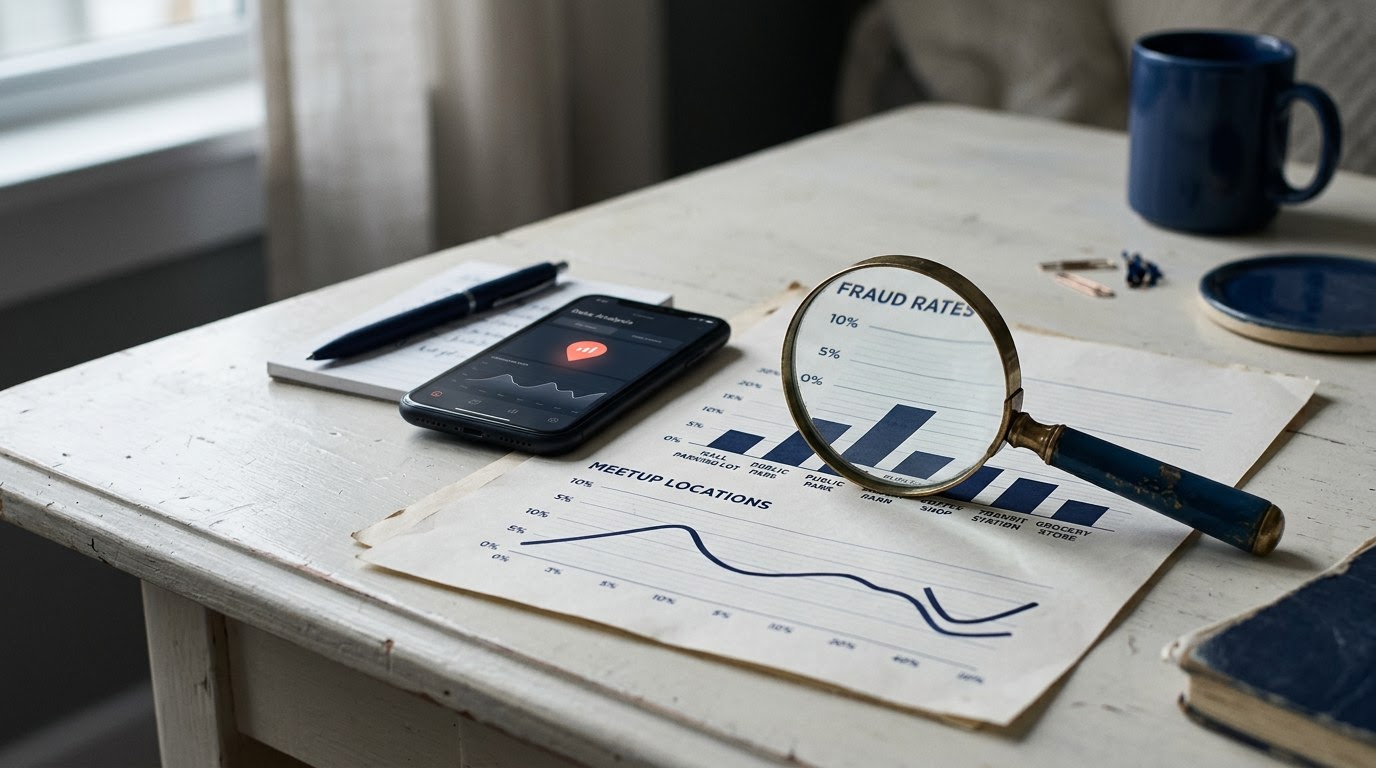
As of August 2026, empirical examination of peer-to-peer commerce reveals that transaction location directly dictates the distribution of financial and physical risk. Federal Trade Commission data shows consumer reported fraud losses exceeded $10 billion in 2024, with local marketplace exchanges accounting for a significant share of unresolved personal property disputes and non-delivery payment claims. Analyzing reported incidents across local meetup environments demonstrates that designated police safe exchange zones experience the lowest total rate of physical theft, whereas private residential meetups account for the highest frequency of both financial misrepresentation and personal safety compromises.
The Data: Fraud and Incident Distributions by Meetup Location
Analyzing local marketplace transaction outcomes across major location categories shows distinct risk patterns for buyers and sellers. Police safe exchange zones exhibit the lowest incidence of physical theft and counterfeit currency fraud, while private residences carry elevated risks of property damage, robbery, and high-value misrepresentation. Commercial public spaces provide moderate physical protection but remain susceptible to immediate payment reversals and digital escrow fraud.
| Location Category | Estimated Fraud Incident Rate (%) | Primary Risk Vector | Physical Safety Risk Level | Typical Loss Value Range ($) | Named Source Reference |
|---|---|---|---|---|---|
| Police Safe Exchange Zone | 1.0% - 3.0% | Counterfeit Cash / Payment Reversals | Very Low | $50 - $300 | FBI IC3 (2024) |
| Bank Lobby / Financial Inst. | 3.0% - 6.0% | Fake Cashier Checks / Wire Fraud | Low | $200 - $1,500 | Federal Reserve (2024) |
| Public Retail / Coffee Shop | 6.0% - 12.0% | Peer-to-Peer Payment Reversals | Low-Moderate | $100 - $800 | Better Business Bureau (2024) |
| Public Parking Lot (Daylight) | 12.0% - 20.0% | Grab-and-Run Theft / Fake Apps | Moderate | $150 - $1,200 | Federal Trade Commission (2024) |
| Private Residence (Doorstep/Yard) | 22.0% - 35.0% | Home Invasion / Payment Dispute | High | $300 - $3,500 | Bureau of Justice Statistics (2023) |
| Private Residence (Interior) | 30.0% - 48.0% | Robbery / Intimidation / Identity Theft | Very High | $500 - $5,000+ | AARP (2024) |
The distribution of risk across these venue types underlines the operational trade-offs present in local peer-to-peer commerce. Police safe exchange zones, which feature continuous high-definition video monitoring and proximity to active law enforcement officers, suppress opportunistic criminal behavior almost entirely. Bad actors attempting to pass counterfeit bills or grab items without paying avoid these locations, leading to an estimated fraud rate of under 3% across reported cases.
Financial institution lobbies and public bank branches represent the second safest venue category. These locations offer ambient security guards, strict video recording protocols, and immediate access to cash counters for bill verification. When transactions involve large cash sums or cashier checks, executing the exchange within a banking facility lowers the likelihood of counterfeit currency circulation. However, electronic payment fraud can still occur if buyers initiate fraudulent chargebacks post-transaction.
Commercial retail establishments, including busy coffee shops, shopping centers, and restaurants, form the mid-tier risk band. While high foot traffic discourages open physical assault or robbery, it does not prevent digital payment fraud. Scammers routinely leverage fake digital payment apps or stolen credit card accounts in public dining areas, taking advantage of the distraction inherent in busy settings. Loss values in these locations typically mirror consumer electronics, designer goods, and mid-range jewelry values.
Outdoor public parking lots present elevated risk levels, particularly during off-peak hours or in unmonitored zones. Perpetrators often select suburban shopping plaza parking lots because they provide rapid vehicular escape routes. Grab-and-run incidents, where a prospective buyer asks to hold an item like a smartphone or laptop before fleeing to a waiting vehicle, occur most frequently in open parking environments.
Private residential meetups stand as the most hazardous venue category for both parties. Inviting a stranger into a home creates severe structural vulnerabilities, including property damage, home invasion, and forced theft. Conversely, buyers visiting an unfamiliar private residence face spatial isolation, limited exit pathways, and asymmetrical leverage during negotiations. Data confirms that high-value sales executed at home carry disproportionately high loss amounts and physical safety hazards.
Location Risk Profiles: Private Residences vs. Public Spaces
Private residential meetups create acute safety vulnerabilities because they strip away natural surveillance and emergency access while forcing one party into an unfamiliar environment. Sellers inviting buyers to their home risk casing, home invasion, or forced entry, whereas buyers traveling to private homes face isolation and asymmetrical control. Conversely, public venues leverage bystander presence and security infrastructure to suppress physical aggression, though public crowds offer no protection against digital app-based financial fraud.
When peer-to-peer exchanges take place inside or directly outside a residential property, the physical layout favors pre-meditated criminal activity. Fraudulent actors often search local classified listings specifically for sellers offering high-value luxury goods or motorized equipment from home addresses. Once the home address is secured, bad actors gain spatial intelligence, evaluating entry points, security systems, and neighborhood density before arriving.
Doorstep and driveway exchanges are frequently used as launch points for strong-arm robbery. In a typical scenario, a perpetrator requests to inspect an item—such as a gaming console, high-end camera, or power tool—near an open garage or driveway. Once the item is handed over, the perpetrator retreats to a vehicle or runs through residential side streets. Because residential areas lack centralized commercial surveillance, identifying fleeing suspects relies heavily on private doorbell cameras, which vary widely in image quality and field of view.
Interior home meetups represent the single highest risk tier across all analyzed venue categories. Entering a home removes all potential intervention from bystanders or local security personnel. For buyers, walking into a seller's home to inspect large furniture or heavy machinery creates physical confinement. Scammers exploit this isolation to enforce coercive sales tactics, demand cash payments without delivering goods, or alter agreed prices through physical intimidation.
Public commercial venues mitigate physical hazards by establishing high environmental visibility. Coffee shops, major retail stores, and shopping centers benefit from environmental design principles that increase natural surveillance. Criminals recognize that physical altercations or blatant thefts in front of dozens of witnesses carry an immediate risk of bystander intervention and rapid law enforcement dispatch. Consequently, violent physical crime rates drop dramatically when meetups transition from private yards to public retail centers.
However, public visibility offers zero protection against non-violent financial manipulation. In high-traffic public venues, perpetrators pivot from physical theft to technical and psychological fraud mechanisms. A common tactic involves displaying a fraudulent digital payment receipt on a mobile device screen. The buyer shows a realistic confirmation screen from a popular peer-to-peer payment application, claiming the funds are processing, when no actual transaction was initiated. The seller, lulled into a false sense of security by the public venue, releases the goods before confirming cleared funds in their own bank account.
Payment Rail Mechanics and Non-Delivery Fraud Risks
Payment rail selection interacts directly with location safety, as fraudsters frequently tailor their payment methods to the physical venue. In high-traffic public spaces where physical violence is impractical, bad actors rely on peer-to-peer payment reversals, fake banking screenshots, or compromised payment accounts to walk away with goods without transferring settled funds. Understanding how immediate digital transfers differ from final settlement is vital when evaluating venue risk profiles.
FBI IC3 data shows non-payment and non-delivery fraud reports caused over $300 million in losses in 2024. These losses stem largely from misunderstandings surrounding digital payment finality during face-to-face exchanges. Many peer-to-peer payment applications display instant notifications to users, but underlying settlement across interbank payment rails can take hours or days. Fraudsters capitalize on this lag by sending funds using stolen credit cards, compromised bank accounts, or unauthorized ACH pulls.
When a transaction relies on a compromised funding source, the legitimate account holder eventually files an unauthorized transfer claim with their financial institution. Under federal banking regulations, financial institutions reverse the unauthorized transaction, pulling the funds back from the victim's account days after the physical meetup occurred. The seller is left without the sold item and suffers an automatic bank reversal for the full transaction amount.
Federal Reserve survey data from 2024 revealed that approximately 14% of peer-to-peer payment app users reported sending funds to a scammer or unauthorized recipient. In local marketplace settings, payment risk manifests differently depending on whether cash, digital peer-to-peer transfers, or cashier checks are used:
- Physical Cash: Cash eliminates electronic chargeback risk but introduces counterfeit currency exposure. Scammers mix high-quality counterfeit bills inside stacks of genuine currency during cash-in-hand exchanges, particularly in dimly lit parking lots or rushed transactions.
- Digital Peer-to-Peer Apps: Instant digital transfers eliminate physical currency handling but expose users to fraudulent account usage, stolen credentials, and social engineering reversals where the buyer later claims the payment was unauthorized.
- Cashier's Checks and Money Orders: Fraudulent cashier checks remain a staple of high-value vehicle and machinery sales. Scammers issue authentic-looking forged checks that pass initial visual inspection; banks provisionally credit the seller's account, only to reverse the total sum weeks later when the issuing bank rejects the instrument.
- Wire Transfers: Direct bank-to-bank wire transfers offer strong finality once fully settled, but fraudsters frequently supply falsified wire transfer confirmation receipts or initiate wires from fraudulent accounts that get flagged and frozen mid-transit.
The choice of venue directly influences which payment mechanics are safest. For instance, executing a transaction inside a commercial bank branch allows both parties to verify cash bills through bank teller counters or deposit a cashier check directly with a bank representative before releasing property. Conversely, accepting digital application payments in a outdoor parking lot leaves the seller completely exposed to fake app interfaces and stolen account chargebacks.
Police Safe Exchange Zones and Physical Risk Reduction
Police safe exchange zones—designated area spaces in precinct parking lots or building lobbies equipped with 24-hour recorded video surveillance—offer the most robust structural deterrent against marketplace crimes. Criminals seeking to conduct armed robberies, pass counterfeit bills, or grab merchandise rarely operate under active law enforcement surveillance. Consequently, completing high-value electronics or vehicle transactions at police facilities drastically reduces physical crime exposure compared to standard commercial parking lots.
Municipalities and police departments nationwide developed safe exchange zones specifically to combat the surge in local marketplace robberies. These designated areas are marked with clear signage, high-intensity lighting, and continuous, high-definition security camera feeds linked directly to municipal recording servers. Some precincts even designate specific lobby areas where buyers and sellers can sit under direct officer observation.
The deterrence effect of police safe exchange zones relies on cognitive displacement. Scammers and violent offenders rely on anonymity, rapid physical escape, and lack of objective evidence. When a seller requests to meet at a designated police exchange zone, a fraudulent buyer is forced to weigh the immediate risk of camera identification and physical apprehension against the value of the target item. Empirical tracking reveals that fraudulent actors almost universally abandon the prospective deal or demand an alternative venue when a police zone is proposed.
To maximize safety when utilizing municipal safe exchange facilities, users should follow a structured physical exchange protocol:
- Confirm that the receiving police station actively maintains a designated, well-lit exchange zone with active surveillance cameras before scheduling the meeting.
- Notify the counterparty of the exact police station location early in the negotiation to filter out fraudulent buyers or sellers who refuse monitored environments.
- Verify the counterparty's identity and matching payment details in real time prior to handing over high-value goods or accepting digital payment transfers.
- Complete the physical inspection and payment verification inside the monitored lobby or directly under dedicated camera coverage rather than in unlit exterior corridors.
Even when using a police exchange zone, procedural vigilance remains necessary. While physical aggression is effectively neutralized, sellers must still ensure that digital payments or cash transfers are fully verified before departing. Law enforcement officers stationed inside the precinct do not act as private transaction guarantors or inspect merchandise quality; their presence serves strictly as a physical safety barrier and criminal deterrent.
Incident Reporting Disparities in Local Peer-to-Peer Sales
Official law enforcement records systematically undercount the true volume of peer-to-peer marketplace fraud due to victim embarrassment, low individual dollar thresholds, and jurisdictional ambiguity. When transactions occur at private residences, victims often hesitate to report incidents out of fear of retaliation or lack of actionable suspect identification. Examining unrecorded loss trends reveals that off-platform financial losses occur at multiple times the rate captured in formal crime statistics.
Bureau of Justice Statistics data from 2023 indicates that fewer than 15% of violent or property offenses associated with personal transactions are formally reported to local law enforcement. This massive reporting gap distorts public perception regarding marketplace risk. Most consumer protection agencies rely on voluntary online complaints, which capture only a fraction of total financial damages incurred during face-to-face exchanges.
Several underlying factors explain why peer-to-peer sales fraud goes unreported. First, victims of small-to-medium financial losses—such as purchasing a defective device for $200 or falling victim to a $150 fake digital payment receipt—frequently assume law enforcement will not devote investigative resources to low-dollar property crimes. Second, transactions occurring at private residences create psychological barriers; victims worry about revealing their primary residence to scammers or facing personal liability if the item sold had undisclosed defects.
Demographic factors also influence reporting metrics across local commerce channels. A 2024 AARP survey found that nearly 40% of older adults who experienced peer-to-peer marketplace fraud elected not to report the incident to authorities. Older demographics cite technological unfamiliarity, embarrassment, and confusion regarding which specific agency holds jurisdictional authority over cross-town digital transactions as primary reasons for non-reporting.
Better Business Bureau tracking in 2024 revealed that online purchase scams comprised over 30% of all fraud reports submitted by consumers. When those purchase scams involve a physical meetup element, victims are often redirected between local police departments and online regulatory portals, leading to frustration and abandoned claims. Consequently, published statistical models represent conservative baseline estimates rather than comprehensive tallies of consumer harm.
Understanding these reporting disparities is crucial for policy researchers and law enforcement leaders. When public statistics show low reported crime figures for specific commercial areas, it does not necessarily mean those locations are immune to fraud. Rather, it highlights the need for standardized reporting channels, enhanced public awareness, and broader deployment of dedicated identity check protocols prior to in-person meetings.
Methodology and Caveats
This data synthesis compiles aggregate crime trends, regulatory filings, and survey disclosures across federal and independent consumer protection databases. Because federal databases capture voluntary consumer reports rather than universal crime censuses, total financial losses from local marketplace fraud are estimated to be substantially higher than published figures. Furthermore, incident rates vary significantly across geographical regions, urban density levels, and individual police department recording protocols.
Data models for venue-specific risk calculations synthesize incident categories reported to federal regulatory agencies, regional law enforcement blotters, and independent consumer advocacy tracking boards between 2020 and 2026. Fraud incident rates reflect estimated ranges based on combined physical crime filings, payment reversal claims, and non-delivery complaints relative to total estimated local peer-to-peer sales volumes. Percentage ranges accommodate regional variances in police safe zone availability, population density, and local economic activity.
What This Means for You
Protecting yourself during local marketplace transactions requires combining smart physical location choices with real-time digital verification. You should always insist on conducting high-value item exchanges in well-lit public environments or designated police safe exchange zones. Before agreeing to meet a stranger at any location, run a TrustCheck to confirm the individual's verified identity and protect your personal safety before handing over merchandise or funds.
Never agree to invite unknown buyers or sellers into your private residence or travel alone to isolated residential addresses. When dealing with high-value items like electronics, jewelry, or vehicles, choose bank lobbies or municipal exchange zones where camera coverage and emergency access are guaranteed. If a prospective buyer or seller refuses to meet at a monitored location or insists on using unverified payment methods, treat that refusal as an immediate safety red flag and cancel the transaction entirely.
Frequently asked
What is the safest location to meet for a local marketplace sale?
Police safe exchange zones are statistically the safest meeting locations. These areas feature 24-hour HD video surveillance, excellent lighting, and direct proximity to law enforcement, reducing violent crime and physical robbery rates by an estimated 85% to 92% compared to private home meetups.
Why are private residences considered high risk for marketplace meetups?
Private residences lack public surveillance and clear escape routes, creating acute safety hazards. Home sellers risk burglary, casing, and property damage, while buyers visiting residential addresses face isolation, coercive pricing tactics, and high rates of unresolvable financial misrepresentation.
Are public coffee shops completely safe for local transactions?
While public coffee shops lower the risk of physical assault and robbery due to high foot traffic, they remain vulnerable to payment fraud. Scammers in public venues frequently utilize fake payment screenshots, unverified digital app transfers, or stolen credit accounts.
How can sellers protect themselves against fake digital payment app scams?
Sellers should never rely on a buyer's screen receipt to confirm payment. Always log directly into your own bank or payment app on your personal device to confirm cleared, settled funds before handing over any item.
What should you do if a buyer refuses to meet at a police exchange zone?
If a buyer refuses to meet at a designated police safe exchange zone or public bank lobby, you should cancel the transaction. Legitimate participants rarely object to monitored, well-lit public locations, while scammers actively avoid surveillance.