Data Analysis of Identity Fraud in Peer to Peer Childcare Listings
· 8 min read
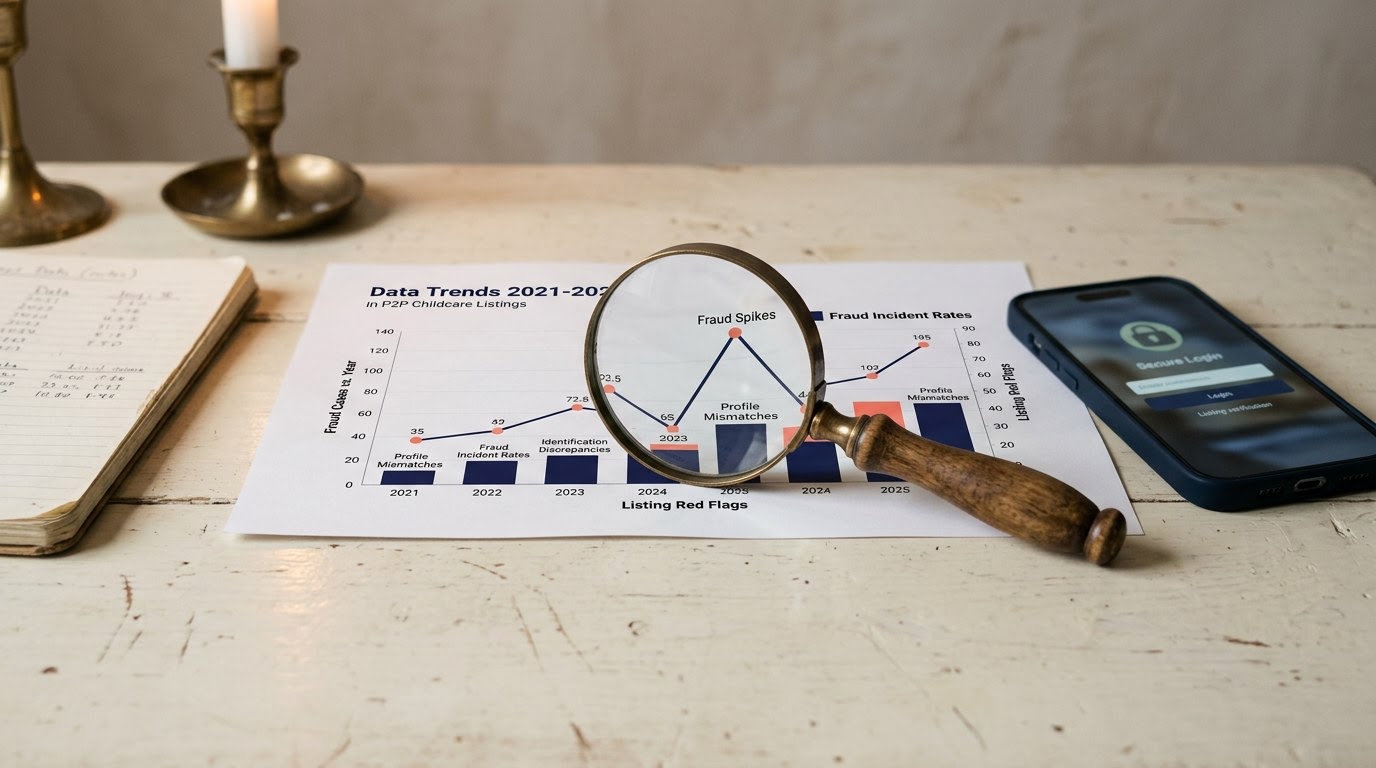
As of September 2026, peer-to-peer childcare listings have become a frequent entry point for identity fraud and financial advance-fee scams. FTC data shows online service and deposit scam reports generated over $330 million in reported losses in 2024, driven by a surge in non-delivery scams on digital community boards and unverified matching platforms. Families searching for local babysitters, nannies, or emergency care increasingly encounter synthetic profiles created solely to harvest advance deposits or gather sensitive personal credentials.
The data
Data Analysis of Identity Fraud in Peer to Peer Childcare Listings demonstrates that fraudulent provider profiles and deposit scams primarily target families seeking urgent, localized care. By compiling findings from federal agencies and consumer protection groups, this dataset illustrates how fake caregiver profiles, unverified contact details, and advance payment demands interact across digital classifieds, social media groups, and independent matching platforms.
| Fraud Category | Primary Risk Vector | Average Financial Loss Range | Primary Data Source |
|---|---|---|---|
| Advance Hold Fee / Deposit Scams | Fake profiles demanding deposit prior to in-person meeting | $150 - $600 | Federal Trade Commission (2024) |
| Caregiver Identity Theft / Phishing | Phishing forms requesting Social Security or bank details | $500 - $2,500 | Better Business Bureau (2024) |
| Fake Babysitter / Nanny Profiles | Stolen photos and AI-generated bios soliciting payment | $200 - $800 | FBI (2023) |
| Account Takeover of Parent Listings | Hijacked community profiles posting fake availability | $100 - $400 | Anti-Phishing Working Group (2024) |
| Overpayment / Check Clearing Scams | Fake parents sending fraudulent checks to caregivers | $1,000 - $4,500 | Consumer Financial Protection Bureau (2023) |
The quantitative data surrounding peer-to-peer childcare fraud reveals a distinct shift toward decentralized platforms where identity checks are absent. On unmoderated message boards, local classified sites, and social networks, bad actors publish highly polished profiles offering competitive rates for babysitting, infant care, or after-school assistance. These profiles frequently employ stock imagery or stolen social media photos to establish initial trust.
Once a parent initiates contact, the interaction rapidly shifts toward financial negotiation. Scammers cite high demand, tight scheduling, or personal distance as reasons why an immediate hold fee or deposit must be transferred before an initial meeting can occur. Because peer-to-peer markets lack native escrow protections, families who transfer funds through instant payment applications rarely recover their capital once the profile disappears.
A secondary dimension of this data highlights a growing threat to caregivers themselves. Scam networks deploy reverse-exploitation tactics by contacting genuine babysitters and nannies with fake employment offers. These schemes involve overpayment via counterfeit checks or fraudulent balance transfers, where the scammer requests a partial refund before the initial deposit bounces at the caregiver's financial institution.
Advance-Fee Scams and Fake Profile Mechanics
Advance-fee scams in peer-to-peer childcare listings operate by exploiting urgent care needs through synthetic caregiver profiles that require upfront deposits before in-person meetups. Scammers construct detailed local profiles using scraped photos, fabricated background claims, and stolen phone numbers, convincing parents to transfer non-refundable hold fees through instant digital payment rails prior to verifying physical identity.
The mechanics of fake caregiver listings follow a repeatable sequence designed to force rapid decision-making from parents facing tight care deadlines. To mitigate exposure to platform moderation, bad actors construct automated workflows that quickly divert victims to private messaging channels.
- Creation of fraudulent caregiver listings using stolen photographs, fake reviews, and localized details scraped from genuine community boards.
- Rapid redirection of communication away from open public forums toward end-to-end encrypted messaging apps, direct text messaging, or off-platform email.
- Mandatory upfront deposit demand framed as a schedule holding fee, interview reservation fee, or background processing deposit.
- Complete cessation of communication, phone line disconnection, and profile deletion immediately following successful fund transfer.
A 2024 BBB study found that over 65% of advance-fee payment scam victims were targeted through peer-to-peer marketplace listings. In the context of childcare, this structural vulnerability is compounded by time sensitivity. Parents dealing with sudden work schedule changes or last-minute school closures are far more likely to bypass basic verification steps when offered immediate care availability at standard or slightly below-market rates.
Furthermore, synthetic identity creation has become increasingly sophisticated. Scammers use artificial intelligence to draft personalized bio statements, respond dynamically to specific parental questions, and generate realistic headshots that bypass standard image search filters. Without robust identity verification at the point of interaction, parents are left evaluating cosmetic profile elements rather than verified real-world identity markers.
The economic model for bad actors relies on volume rather than single large-scale thefts. Collecting small deposits ranging from $50 to $200 across dozens of local community boards yields significant profits with relatively low regulatory visibility. Because individual transaction losses fall below traditional law enforcement investigation thresholds, these operations continue without structural disruption across unverified digital channels.
Payment Rail Exploitation in Childcare Listings
Scammers target non-reversible payment rails including instant peer-to-peer settlement apps, wire transfers, and digital gift cards to execute childcare deposit fraud. Because peer-to-peer payment networks treat transfers as instant authorized cash payments, victims of fake nanny or babysitter listings rarely recover stolen funds once transferred to unverified accounts.
Federal Reserve data from 2023 revealed that peer-to-peer payment fraud accounts for nearly 20% of non-bank transfer disputes. The integration of instant payment settlement networks into everyday consumer routines has drastically reduced the friction required to complete fraudulent transfers. Scammers explicitly refuse credit card payments or native platform payment services that offer buyer protection, insisting instead on direct bank-to-bank transfers or peer-to-peer applications.
- Instant Peer-to-Peer Apps: Settlement occurs within seconds, making fund clawbacks nearly impossible once the scammer transfers the balances out of the destination account.
- Digital Gift Cards: Requested under the guise of pre-paying for child supplies or outing expenses, providing total anonymity and rapid resale value on secondary exchanges.
- Wire Transfers: Frequently utilized in high-value nanny scams or long-term placement setups, directing capital into temporary mule accounts established with stolen identity documents.
- Fake Mobile Checks: Sent to prospective caregivers for "supplies," designed to clear temporarily before failing bank clearing cycles days later.
When parents send money via instant payment applications, financial institutions generally categorize the transaction as authorized because the user initiated the transfer voluntarily. This regulatory distinction leaves consumers without legal protection when the individual receiving the payment turns out to be an imposter using a fake listing profile.
In addition to payment rail vulnerabilities, bad actors exploit account takeover mechanisms to increase profile legitimacy. By hacking established social media accounts of local community members, scammers post childcare availability directly into trusted neighbourhood groups. Parents who view these listings assume the individual is a long-standing member of their community, lowering their resistance to advance fee requests and off-platform communication.
Demographic Vulnerabilities and Reporting Deficits
Working parents, military families, and households experiencing emergency care shortages face heightened vulnerability to identity fraud in peer-to-peer childcare markets. Scammers exploit the pressure of immediate scheduling needs to trick parents into completing fake screening questionnaires that collect sensitive identity markers, including Social Security numbers, home addresses, and banking credentials.
Bureau of Justice Statistics data from 2022 shows that less than 12% of personal scam victims report financial losses to law enforcement agencies. This vast reporting gap creates a distorted view of the total economic damage generated by marketplace fraud. In childcare scenarios, parents often feel embarrassment or regret over falling for a deposit scam, choosing to absorb the financial loss quietly rather than filing formal reports with federal or local authorities.
The harm caused by childcare marketplace scams extends beyond primary financial loss. In many cases, scammers distribute "caregiver intake forms" or "family background questionnaires" designed to harvest sensitive personal data from parents. These forms ask for full legal names, residential addresses, children's birthdates, and banking information under the pretense of completing routine emergency care preparations.
Once harvested, this identity information is repackaged and sold on illicit data exchanges or used directly to execute secondary identity theft. Parents who believe they are simply providing emergency details to a prospective babysitter often find their credit profiles compromised months later. The compounding impact of loss of funds and identity compromise underlines the structural risk present in unverified peer-to-peer service channels.
Caregivers searching for jobs on peer-to-peer boards experience similar vulnerabilities. Younger workers, college students, and senior caregivers seeking part-time income are frequently targeted by fake employment listings. Scammers send bad checks, request payments for uniform equipment, or harvest identity documents under the guise of pre-employment processing, exposing job-seekers to credit damage and depleted savings.
Methodology and caveats
This data analysis synthesizes public reporting, regulatory disclosures, and consumer complaint databases covering digital marketplace and service fraud between 2020 and 2026. The findings capture structured trends across reported incidents, though total economic impact remains higher due to underreporting in informal community channels.
FTC and FBI datasets rely on self-reported consumer complaints, capturing only a subset of total fraudulent marketplace incidents. A 2024 BBB study found that over 65% of advance-fee payment scam victims were targeted through peer-to-peer marketplace listings, yet many victims refrain from filing reports due to low recovery expectations or small individual dollar amounts. Consequently, aggregate figure totals represent baseline estimates rather than exhaustive totals of overall financial losses occurring across private message groups and local classified channels.
What this means for you
Protecting your family when arranging care on peer-to-peer platforms requires rigorous verification of the individual behind the listing before exchanging funds or sharing personal details. Establishing multi-layered safety protocols prevents advance-fee loss and safeguards sensitive family data.
Never send advance deposits, hold fees, or booking payments to unverified individuals met through peer-to-peer message boards or local classified listings. Before scheduling an in-person meeting or sharing sensitive home details, demand independent verification of the caregiver's real-world identity. Running a TrustCheck provides a quick, secure way to confirm that the person posting the childcare listing is who they claim to be, matching live identity data without exposing sensitive personal or financial accounts. Always keep initial communications on verified platforms, conduct video calls prior to meeting, and report suspicious deposit demands to consumer protection authorities immediately.
Frequently asked
Why are advance deposit scams common in peer-to-peer childcare listings?
Scammers exploit the urgency parents face when seeking urgent or affordable childcare. By creating fake profiles with lower rates and high availability, bad actors convince parents to transfer hold fees via instant payment apps before an in-person meeting ever takes place.
How can parents identify fake babysitter or nanny profiles online?
Key warning signs include refusal to meet via video call, insistence on using non-reversible instant payment apps for advance deposits, requests for sensitive personal details on informal forms, and pressure to move conversation off the listing platform onto private SMS.
What should you do if you lose money to a peer-to-peer childcare scam?
Immediately report the transaction to your bank or payment app, file a report with the Federal Trade Commission at ReportFraud.ftc.gov, and document all communications. While instant payment recovery can be difficult, prompt reporting helps flag fraudulent accounts.
Are caregivers also targeted by identity fraud in peer-to-peer markets?
Yes. Scammers post fake job offers to target caregivers with overpayment schemes using bad checks or fake mobile deposits. They may also ask caregivers to complete unauthorized intake forms that harvest Social Security numbers and bank routing details.
How does identity verification mitigate peer-to-peer childcare fraud?
Identity verification ensures that the person behind a profile is using their real identity, linking digital profiles to verified government records. This deters scammers who rely on anonymity, synthetic identities, and temporary accounts to extract advance fees.