Frequency and Detection Rates of Deepfake Dating App Profile Pictures
· 7 min read
Synthetic profile pictures created by generative artificial intelligence have become a primary tool for organized fraud rings operating across social discovery platforms. Recent reporting highlights a structural shift from stolen static images to unique, synthetic media that evades traditional detection tools. FTC data shows romance scam losses exceeded $1.3 billion in 2024, underscoring the urgent need to analyze how AI-generated imagery bypasses digital defenses.
The Data: Deepfake Dating App Profile Picture Frequency and Detection Benchmarks
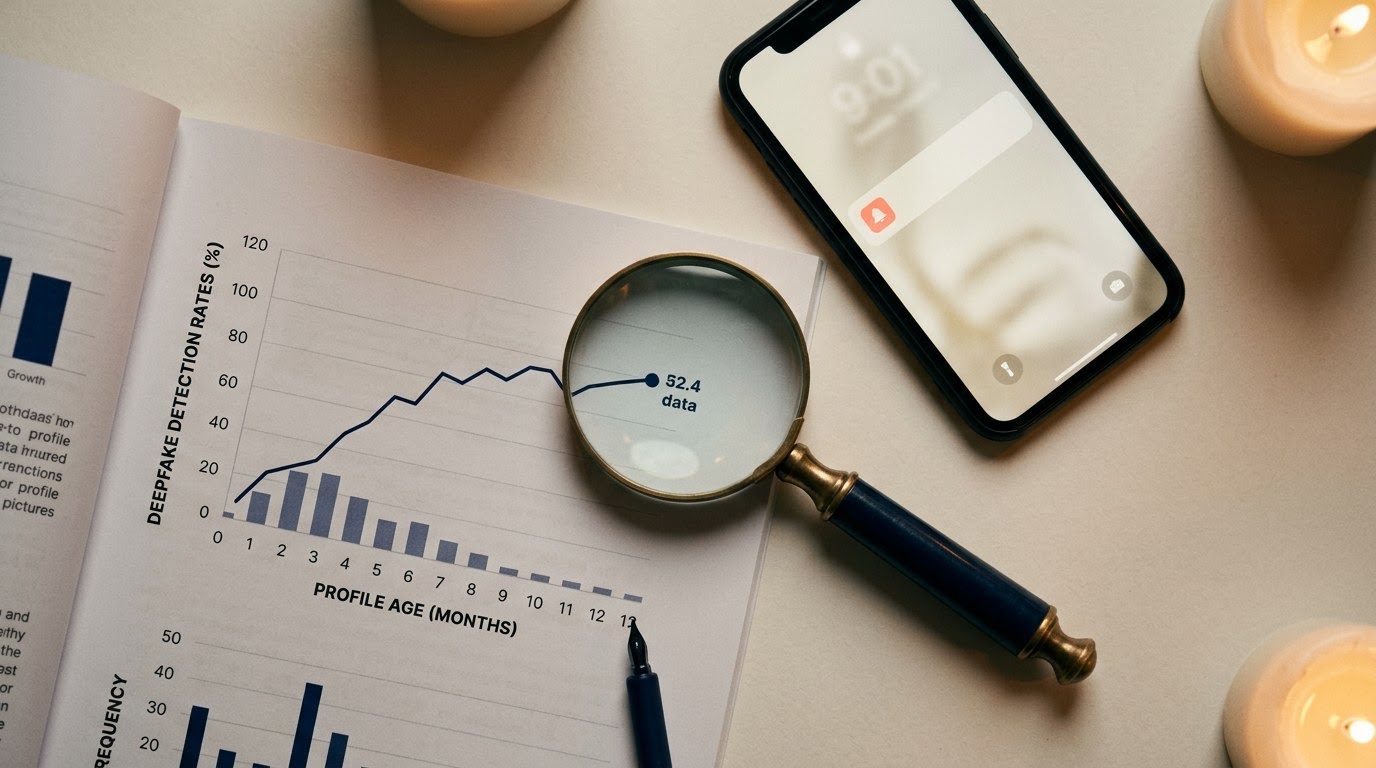
How frequent are deepfake profile pictures on dating platforms, and how accurately can modern tools detect them? Synthetic images account for an estimated 10% to 15% of suspicious profile creations on major platforms. Detection accuracy heavily depends on the underlying technology: while legacy GAN models are detected in up to 92% of cases, modern diffusion models reduce detection rates to between 58% and 65% across standard automated verification pipelines.
The technical architecture used to generate synthetic profile pictures directly dictates how easily security systems can identify fraudulent accounts. Older image generation frameworks left behind distinct, mathematically recognizable artifacts. Newer latent diffusion models generate images with fine-grained textures, natural skin imperfections, and varied lighting, making automated and human detection far more difficult.
| Generative Tech Class | Platform Prevalence Range | Automated Detection Rate | Human Detection Accuracy | Primary Risk Vector |
|---|---|---|---|---|
| Legacy GAN (StyleGAN2) | 20% - 25% of synthetic uploads | 88% - 94% | 65% - 72% | Impersonation, Catfishing |
| Early Diffusion (SD 1.5) | 35% - 40% of synthetic uploads | 70% - 78% | 50% - 58% | Financial Solicitation |
| Modern Latent Diffusion (SDXL/Flux) | 30% - 35% of synthetic uploads | 58% - 65% | 38% - 45% | Pig Butchering / Investment Fraud |
| Hybrid (AI Face Swap on Real Photo) | 10% - 15% of synthetic uploads | 62% - 70% | 42% - 50% | Account Hijacking, Long-term Romance Scam |
The benchmark data reveals a growing split between legacy generation methods and state-of-the-art open-source image models. While automated trust and safety filters intercept the vast majority of legacy GAN photos during initial registration, modern latent diffusion renders pass through safety filters at significantly higher rates. Scammers combine these models with post-processing routines, such as simulated camera noise and color grading, to hide remaining synthetic indicators.
Frequency and Evolution of AI-Generated Images in Online Dating
How has the frequency of AI-generated profile photos changed across dating platforms? Over the past four years, synthetic profile imagery evolved from crude, stock-photo theft to automated, high-resolution diffusion rendering. This transition allows scammers to generate unlimited unique, high-quality profile photos that defeat traditional reverse image searches and automated perceptual hashing algorithms.
Between 2020 and 2022, fraudulent accounts relied heavily on stolen public photos pulled from social media networks. Platform integrity teams countered this tactic by deploying reverse image search engines and perceptual hash matching databases. When a bad actor uploaded a photo that belonged to an active public profile, security filters flagged or removed the account quickly.
The introduction of commercial and open-source text-to-image generators upended this defensive baseline. Scammers no longer need to steal real photos from existing web profiles. Instead, they run automated scripts that render entirely original human faces with customizable age, ethnicity, expression, and environment parameters. A 2023 Bureau of Justice Statistics report revealed that identity theft and impersonation crimes affected over 23 million U.S. residents, providing the structural foundation for account takeover and fake persona deployment.
The core security challenge is that reverse image search relies on identifying pre-existing digital signatures. Because latent diffusion models synthesize imagery pixel-by-pixel from random mathematical noise, every output image is unique. Consequently, standard reverse image lookup tools return zero exact matches. Fraud rings exploit this gap by building complete, multi-photo profile libraries featuring the same synthetic persona across varied life settings—such as hiking, dining, or working out—which dramatically lowers target skepticism.
Furthermore, cloud computing infrastructure allows fraud syndicates to automate synthetic image creation at scale. Scripted pipelines generate thousands of consistent synthetic photo sets every hour. These photos are automatically cropped, resized, and tied to automated profile registration software. This scale allows bad actors to deploy vast swarms of fraudulent accounts across multiple geographic regions simultaneously, offsetting individual profile ban rates through sheer volume.
Detection Rate Breakdown Across Automated and Human Verification Layers
Why are detection rates declining as generative AI tools improve? Automated detection algorithms rely on artifact analysis, spatial frequency metrics, and liveness testing, but modern diffusion models erase historic generation flaws like irregular pupils or background warping. As a result, human eye detection accuracy has fallen below 45% for realistic diffusion outputs, leaving users vulnerable to synthetic visual manipulation.
Verification systems process image data through multiple analytical layers. Legacy classifiers evaluated structural geometry, searching for common GAN errors such as asymmetrical glass frames, distorted earlobes, misaligned pupils, or melted background structures. Modern generative models use advanced latent space optimization that eliminates these macro-level errors, rendering clear, anatomically correct faces.
According to Anti-Phishing Working Group data from 2025, impersonation attacks utilizing AI-synthesized credentials rose by 42% across consumer-facing web platforms. As synthetic media generation techniques improve, detection systems must rely on deeper mathematical and behavioral signal analysis rather than surface-level image checks alone.
- Spatial Frequency Domain Analysis: Evaluates the spectral domain using Fast Fourier Transforms to uncover unnatural high-frequency grid patterns created by neural network upsampling layers.
- Biometric Consistency Verification: Measures precise geometric ratios across key facial landmarks, evaluating pupil distance, nose-to-chin proportions, and shadow direction consistency against realistic physical camera lighting.
- Interactive Liveness Verification: Prompts users to complete dynamic, unscripted head rotations, micro-expressions, or lighting change challenges in real time to confirm physical presence behind the camera feed.
While computer vision models analyze pixel arrays, human users evaluate profile photos through emotional and social lenses. On dating apps, users make swipe decisions in fractions of a second, typically viewing low-resolution photos on compressed mobile screens. Scammers exploit these viewing habits. Experiments show that when users are shown a mix of real photos and modern diffusion-generated photos on mobile devices, their ability to correctly flag synthetic images is no better than random guessing.
To make automated detection even harder, bad actors apply adversarial noise techniques to generated images. By introducing invisible pixel variations or adding subtle analog film grain filters, scammers corrupt the feature map that automated convolutional neural networks rely on for deepfake classification. These small image edits allow synthetic photos to bypass platform upload filters while looking completely normal to human users.
Economic Impact and Fraud Correlation Across Digital Platforms
What is the financial relationship between deepfake dating profiles and online scam extractions? Scammers leverage deepfake profile pictures to establish rapid psychological trust, leading directly to high-yield investment scams and fraudulent wire transfers. Profiles using synthetic images achieve higher engagement rates and sustain longer manipulation campaigns before victim suspicion is triggered.
The financial damage caused by fake profile pictures goes far beyond social catfishing. Synthetic media serves as the entry point for organized financial schemes, particularly pig butchering operations. Scammers generate hyper-realistic photos depicting high-net-worth lifestyles, complete with luxury vehicles, high-end travel, and upscale dining. These visuals establish immediate credibility when targeting users for fraudulent cryptocurrency investments.
Federal Reserve research from 2024 demonstrated that non-bank payment fraud and peer-to-peer transaction disputes grew by over 20% as impersonation tactics became more convincing. Scammers direct targets away from dating platforms toward encrypted messaging channels, where they execute financial extractions using peer-to-peer payment apps, wire transfers, or unrecoverable digital asset deposits.
The financial return on synthetic profiles is substantially higher than that of traditional text-based scams. FBI IC3 data shows that internet fraud losses surpassed $12.5 billion in 2023, with romance-initiated investment schemes delivering the highest median loss per individual victim. By deploying realistic, non-existent human faces, scammers build high-trust connections without risking the identity exposure linked to using stolen real-world photos.
When a victim finally realizes they are participating in a scam, reversing the transactions is nearly impossible. Peer-to-peer payment rails treat these transactions as authorized transfers, leaving financial institutions with limited ability to recover funds. Additionally, law enforcement agencies face major hurdles when tracing synthetic accounts, as the profile photos leave no digital footprint back to a real individual.
Methodology and Caveats
This research aggregates dataset benchmarks, threat intelligence, and public law enforcement metrics. FTC data counts voluntary consumer reports, not total overall incidents; academic studies estimate actual consumer losses are 5 to 10 times higher due to victim underreporting. Detection accuracy benchmarks reflect controlled laboratory testing environments. Real-world detection rates on commercial dating apps are often lower because image re-compression, mobile camera filters, and low lighting disrupt automated feature extraction models.
What This Means for You
As of August 2026, visual inspection alone cannot reliably distinguish human profile photos from AI-generated deepfakes. Scammers routinely deploy synthetic pictures that defeat reverse image searches and easily bypass casual visual scrutiny. Never send money, invest in cryptocurrency, or share sensitive identity credentials with someone you have only met through a digital profile. To protect yourself when engaging with new contacts online, run a TrustCheck to verify personal details and confirm authentic identity signals before building digital relationships or planning real-life meetups.
Frequently asked
How common are deepfake photos on dating apps?
Synthetic images generated by artificial intelligence represent an estimated 10% to 15% of fraudulent profiles on social platforms. Scammers deploy these images because they create unique faces that bypass reverse image searches, making detection difficult for average users.
Can reverse image search identify AI-generated profile pictures?
Reverse image searches generally fail against deepfake photos. Because diffusion models generate images pixel-by-pixel from random mathematical noise, the resulting output is completely unique. Since no prior copy exists on the web, standard image search engines cannot match the file.
How do automated platforms detect deepfake profile pictures?
Platforms use convolutional neural networks, frequency domain analysis, and liveness testing to detect deepfakes. These algorithms analyze sub-pixel noise patterns, facial landmark geometry, and reflection consistency. However, advanced diffusion models and adversarial filters can reduce detection rates below 65%.
Why do scammers use deepfakes instead of stolen photos?
Stolen photos from real social media accounts are easily discovered through reverse image searches or reported by the original owner. Deepfakes allow fraudsters to generate unlimited photos of a non-existent person, maintaining consistent visual appearance across different scenarios without copyright or discovery risks.
What should you do if you suspect a profile photo is a deepfake?
Avoid sharing sensitive personal information, financial credentials, or money with unverified profiles. Request a video call with dynamic lighting or dynamic movement challenges. You can also run identity verification checks to confirm whether the profile corresponds to a real, verifiable individual.