How Ultra Wideband Tech Verifies Precise Proximity During Meetups
· 10 min read
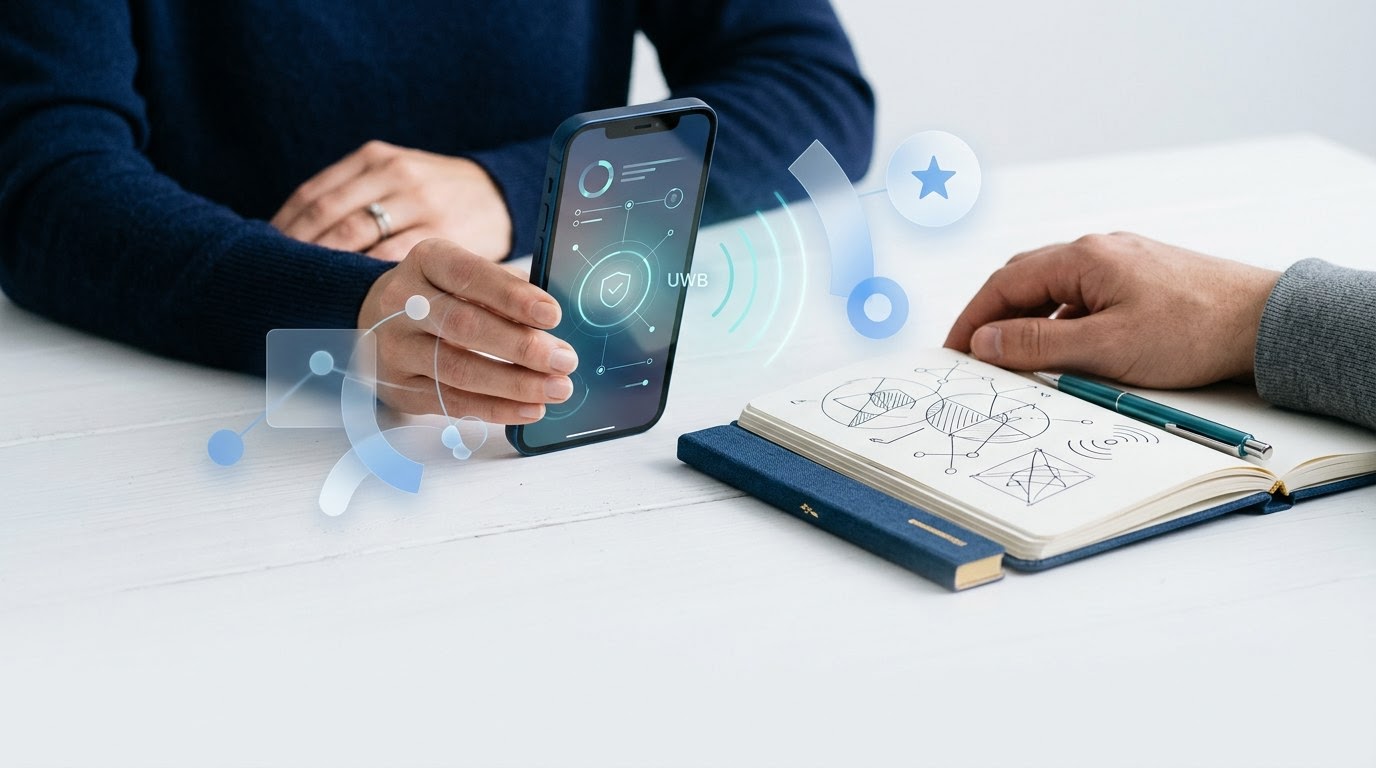
Ultra Wideband (UWB) technology verifies precise physical proximity by measuring the exact nanosecond travel time of radio pulses between two hardware-authenticated smartphones. When meeting a stranger to complete a high-value private sale or exchange, this technology ensures that the person standing across from you is the exact individual verified by the platform, blocking relay scams and remote identity spoofing. Platforms like TrustMatch use ultra wideband technology to turn physical distance into an unforgeable cryptographic proof.
What Is Ultra Wideband and How Does Time-of-Flight Ranging Work?
Ultra Wideband (UWB) measures distance by timing how long nanosecond radio pulses take to travel between two devices at the speed of light. This Time-of-Flight (ToF) signal is an unforgeable physical metric because light speed is a universal constant; an attacker cannot force radio waves to travel faster than light to fake a closer distance. Measuring time delays down to picoseconds translates directly into distance accuracy within centimeters.
To understand why this radio mechanism works, consider how audio echoes work in a canyon. If you yell across a gorge and time how long it takes for your voice to echo back from the rock wall, you can calculate the exact distance to the cliff side. Sound travels through air at approximately 343 meters per second. If your echo takes exactly two seconds to bounce back, the sound traveled 686 total meters—meaning the canyon wall is 343 meters away. The physics of radio ranging operate under the exact same calculation, but instead of sound waves, the hardware uses electromagnetic pulses traveling at the speed of light ($299,792,458$ meters per second).
Ultra Wideband devices do not broadcast a continuous radio wave like an FM radio station or a Wi-Fi router. Instead, a UWB transmitter emits billions of short, broad spectrum radio pulses across a frequency bandwidth wider than 500 MHz. These pulses last less than one nanosecond each. Because light travels roughly 30 centimeters (about one foot) in a single nanosecond, a smartphone equipped with a specialized UWB transceiver chip can measure tiny time intervals. By calculating the Time-of-Flight (ToF) for a radio pulse sequence to travel from Device A to Device B and return, the system establishes a physical distance measurement precise to within a couple of inches.
This wide spectrum architecture also resolves a common problem in wireless communications: multipath interference. In urban environments or indoor spaces, radio signals bounce off concrete walls, parked vehicles, glass windows, and metal structures. Standard radio signals blur together when these bounced signals overlap. UWB pulses are so brief that the direct line-of-sight pulse arrives at the receiving antenna long before any bounced reflections reach it. The receiver easily separates the true first-arriving pulse from its delayed echoes, yielding a clean, noise-free distance calculation.
Why Bluetooth and GPS Fail at High-Security Proximity Verification
Bluetooth signal strength (RSSI) and GPS positioning fail as security signals because both are easily manipulated by software spoofing or signal amplifiers. Bluetooth estimates distance by measuring signal drop-off, which an attacker can fake by simply broadcasting at a higher transmission power. GPS relies on satellite signals that smartphone apps can fake entirely through virtual location software. Neither technology proves that two physical devices are actually standing next to each other.
Legacy proximity systems rely heavily on Received Signal Strength Indication (RSSI). Bluetooth Low Energy (BLE) beacons attempt to estimate distance by measuring how faint a radio signal appears when it reaches a phone. The fundamental vulnerability in this approach is that radio power drop-off is not a fixed physical constant. Radio waves weaken as they pass through human bodies, drywall, or bad weather. Conversely, an adversary can easily attach a low-cost signal booster or high-gain directional antenna to a transmitter. By amplifying the signal power, an attacker located two blocks away can trick a receiver into registering a high-power signal, deceiving the receiving device into reporting that the transmitter is standing right beside it.
Global Positioning System (GPS) technology suffers from a completely different set of vulnerabilities. GPS receivers rely on weak radio signals beamed down from satellites medium-Earth orbit. Because these signals reach smartphones at extremely low power levels, they are susceptible to software-level location spoofing. Operating systems allow developers to inject "mock locations" for testing purposes. Fraudulent actors exploit these software developer settings to broadcast arbitrary geographic coordinates. Furthermore, physical GPS spoofers can emit local satellite signals to trick nearby chips into reporting incorrect coordinates. GPS also fails indoors, underground, or inside crowded parking garages where satellite line-of-sight is blocked.
| Technology | Primary Signal Input | Distance Precision | Spoofing Vulnerability Vector | Relay Attack Resistance |
|---|---|---|---|---|
| Ultra Wideband (UWB) | Pulse Time-of-Flight (ToF) & Phase Angle | 1 to 10 centimeters | None (Bound by light speed physics) | High (Cryptographic IEEE 802.15.4z) |
| Bluetooth Low Energy (BLE) | Received Signal Strength (RSSI) | 1 to 5 meters | High (Signal amplification / power changes) | None (Vulnerable to simple signal repeaters) |
| Global Positioning System (GPS) | Satellite Time Difference of Arrival | 5 to 15 meters | High (OS mock locations & RF generators) | Low (Location data can be injected in software) |
| Wi-Fi Round-Trip-Time (RTT) | Packet arrival timestamping | 1 to 2 meters | Moderate (MAC spoofing & latency buffers) | Moderate (Lacks dedicated hardware STS chip) |
Cryptographic Distance Bounding: How UWB Prevents Relay Attacks
Cryptographic distance bounding secures radio timing by encrypting the time-stamped pulses with a pseudo-random code generated by a hardware security element. This pulse sequence acts as a tamper-proof signal because a relay attacker sitting between two distant devices cannot predict the encrypted bit stream in advance. Any attempt to intercept and retransmit the radio signal adds nanoseconds of processing delay, which immediately exposes the relay attempt and invalidates the proximity proof.
To understand the necessity of distance bounding, imagine a classic relay attack (a Man-in-the-Middle exploit). Suppose Alice is standing in a coffee shop expecting to meet Bob. Eve, an attacker, wants to impersonate Bob. Eve sits five miles away, while her accomplice stands near Alice in the coffee shop. The accomplice carries an intermediate radio transceiver linked over high-speed 5G cellular to Eve’s device miles away. If Alice’s phone simply asks "Is Bob’s phone nearby?" and Bob’s phone answers over a basic wireless protocol, Eve’s network can relay that request and answer back and forth across town in milliseconds. Alice's phone might validate the signature, falsely concluding Bob is physically present.
UWB prevents this exploit through cryptographic distance bounding defined by the IEEE 802.15.4z standard. Before ranging begins, both devices negotiate a cryptographically secure session key within their dedicated hardware Secure Elements (isolated microchips designed specifically to prevent key extraction). The UWB radio inserts a Scrambled Timestamp Sequence (STS) directly into the physical layer of the radio packet. The STS is a sequence of pseudo-random pulse patterns generated by an AES-128 cryptographic engine.
Because these pulse patterns are mathematically unpredictable, an attacker sitting between the devices cannot guess what pulse shape is coming next. The relay device must wait for a pulse to arrive, decode it, transmit it over a cellular link to the distant accomplice, and re-emit it. Processing and retransmitting that signal takes tens or hundreds of nanoseconds. Because light travels 30 centimeters per nanosecond, adding just 50 nanoseconds of relay latency makes the two devices appear 15 meters farther apart than they actually are. If the calculated physical distance exceeds the allowable threshold, the handshake fails instantly.
When a device calculates a physical range under 3 meters using secure STS pulses, this hardware signal feeds into the TrustMatch combined score alongside identity verification metrics. This guarantees that the digital presence score and the physical presence score stem from hardware-verified facts rather than spoofable software data.
How It Works, Step by Step: The UWB Proximity Verification Handshake
A UWB proximity handshake verifies physical presence through a sequence of time-stamped radio exchanges and spatial angle calculations between two authenticated smartphones. This multi-step process converts raw nanosecond pulse measurements into a cryptographically signed spatial proof. Executing these steps ensures that both parties are physically standing within arm’s reach before high-value peer-to-peer transactions or item transfers take place.
The sequence relies on strict interaction between low-level hardware registers, cryptographic processors, and application software. Here is how two devices execute an unforgeable physical proximity check:
- Cryptographic Session Initialization: Both smartphones establish an out-of-band encrypted control channel over Bluetooth Low Energy to exchange ephemeral public keys. Using these keys, each device’s Secure Element generates a shared mathematical seed for the UWB Scrambled Timestamp Sequence (STS), ensuring that neither operating system nor outside attackers can read or alter the timing code.
- Poll Packet Transmission: Device A (the initiator) fires a low-power UWB poll packet containing the first encrypted STS pulse train. The internal clock on Device A logs the exact departure timestamp ($T_1$) down to picosecond resolution at the precise moment the first radio pulse leaves its antenna.
- Response Packet & Time-of-Arrival Logging: Device B (the responder) detects the incoming STS pulse stream, verifies its cryptographic validity, and logs the precise arrival timestamp ($T_2$). After a pre-determined hardware processing delay ($\Delta T_{\text{reply}}$), Device B fires back a cryptographic response packet at timestamp $T_3$.
- Final Clock Calculation: Device A receives the response packet at timestamp $T_4$. Device A now evaluates the full Round-Trip Time equation:
$$\text{Time of Flight} = \frac{(T_4 - T_1) - (T_3 - T_2)}{2}$$
Multiplying this result by the speed of light yields the exact physical distance separating the two devices. - Angle of Arrival (AoA) Verification: As the incoming radio wave hits Device A, it strikes two distinct internal antennas separated by a tiny sub-millimeter fraction of a distance. Device A measures the Phase Difference of Arrival (PDoA) between the two antenna signals. This phase offset calculates the exact spatial angle (elevation and azimuth) from which the signal arrived, pinpointing where the other device is pointing in 3D space.
- Signed Attestation Token Generation: Once distance (e.g., 1.2 meters) and spatial orientation are verified, both hardware chips co-sign an ephemeral attestation token. This token attests that Device A and Device B were physically within touching distance at that exact timestamp.
Evaluating Physical Trust Signals for High-Value Peer-to-Peer Transactions
Combining physical proximity timing with identity verification creates a dual-layer defense against fake buyers, transaction ambushes, and fraudulent item swaps. Physical presence is a vital signal because digital identity accounts can be stolen, but physical hardware bound by the laws of physics cannot be telepathically beamed into a physical location. Proving that a verified individual is physically present at the agreed location mitigates risk during real-world exchanges.
Peer-to-peer marketplaces, online classifieds, and localized dating platforms have transformed how people interact, but they have also introduced physical security risks. Bad actors frequently compromise legitimate social media accounts or create synthetic identity profiles using stolen credentials to orchestrate scams. According to FBI data from 2025, online buy-and-sell scams resulted in over $420 million in reported consumer losses. A 2024 BBB report found that 28% of peer-to-peer marketplace fraud cases involved bad actors using fake accounts to conduct in-person transactions.
When two individuals meet in a parking lot or coffee shop to trade a luxury watch, high-end electronics, or a vehicle, digital identity verification solves only half the problem. A compromised account can pass remote checks if the victim’s login tokens or identity documents were stolen. However, an attacker operating remotely cannot fake physical UWB proximity signals. The laws of physics mandate that to generate a valid sub-nanosecond Time-of-Flight response, the physical smartphone harboring the matching Secure Element hardware must be located within a few feet of the counterparty.
As of November 2026, modern smartphones come standard with dedicated UWB microcontrollers operating in the 6.5 GHz and 8.0 GHz spectrums. By integrating hardware proximity verification directly into meetup protocols, platforms eliminate the window of opportunity for "bait-and-switch" attacks, where a scammer sends an unvetted accomplice to collect items or cash while keeping the verified primary user safely hidden away.
By combining cryptographic identity checks with UWB proximity verification, TrustMatch provides a multi-layered shield for high-stakes real-world meetups. Knowing that the person standing across from you possesses both verified credentials and the physical device tied to that record transforms high-stakes meetups from uncertain gambles into secure transactions.
Frequently asked
What is Ultra Wideband (UWB) technology?
Ultra Wideband is a short-range, low-power radio technology that broadcasts nanosecond pulses across a broad frequency spectrum (above 500 MHz). By timing how long these pulses take to travel at light speed, devices calculate distance down to centimeters.
How does UWB differ from Bluetooth proximity checks?
Bluetooth estimates distance using signal strength, which can be easily faked using amplifiers or high-power transmitters. UWB measures actual pulse travel time, which relies on the constant speed of light and cannot be spoofed by altering power levels.
Can a scammer relay UWB signals over the internet or 5G?
No. UWB utilizes cryptographic distance bounding (IEEE 802.15.4z) with scrambled timestamp sequences. Relaying signals over cellular or Wi-Fi networks adds nanoseconds of latency, which immediately alerts the system to a relay attack and invalidates the check.
Does UWB tracking invade my location privacy?
No. UWB ranging does not broadcast absolute GPS coordinates to global servers. It only measures the relative distance and angle between two localized, consent-authenticated hardware devices during an active peer-to-peer verification session.
What devices support Ultra Wideband proximity verification?
Most modern flagship smartphones released after 2020 feature built-in UWB transceiver chips. These isolated microcontrollers handle high-precision radio timing and cryptographic key management inside hardware Secure Elements.