How Ultrasonic Audio Beaconing Verifies Proximity During In-Person Meetups
· 10 min read
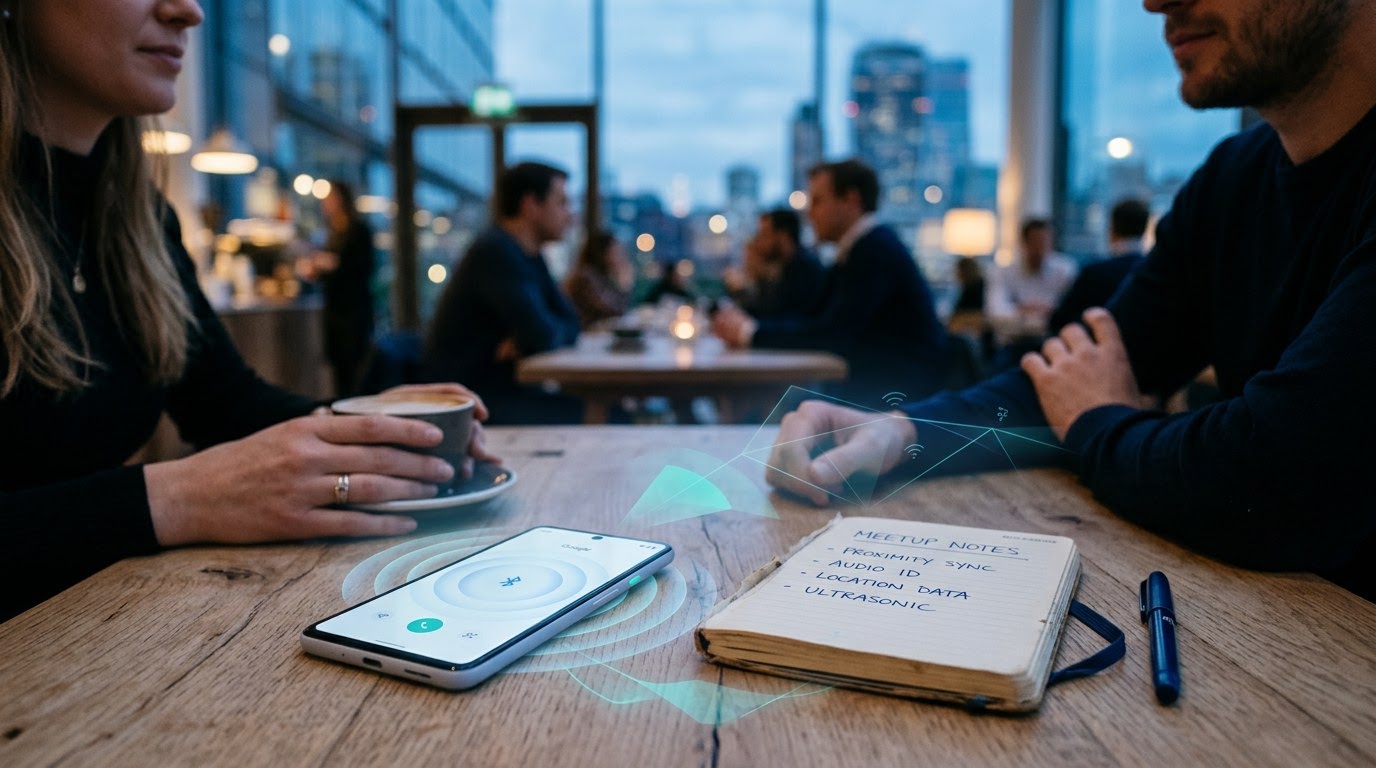
When buying or selling high-value items through online marketplaces, proving that both parties are physically present at the agreed meetup location is a critical safety challenge. Ultrasonic audio beaconing solves this by broadcasting encoded, high-frequency sound waves between two devices to cryptographically confirm they share the same physical space. For anyone executing private sales with strangers, this mechanism guarantees that the person you are communicating with is actually standing in front of you rather than spoofing a location from miles away. Platforms like TrustMatch evaluate digital and physical proximity indicators to ensure online interactions map directly to real-world presence.
Why GPS and Bluetooth Fall Short for Meetup Verification
GPS and Bluetooth fail to provide absolute proximity verification because GPS signals can be easily faked using software mock locations, while Bluetooth signals bleed through walls and floors. GPS tells a server where a phone claims to be, but it cannot prove two devices are in the same room. Bluetooth radio waves propagate through concrete, creating false proximity matches across different apartments or store levels. Ultrasonic audio solves both vectors by using sound waves that physically cannot penetrate solid barriers.
To understand why radio-based location tracking fails during high-stakes meetups, you must look at how mobile operating systems handle spatial data. A smartphone determines its GPS position by measuring timing signals from orbiting satellites. However, both Android and iOS contain developer settings designed to let programmers test apps by injection. A user can install a basic location-spoofing application that overrides the internal GPS provider, feeding false latitude and longitude coordinates to every app on the phone. To a server relying on GPS, a scammer sitting in another country appears to be standing in a coffee shop parking lot right beside you.
Bluetooth Low Energy (BLE) avoids satellite spoofing by measuring the received signal strength (RSSI) between two nearby chips. However, Bluetooth operates on a 2.4 GHz radio frequency. Radio waves of this frequency pass effortlessly through drywall, glass, wooden doors, and even light concrete structures. If you are waiting inside a bank lobby to trade a high-end watch, a buyer standing in an adjacent hallway, a store on the floor above, or a car parked outside could successfully complete a Bluetooth handshake. BLE proves relative distance across radio space, but it fails to prove shared room presence.
FTC data from 2024 revealed that online shopping and marketplace fraud caused over $390 million in consumer losses. A massive driver of this loss is the inability of buyers and sellers to verify who is actually present at a physical drop-off point. Software-level tricks allow fraudsters to simulate local attendance while operating from total anonymity. High-frequency acoustic signals eliminate this vulnerability by shifting the physical verification vector from radio frequencies to localized mechanical sound waves.
The Physics of High-Frequency Acoustic Signals
Ultrasonic audio beaconing relies on high-frequency sound waves between 18 kHz and 22 kHz, which are imperceptible to adult human ears but easily captured by standard mobile microphones. Because sound travels at roughly 343 meters per second in air—nearly a million times slower than radio waves—smartphones can measure microsecond arrival delays to calculate physical distance down to the inch. Furthermore, high-frequency sound attenuates rapidly and reflects off walls, restricting the signal strictly to an enclosed physical environment.
Sound is a mechanical pressure wave that vibrates physical molecules in the air. This fundamental property creates distinct boundaries that radio signals lack. High-frequency sound waves possess extremely short wavelengths (approximately 1.5 to 1.8 centimeters at 20 kHz). When these waves strike a solid surface like a glass window, drywall, or a human body, they do not pass through. Instead, they bounce off or are absorbed by the material. This physical reality means an ultrasonic sound emitted inside a room cannot be picked up by a phone on the other side of a closed door.
Mobile phone hardware is natively equipped to handle these frequencies. Standard audio hardware records and plays back sound at a sampling rate of 44.1 kHz or 48 kHz. According to the Nyquist-Shannon sampling theorem, a digital audio system can accurately capture frequencies up to half its sampling rate. This means any off-the-shelf smartphone microphone can digitize frequencies up to 22.05 kHz or 24 kHz without requiring specialized hardware accessories or hardware modifications.
The human ear canal filters out these high frequencies as we age. While children can occasionally hear up to 20 kHz, adult hearing typically cuts off around 15 kHz to 17 kHz. By selecting a transmission band between 18.5 kHz and 21.5 kHz, smartphones transmit data payloads continuously through standard speakers without creating audible noise, chirps, or interference for the people conducting the trade.
How It Works, Step by Step
The ultrasonic verification process operates as a synchronized acoustic handshake completed within milliseconds. One phone generates a randomized cryptographic token, modulates it into an ultrasonic audio sequence, and broadcasts it through its loudspeaker. The receiving phone listens via its microphone, demodulates the high-frequency tone back into data, and sends a cryptographic response back to a central verification server. If the audio pattern matches the expected cryptographic output and arrives within precise timing windows, proximity is verified.
- Nonce Generation & Session Initiation: When both parties initiate a proximity check on their phones, the server generates a cryptographically secure, single-use random number called a nonce. This prevents replay attacks, ensuring an old audio recording cannot be reused later.
- Digital Signal Modulation: The broadcasting phone takes the nonce and converts the binary data into sound using Frequency Shift Keying (FSK) or Phase Shift Keying (PSK). Specific ultrasonic frequencies are mapped to binary ones and zeros, creating a unique acoustic signature.
- Acoustic Emission: The phone plays the modulated ultrasonic sequence through its internal loudspeaker. The broadcast lasts under 500 milliseconds and occurs at a sound pressure level that remains completely silent to adult human ears.
- Microphonic Capture & Filtering: The receiving phone's microphone continuously samples ambient air. Software filters isolate the 18 kHz–22 kHz frequency band, stripping away low-frequency background noise like traffic, speech, and air conditioning.
- Demodulation & Time-Difference Analysis: The receiving device converts the captured high-frequency sound back into digital bits. It records the exact microsecond timestamp of signal arrival to evaluate Time-Difference-of-Arrival (TDoA) characteristics.
- Cryptographic Attestation: The receiving device sends the decoded nonce along with timestamp metadata back to the verification server. The server compares the payload, sound attenuation levels, and speed-of-sound timing constraints to confirm both phones are in the same physical acoustic envelope.
Evaluating Proximity Tech: Sound vs. Radio Signals
Comparing proximity technologies highlights why acoustic signals excel at zero-knowledge local verification compared to traditional positioning systems. Radio-based methods like GPS, Cellular Triangulation, and Bluetooth either disclose exact geographic coordinates or fail to enforce physical boundary walls. Ultrasonic beaconing provides a strict binary confirmation of shared physical space without transmitting continuous GPS coordinates to third parties.
To evaluate how these technologies perform during an in-person marketplace meetup, we can measure them across structural boundaries, spoofing susceptibility, spatial granularity, and location privacy exposure:
| Technology | Spatial Boundary Enforcement | Vulnerability to Software Spoofing | Discloses Exact GPS Coordinates |
|---|---|---|---|
| Ultrasonic Audio | Strict (Stopped by walls and glass) | Extremely Low (Requires physical mic access) | No (Zero-knowledge room proof) |
| GPS / GNSS | None (Calculates global position) | High (Mock location tools, VPNs) | Yes (Exposes exact lat/long) |
| Bluetooth Low Energy (BLE) | Weak (Bleeds through drywall & glass) | Moderate (MAC spoofing, signal amplifiers) | No (Measures relative proximity) |
| Wi-Fi RTT (Fine Timing) | Moderate (Attenuated by concrete) | Moderate (Access point emulation) | Optional (Requires local router map) |
GPS exposes your exact physical coordinates to central servers, raising significant privacy concerns for users who want to meet safely without revealing their living location or precise daily routes. Conversely, Bluetooth measures signal strength but cannot tell if a user is standing in front of you or hiding in a nearby vehicle. Ultrasonic beaconing isolates the physical interaction strictly to the active room while protecting overall user location privacy.
Integrating Ultrasonic Proximity into a Combined Safety Profile
Physical proximity verification serves as a foundational anti-spoofing layer when combined with digital identity verification signals. While digital identities can be synthetically manufactured or manipulated across remote networks, physical acoustic presence forces an attacker to be physically located within inches of their victim. Integrating acoustic proximity into digital risk modeling transforms remote identity indicators into a unified, cryptographically backed assertion of real-world physical safety.
Digital identity signals typically look at remote traits. Fraud analysts evaluate a synthetic identity, which is a fraudulent profile created by combining real social security numbers or identity fragments with fake personal details. They also check a device fingerprint, which is a unique profile created from a device's hardware, operating system version, and browser settings. While these digital markers catch remote automated bots, they cannot confirm if a person operating a legitimate account is actually present at a physical meetup point.
A buyer might pass digital checks because their phone uses clean residential IP addresses and valid device traits. However, if that user refuses or fails an in-person acoustic handshake, the safety architecture immediately flags the disparity. An attacker attempting a remote scam cannot complete an ultrasonic exchange from another city or from inside an isolated vehicle across the street.
Within the TrustMatch framework, this acoustic handshake feeds directly into the TrustCheck combined score, where an identity score and trust score merge to evaluate fraud risk. By combining historical digital identity records with live, room-bounded physical proof, the system eliminates account takeover risks and remote proxy scams during local trades.
Privacy, Security, and Preventing Relay Attacks
Acoustic beaconing protects user privacy by eliminating the need to record continuous GPS tracking logs or reveal actual location addresses. Security is maintained through short-lived challenge-response nonces that prevent replay attacks, where a malicious user records an audio tone to play back later. Additionally, time-of-flight acoustic calculations detect relay attacks—where an attacker streams the audio over a phone call—because network latency introduces noticeable, invalid time delays into the sound transmission.
A common concern among technical users is whether ultrasonic proximity systems act as passive listening bugs. Robust acoustic verification frameworks operate entirely on on-device, localized DSP (Digital Signal Processing) buffers. The microphone does not record human speech, save voice audio files, or transmit raw sound recordings to cloud servers. The operating software applies a sharp band-pass filter that isolates only the 18 kHz–22 kHz window, immediately discarding all audible frequency data where human speech resides.
Another vector attackers attempt is a acoustic relay attack. In a relay scenario, Fraudster A stands near Victim A, while Fraudster B stands near Victim B miles away. Fraudster A calls Fraudster B over a cellular or VoIP connection. When Victim A emits the ultrasonic tone, Fraudster A captures it and plays it through the phone call to Fraudster B, who broadcasts it to Victim B.
Ultrasonic systems defeat relay attacks using speed-of-sound timing constraints. Sound travels through air at 343 meters per second, meaning an ultrasonic wave takes roughly 3 milliseconds to travel 1 meter between two phones. Digital cellular networks and VoIP streams introduce an unskippable network latency of 50 to 300 milliseconds. When the receiving device sends its arrival timestamp back to the server, the server calculates the total round-trip latency. If the time delay exceeds the physical limits of local acoustic propagation, the handshake is instantly rejected as a relay attempt.
Real-World Meetup Applications and Safety Outcomes
In-person meetups for peer-to-peer marketplaces require immediate, friction-free verification before goods or money change hands. Ultrasonic beaconing allows buyers and sellers to confirm they are meeting the exact party registered on the platform without exchanging personal phone numbers or sharing home addresses. This localized physical proof drastically reduces bait-and-switch scams, remote impersonation, and armed robbery risks during high-value local exchanges.
Consider a typical high-value transaction, such as purchasing a used laptop in a busy shopping center food court. Dozens of people are milling around, and multiple Bluetooth devices are broadcasting simultaneously. GPS places both buyer and seller generally within the same shopping mall, but it cannot confirm that the person handing over the box is the verified user from the app. By initiating a quick acoustic handshake, both phones emit and receive high-frequency tones within two seconds. The app visually confirms that both users are standing face-to-face.
This confirmation removes the need for physical cash exchanges or risky wire transfers before seeing the item. Because the acoustic handshake requires physical proximity inside the same acoustic space, it guarantees that neither party is being tricked by a remote handler directing an unwitting courier. The entire transaction becomes anchored to a verified physical interaction.
As of September 2026, peer-to-peer commerce relies heavily on real-time fraud prevention mechanisms that bridge the gap between digital accounts and physical human bodies. Ultrasonic audio beaconing delivers an elegant, privacy-preserving solution to the age-old problem of establishing physical trust between strangers. Before engaging in your next private marketplace trade, running a TrustCheck gives you the complete picture of who you are dealing with before and during the meetup.
Frequently asked
Can ultrasonic audio beaconing pass through windows or glass?
No, ultrasonic audio frequencies between 18 kHz and 22 kHz have extremely short wavelengths that reflect off or are absorbed by hard, solid surfaces like glass windows, drywall, and concrete. This physical boundary restriction ensures that proximity verification can only occur when two devices are inside the exact same physical room.
Is ultrasonic audio beaconing safe for pets and human ears?
Yes, ultrasonic beaconing uses extremely low power levels and sound pressure levels comparable to whisper-quiet ambient noise. The audio pulses last less than half a second, which is far below the volume or duration required to cause discomfort to domestic pets or humans.
How does ultrasonic verification stop audio recording replay attacks?
The system uses single-use cryptographic tokens called nonces that expire within seconds. If an attacker records the high-frequency tone and attempts to play it back later, the central verification server rejects the signal because the cryptographic nonce inside the audio frequency data has already expired.
Does ultrasonic proximity tracking require an active internet connection?
Yes, both devices require an active cellular or Wi-Fi data connection to communicate with the verification server. The server generates the initial randomized cryptographic token and validates the timestamp and sound payload returned by the receiving device.
Can an attacker bypass acoustic beaconing using a phone call relay?
No, relaying the audio over a cellular call or VoIP stream introduces network transmission latencies between 50 and 300 milliseconds. Because sound travels through air at a fixed speed, the server detects these latency delays and rejects the verification attempt.