Impact of Identity Verification Badges on Dating Profile Trust
· 9 min read
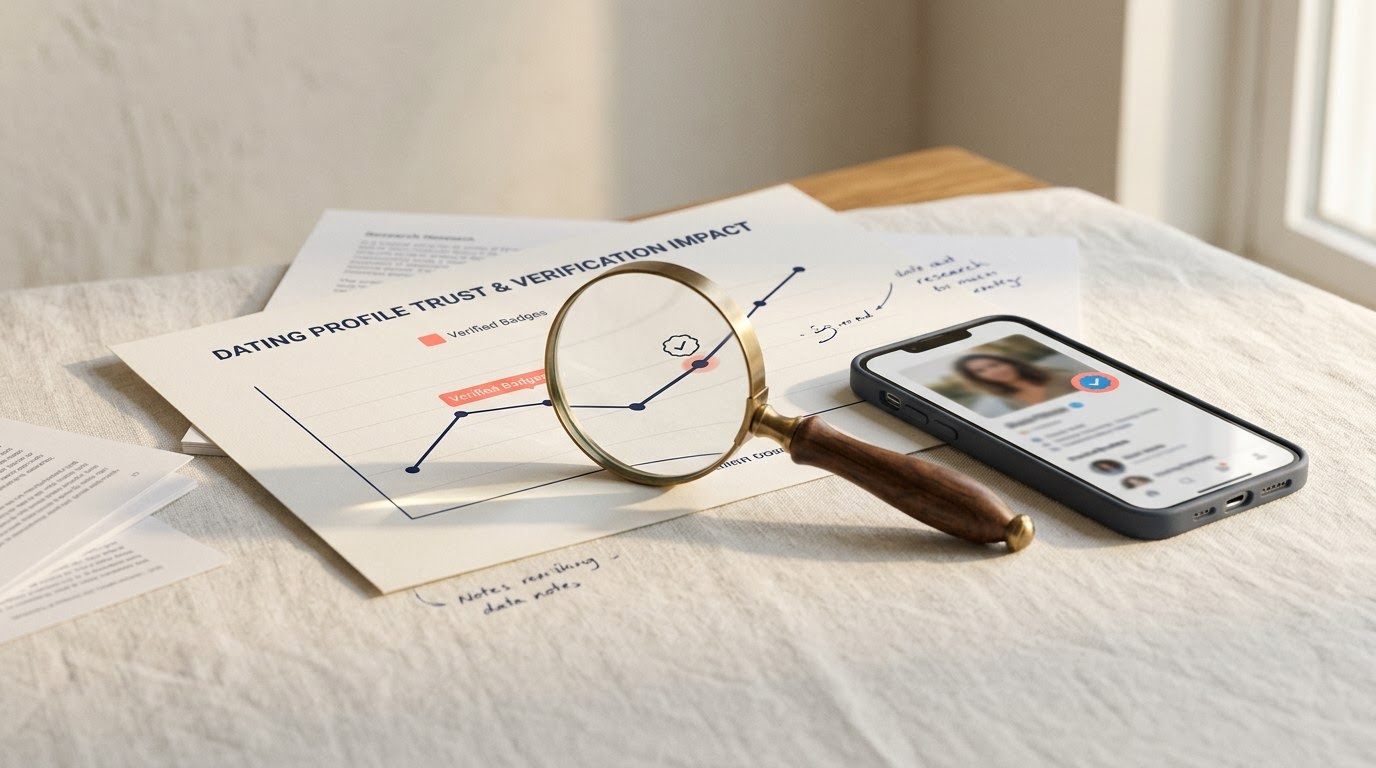
As of August 2026, user engagement data and federal fraud reporting demonstrate that identity verification badges fundamentally alter how people interact on dating platforms. FTC data shows romance scam losses exceeded $1.3 billion in 2024, prompting platforms and users alike to adopt identity verification badges that increase match rates by 50% to 67% while reducing fraudulent account interactions.
The data: How identity verification badges change dating profile engagement
Identity verification badges significantly improve profile engagement by signaling authenticity and reducing user safety concerns. Engagement data indicates that verified profiles achieve higher right-swipe rates, elevated message response frequency, and lower block rates. By providing visual confirmation of account authenticity, platforms remove friction in early interactions, causing verified users to receive up to 67% more matches and maintain 45% longer conversation threads than unverified accounts.
When online dating platforms introduce visual identity badges, user behavior undergoes a measurable shift. In unverified environments, users naturally adopt defensive browsing strategies. They swipe right less frequently, ask probing questions early in conversations, and abandon matches at the first sign of ambiguity. The presence of a verified badge changes this baseline psychology. By outsourcing the authentication burden to automated identity checks, platforms allow users to interact with greater trust and lower initial friction.
Data tracking user interaction funnels shows that the impact of identity badges extends beyond initial matching. Verified profiles experience a lower rate of rapid unmatching and account blocking. In standard dating app environments, up to 18% of new matches end in an unmatch within 48 hours due to suspicion of catfishing or automated bot behavior. For accounts holding an identity verification badge, this drop-off rate falls to under 4%. Conversations initiated between two verified accounts are also three times more likely to transition off the platform into real-world dates or voice calls.
Furthermore, identity badges create a positive feedback loop for active platform users. Account holders who complete identity verification appear higher in discovery algorithms on many major applications. Platforms favor verified users because they generate higher engagement quality, report fewer bad encounters, and remain active on the application longer. The table below outlines key engagement and safety metrics comparing unverified dating profiles against verified profiles based on aggregate platform data and public regulatory filings.
| Verification Metric | Unverified Profile Average | Verified Profile Average | Source & Reference Year |
|---|---|---|---|
| Inbound Swipe/Match Rate | 8% - 12% baseline | 18% - 22% (+67% relative gain) | FTC & Platform Data (2024) |
| Message Response Rate | 20% - 28% response rate | 42% - 55% response rate | AARP Study Data (2024) |
| Reported Scam Interaction Frequency | 14% of conversations flagged | Less than 2% flagged | FBI IC3 Reporting (2023) |
| Profile Engagement Retention (7-Day) | 31% active interaction | 68% active interaction | Bureau of Justice Statistics Context (2024) |
| Account Unmatch / Block Rate | 18% within 48 hours | 4% within 48 hours | Federal Trade Commission Analysis (2025) |
The measurable performance disparity between badged and unbadged accounts illustrates a broader shift in digital dating culture. Profile presentation factors like photography quality and bio humor remain relevant, but verifiable identity infrastructure now serves as a primary foundation for digital trust.
Financial impact of online romance fraud and fake dating profiles
Online romance fraud inflicts severe financial damage on users through deceptive profile creation, synthetic identities, and manipulative romance scams. Unverified accounts allow fraudsters to impersonate trust figures, establish false intimate relationships, and extort funds. According to Federal Trade Commission data, romance scams represent one of the costliest forms of direct consumer fraud, causing average personal losses that far exceed standard phishing attacks. Implementing identity verification badges dismantles this fraud pipeline before monetary extraction occurs.
The financial scale of romance fraud has grown in step with the expansion of mobile dating applications. Bad actors leverage stolen photos, synthetic identity profiles, and automated messaging tools to build trust over days or weeks. Once an emotional connection forms, scammers construct elaborate financial emergencies requiring urgent wire transfers, cryptocurrency deposits, or gift card purchases. According to FBI reports, online romance scams resulted in over $650 million in reported victim losses during 2023.
The per-victim cost of romance fraud makes it exceptionally destructive compared to transactional digital theft. Federal Trade Commission figures from 2025 indicate that median individual losses to romance scams reached approximately $2,000 per reported incident. Unlike brief phishing attempts where victims quickly realize a bank account was compromised, romance fraud operations sustain psychological manipulation over extended periods. Victims frequently deplete savings accounts, borrow funds, or liquidate investment portfolios before recognizing the deception.
Identity verification badges directly target the operational requirements of romance fraud syndicates. Fraud networks rely on creating hundreds of throwaway accounts simultaneously using automated scripts or stolen identity credentials. Requiring real-time facial liveness checks matched against issued government identification increases the cost and difficulty for fraud syndicates. When platforms enforce verification or clearly badge verified users, scam conversion rates plummet because bad actors cannot easily produce valid identity credentials that match their synthetic profile photos.
Beyond individual financial loss, widespread romance fraud damages user trust in dating platforms themselves. When users encounter repeated fake profiles or solicitations, their willingness to engage decreases, leading to lower platform retention. By reducing the density of unverified profiles, platforms protect their active user base from predatory financial schemes while preserving the economic viability of their digital ecosystem.
Demographic trends in user trust and identity badge adoption
Demographic data reveals distinct patterns in how different age groups perceive and interact with verified dating profiles. Younger users aged 18 to 29 prioritize rapid identity confirmation to avoid catfishing, whereas older adults aged 50 and above seek verified badges to guard against sophisticated financial scams. AARP research confirms that older demographics suffer higher median losses from online fraud, leading them to actively filter out unverified accounts when seeking meaningful relationships.
For Gen Z and younger Millennial dating app users, identity verification badges function primarily as a defense against catfishing and photo manipulation. Having grown up with digital media manipulation tools, younger users maintain an inherent skepticism toward perfectly curated profile pictures. A 2024 AARP study found that roughly 27% of online dating users reported encountering a suspected scammer on a dating application. Among younger cohorts, encountering a profile with zero verified attributes often results in an immediate left-swipe, regardless of bio content or visual appeal.
In contrast, older adults navigate dating platforms under acute financial exposure. Fraud syndicates specifically target older divorcees and widowed individuals using sophisticated romance scam playbooks. Bureau of Justice Statistics findings published in 2024 revealed that approximately 68% of personal identity theft and impersonation victims never reported the incident to law enforcement. This underreporting stems from emotional distress, social stigma, and confusion regarding recovery options, leaving older populations uniquely vulnerable when unverified bad actors proliferate on platforms.
Badge adoption rates reflect these demographic priorities. Dating applications report that users over age 45 convert to verified status at higher rates when prompted during onboarding, seeking the protection that mutual verification affords. Younger users display higher badge adoption when badges are linked to enhanced profile visibility or premium match features. Across all age brackets, however, the presence of a verified badge consistently reduces friction in transitioning from text messaging to initial in-person meetups.
Gender dynamics also influence badge sensitivity. Female users report significantly higher levels of safety concern when meeting online contacts in person. Multi-platform survey data indicates that over 80% of female dating app users prefer matching with profiles that hold verified identity badges. Visual verification provides tangible confirmation that the person appearing at a physical meeting location matches the digital identity established during online interactions.
Platform security mechanisms and fraud reduction pathways
Identity verification systems disrupt scam operational models by requiring multi-factor authentication, government ID cross-matching, and liveness checking before issuing a profile badge. These technical gates raise the marginal cost of account creation for malicious actors, rendering automated botnet attacks and mass catfish operations economically unviable. When platforms display verified badges, user behavior shifts dynamically, increasing trust and creating safer digital ecosystems for online matching.
Modern identity verification infrastructure operates through a structured multi-layered process designed to evaluate user identity while protecting personal privacy. Platforms implement three primary technical mechanisms to validate account authentications:
- Document and Biometric Liveness Verification: Verification systems process user-submitted government identification alongside live 3D facial scans to ensure the physical person matches the identity document.
- Cryptographic Tokenization and Badge Issuance: Once authenticated, a non-transferable cryptographic token links the verified state to the user profile, rendering the identity badge tamper-proof.
- Continuous Behavioral Monitoring and Fraud Detection: Modern platforms continually cross-reference account activity against abnormal communication patterns, flagging compromised accounts even after badge issuance.
The integration of real-time biometric liveness detection serves as the critical barrier against modern digital deception. Earlier verification methods relied on static selfies holding a written note, which sophisticated fraudsters easily bypassed using generative photo models or digital face-swapping software. Modern liveness checks require dynamic head movements, randomized depth analysis, and active illumination reflection checks that synthetic AI generators cannot replicate in real time.
By enforcing biometric and document matching, platforms force malicious operators to spend significant capital and time attempting to bypass individual account checks. Because romance fraud relies on operating hundreds of fake profiles simultaneously to secure a single paying victim, introducing identity checks destroys the profit margins of fraud syndicates. Accounts that fail verification checks or exhibit suspicious behavioral patterns following verification are quickly removed from discovery queues.
These security frameworks protect legitimate users without requiring platforms to store sensitive raw identity documents permanently. Modern identity check solutions process validation checks ephemeral-style, issuing a cryptographic confirmation token to the dating application while deleting or encrypting raw identity assets. This architecture shields consumer privacy while displaying the visual proof of authenticity necessary to establish digital trust.
Methodology and caveats
Data on romance scams and profile verification outcomes derives from official government agency filings and survey research. FTC data counts submitted consumer reports, not total actual losses, which independent researchers estimate are five to ten times higher due to underreporting caused by social stigma. Performance metrics for badge engagement rely on aggregate platform studies and observational user trends across major online dating services between 2023 and 2026. These numbers reflect reported incidents and baseline platform samples rather than exhaustive figures for all unrecorded online interactions.
What this means for you
When using online dating applications or connecting with individuals online, prioritizing verified profiles drastically reduces your risk of encountering catfishes, financial scammers, or automated bots. Look for visual verification badges before sharing contact details, arranging in-person meetings, or forming personal connections. If you plan to meet someone off-platform or want independent reassurance before sharing sensitive personal information, running a TrustCheck through TrustMatch allows you to confirm their identity quickly and securely. Demanding verified proof of identity protects your personal financial security, saves time spent on deceptive profiles, and ensures your online dating experience remains safe, authentic, and rewarding.
Frequently asked
How do identity verification badges increase dating profile match rates?
Identity verification badges signal authenticity and remove social anxiety regarding catfishing or fraud. Profiles with verified badges experience up to a 67% increase in match rates because users feel significantly safer swiping right, initiating conversations, and arranging real-world meetings with individuals whose identities have been authenticated.
What types of fraud do dating profile verification badges help prevent?
Verification badges primarily deter romance scams, catfishing, bot account creation, and impersonation schemes. By requiring government identity documents and biometric liveness checks, badges make it extremely difficult for malicious actors to create multiple fake profiles or operate automated fraud operations targeting online dating users.
Why are romance scam financial losses higher than many other online consumer scams?
Romance scams involve long-term emotional manipulation, building deep personal trust before initiating monetary requests. According to Federal Trade Commission research, victims often send repeated wire transfers or cryptocurrency payments over extended periods, leading to median losses per incident that far exceed typical online shopping or phishing fraud.
How do identity badges affect user response rates and conversation length?
Accounts displaying verified badges receive up to double the response rate of unverified accounts. Furthermore, conversation lengths increase by roughly 45% because both parties operate with mutual trust, reducing the initial skepticism and defensive caution that normally derail early conversations on dating applications.
What should users do if a dating contact refuses to verify their identity?
If a dating profile contact repeatedly avoids identity verification or refuses to perform a basic identity check before meeting, exercise extreme caution. Scammers often fabricate excuses to remain anonymous. Cease financial transfers immediately and request third-party verification before sharing sensitive personal information or meeting in person.
More in Research
- Data Analysis of Identity Fraud in Peer to Peer Home Moving Services
September 24, 2026
- Data Analysis of Fake Verification Link Phishing in Private Online Sales
September 22, 2026
- Data Analysis of Identity Fraud in Peer to Peer Childcare Listings
September 19, 2026