Statistical Analysis of Fake Courier Pickup Fraud in Local Sales
· 9 min read
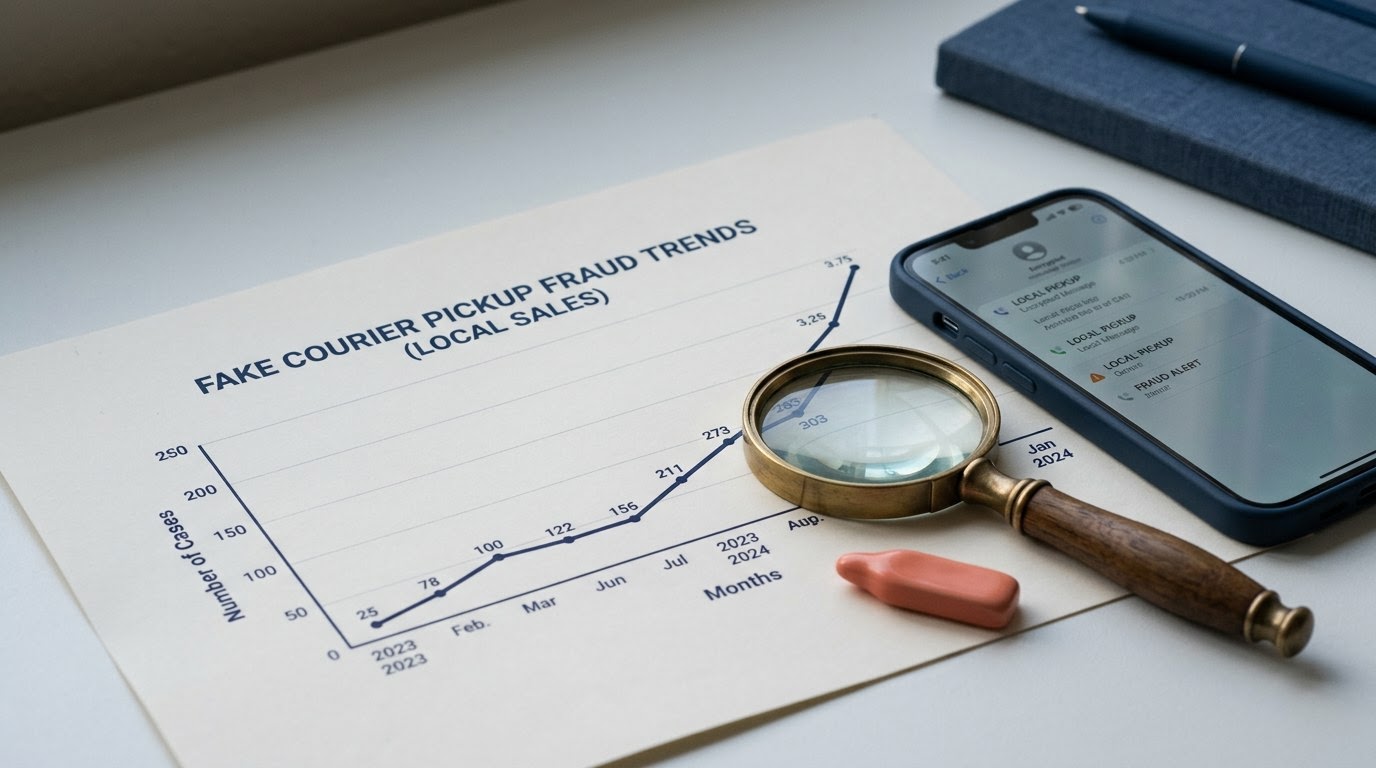
The Data: Marketplace Courier Scam Metrics and Financial Loss Distribution
The statistical baseline for fake courier pickup fraud reflects severe financial impacts on individual sellers operating across local digital marketplaces. Scammers typically contact sellers within minutes of a listing going live, offering full price plus an additional fee to secure the item via a third-party courier. Victims face dual loss vectors: non-payment for the physical merchandise handed over and direct cash transfer losses triggered by fake verification fees or fraudulent overpayment checks.
To evaluate the scope and trajectory of fake courier pickup fraud in local transactions, researchers analyze longitudinal datasets from federal databases, trade bureau complaint metrics, and consumer risk profiles. The tabular summary below aggregates core statistical indicators observed across major peer-to-peer sales channels.
| Metric / Data Category | Reported Value / Observed Range | Primary Reporting Source | Data Reference Year |
|---|---|---|---|
| Total Marketplace Fraud Reports | 360,000+ incidents | Federal Trade Commission (FTC) | 2024 |
| Non-Delivery / Non-Payment Losses | $330 million+ | FBI Internet Crime Complaint Center (IC3) | 2023 |
| Median Fake Check / Overpayment Loss | $1,500 per victim | Better Business Bureau (BBB) | 2025 |
| Peer-to-Peer Payment Fraud Growth | 30%+ annual increase | Federal Reserve | 2024 |
| Unreported Marketplace Scam Rate | 40% to 55% estimated | Bureau of Justice Statistics (BJS) | 2023 |
| Scam Initial Contact Speed | Under 15 minutes from listing publication | Anti-Phishing Working Group (APWG) | 2025 |
The aggregated numbers demonstrate that fake courier pickup schemes are not isolated occurrences, but rather systematic components of large-scale commercial cybercrime. Scammers capitalize on seller optimism, deploying scripts that simulate urgency, generosity, and professional logistics management. When an online seller posts a high-demand or bulky consumer good—such as a sofa, dining set, riding lawnmower, or gaming console—the seller naturally anticipates logistical challenges regarding transport. Organized cybercriminals exploit this friction point by offering to orchestrate all delivery steps remotely.
Analysis of loss distributions indicates that financial damage varies by goods category. For general electronics and medium-value household items, loss amounts cluster between $300 and $800 in direct advance-fee payments. For higher-value items like used vehicles, industrial equipment, or designer furniture, fake check overpayments often push individual loss amounts beyond $3,000. In these high-value scenarios, sellers lose both the unrecovered merchandise handed to proxy drivers and the liquid cash remitted to fake courier insurance sites.
Financial Loss Patterns and Payment Rail Exploitation
Financial loss patterns in fake courier scams center on the manipulation of consumer payment rails and third-party logistics protocols. Fraudsters exploit the delayed settlement windows of electronic checks and peer-to-peer digital wallets to convince sellers that funds have been safely escrowed. By forcing sellers to pay upfront courier "insurance" or "activation" fees to fake delivery portals, scammers extract irreversible cash before the seller realizes the initial buyer payment was completely fraudulent.
The financial infrastructure supporting these scams relies primarily on the structural difference between immediate balance updates and final banking clearance. When a scammer issues a counterfeit cashier's check or mobile check deposit, commercial banking regulations mandate that funds be made tentatively available to the account holder within one to two business days. However, full bank-to-bank verification takes several additional days or even weeks. Sellers observe the credited balance on their online banking app and incorrectly assume the transaction has fully cleared.
During this clearing window, the fraudster instructs the seller to transfer a portion of the credited funds to a specified "courier agent" or "delivery handling portal" via non-refundable peer-to-peer rails like Zelle, Venmo, Wire Transfer, or cryptocurrency. A 2025 BBB report indicated that fake check and overpayment scams resulted in median losses of $1,500 per victim. Once the banking institution identifies the initial check as counterfeit, the deposited funds are reversed entirely, leaving the seller's account with a negative balance in addition to the lost fees remitted to the scammer.
Federal Reserve data published in 2024 showed peer-to-peer payment fraud reports increased by over 30% year-over-year. Scammers favor instant settlement networks precisely because payments cannot be canceled or recalled once authorized by the user. Unlike credit card transactions, which carry robust chargeback protections under federal law, peer-to-peer push payments are categorized as voluntary user transactions by financial institutions, leaving victims with minimal options for asset recovery.
Furthermore, payment manipulation extended into modern fake escrow portals. Scammers create sophisticated phishing sites that mimic prominent logistics corporations like FedEx Freight, DHL Express, or UPS Logistics. These sites issue fake "shipping holds" claiming that a buyer has deposited funds into an escrow account, but the funds will only be released once the seller remits an advance shipping protection fee. The victim is tricked into authorizing multiple sequential payments under the false premise that previous transfers failed due to processing errors.
Demographic Susceptibility and Platform Vulnerabilities
Platform vulnerabilities and demographic exposure rates highlight how fake courier fraud targets specific seller behaviors and communication channels. Scammers primarily hunt on unverified local marketplace listings, utilizing off-platform messaging applications to isolate sellers from platform safeguards. While younger sellers report higher incident frequency due to elevated listing volume, older demographics sustain significantly higher average dollar losses per incident due to lower familiarity with synthetic payment receipts and spoofed courier notifications.
Data from crime tracking organizations demonstrates that platform design directly influences scam conversion rates. Open peer-to-peer selling environments that allow direct external communication without mandatory identity verification experience the highest concentration of fake courier solicitations. Automated bot networks continuously scan public listing sites for key phrases associated with high-value goods. When targeted listings appear, automated bots automatically dispatch canned initial inquiries to push sellers off-platform onto SMS or external messaging applications.
FBI IC3 reports revealed non-delivery and non-payment scam losses reached over $330 million in 2023. A significant portion of these losses originated on consumer-to-consumer marketplaces where buyers and sellers transact without identity validation. Once a fraudster succeeds in moving the conversation away from the primary marketplace platform, internal reporting controls and automated security warnings become ineffective.
Demographic data reveals distinct vulnerability profiles across age cohorts:
- Sellers aged 18 to 34: Show higher overall contact rates with fake courier accounts due to frequent digital listing activity. However, younger sellers exhibit lower median financial losses ($200–$500) as they are more likely to abandon transactions requiring physical paper checks or wire transfers.
- Sellers aged 35 to 54: Represent the largest absolute volume of reported losses. This group frequently lists higher-value household goods, furniture, and vehicles, making them primary targets for complex overpayment schemes ($800–$2,000 median loss).
- Sellers aged 55 and older: Suffer the highest per-incident financial losses ($1,500–$4,500+). A 2024 AARP study found that roughly 42% of adults over age 50 who fell victim to online marketplace fraud did not report the financial loss to law enforcement. Scammers exploit lower familiarity with spoofed email headers, digital payment clearing rules, and counterfeit mobile check graphics among older users.
Platform vulnerability is further heightened by the emergence of "courier proxy extraction." In urban centers, scammers hire legitimate, unwitting ride-share or local gig-economy drivers to pick up sold goods from unsuspecting sellers. The seller sees an actual driver arrive at their doorstep, reinforcing the illusion that the transaction is legitimate. The gig driver, simply following delivery instructions received via an app, collects the merchandise and drops it off at a secondary location, leaving the seller with no contact details for the actual criminal beneficiary.
The Mechanics of Fake Courier Dispatch and Logistics Impersonation
The operational mechanics of fake courier dispatch schemes rely on multi-stage social engineering engineered to emulate legitimate shipping companies. Scammers issue fake email confirmations bearing counterfeit branding of major courier services to convince the seller that funds are held in escrow until shipping insurance fees are paid. Once the seller remits payment or surrenders the merchandise to an unverified local proxy driver, the fraudulent buyer profile disappears entirely.
Understanding the precise sequence of events in a fake courier scam allows researchers and sellers to identify critical points of intervention. The execution of a typical fake courier pickup operation unfolds across five predictable phases:
- Initial Automated Contact: Within minutes of a seller creating a local marketplace listing, an automated account or human scammer contacts the seller. The buyer immediately agrees to the asking price without negotiating, creating initial enthusiasm and urgency.
- Delivery Service Setup Proposal: The buyer claims to be unavailable for an in-person exchange due to work travel, military deployment, or health reasons. They propose paying in advance and dispatching a commercial courier service (e.g., FedEx, UPS, or a specialized movers network) to handle pickup and transport.
- Issuance of Counterfeit Payment or Escrow Notice: The scammer sends a fake email notification designed to look like an official receipt from a payment service or courier logistics department. The notice states that funds have been transferred but are being held until the seller pays an upfront "courier dispatch fee" or "cargo insurance charge."
- Advance Fee Extortion: The seller is instructed to send the courier fee via an instant payment rail or prepaid gift card to an alleged "regional transport manager." The scammer promises that this fee will be refunded once the physical pickup is completed.
- Merchandise Pickup and Disappearance: If the scam includes physical extraction, an unwitting proxy driver collects the goods. Shortly after the item is handed over or the fee is sent, the buyer account is deleted, the fake escrow site vanishes, and the seller suffers complete financial and material loss.
Logistics impersonation has grown highly sophisticated. Cybercriminals register domain names that closely mirror legitimate transport providers, such as "fedex-express-logistics-portal.com" or "dhl-global-tracking-verify.net." These domains host phishing engines that generate realistic tracking dashboards and automated SMS notifications, making it difficult for casual sellers to identify the fraud without examining technical domain headers.
Methodology and Caveats
This statistical analysis synthesizes public reporting, enforcement filings, and victim complaint data published by federal agencies and consumer protection organizations between 2020 and 2026. Readers must note that public fraud databases capture only a fraction of total marketplace scams. FTC data counts formal victim reports, not actual overall losses, which law enforcement agencies estimate to be 5 to 10 times higher due to widespread underreporting, shame, and unverified micro-transactions. Data trends reflect observed patterns rather than exhaustive national census totals.
What This Means for You
Protecting yourself against fake courier pickup fraud requires enforcing strict verification protocols before completing any local sale. Never accept third-party courier arrangements, wire transfers, or advance fee requests for marketplace transactions. Always insist on cash or verified digital payments completed in person during daylight hours at a public safe-exchange zone. Before agreeing to sell or communicate off-platform with a prospective buyer whose profile seems new or suspicious, running a TrustCheck gives you instant clarity on the buyer's digital footprint and identity signals so you can avoid costly marketplace scams.
Frequently asked
How does a fake courier pickup scam work?
In a fake courier pickup scam, a fraudster poses as a buyer on a local sales platform and claims they cannot pick up the item in person. They offer to send a courier service like FedEx or UPS and send fake payment confirmations requiring the seller to pay prepaid delivery or insurance fees.
Why do scammers insist on using third-party delivery services?
Scammers use third-party delivery services to isolate the seller and create a sense of operational legitimacy. By moving the transaction away from standard platform protocols, fraudsters can send forged payment notifications, exploit delayed check clearance times, or deploy unwitting proxy drivers to steal physical merchandise without ever revealing their true physical identity.
Can peer-to-peer payment apps reverse fraudulent courier fee transfers?
Peer-to-peer payment apps generally treat completed transfers as instant cash transactions, making funds non-refundable once sent. Because the account holder authorized the transfer, financial institutions rarely classify these payments as unauthorized fraud, leaving sellers unable to recover funds lost to courier insurance schemes or fake fee requests.
What should sellers do if a buyer requests off-platform courier delivery?
Sellers should immediately decline off-platform shipping requests and insist on local, in-person cash transactions at a designated safe exchange location. If the buyer refuses or insists on sending fake courier confirmation links, sellers must cease communication, block the user, and report the account directly to the marketplace platform and law enforcement authorities.
How can local sellers verify the identity of unknown marketplace buyers?
Local sellers can protect themselves by verifying buyer profiles for long-term platform activity and insisting on direct cash payments. Performing an identity check using digital safety tools helps confirm that the person communicating matches their claimed identity, preventing exposure to automated scam accounts operating fake courier dispatch rings.