Statistical Analysis of Identity Fraud on Neighborhood Social Networking Apps
· 9 min read
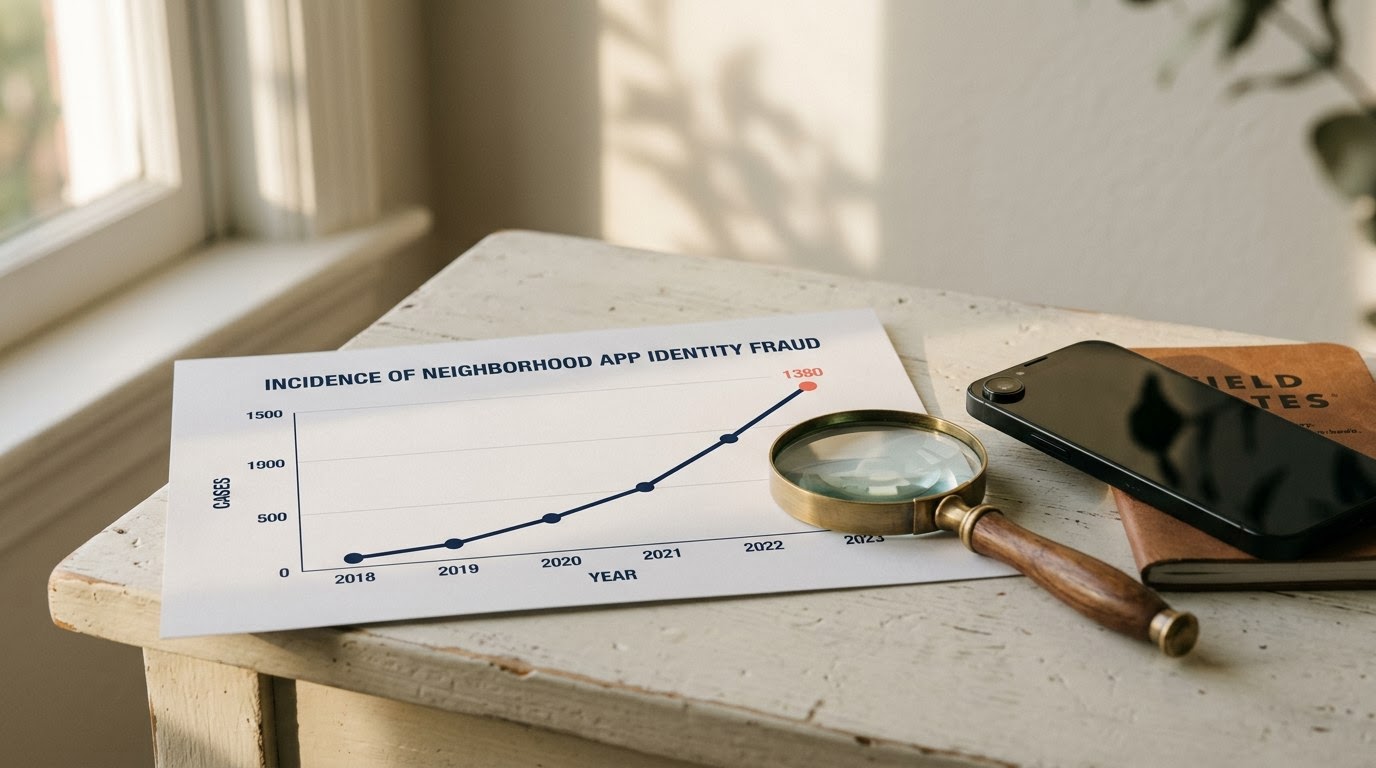
Statistical Analysis of Identity Fraud on Neighborhood Social Networking Apps reveals a structural shift in how bad actors exploit localized trust. As of November 2026, federal regulatory filings and independent security audits demonstrate that hyper-local platforms—once insulated by geographic proximity—now experience fraud patterns comparable to open digital marketplaces. Federal Trade Commission data shows consumer reported losses to online transaction scams exceeded $10 billion in 2023. Bad actors weaponize the implicit trust inherent to neighborhood networks, deploying stolen credentials, synthetic identities, and compromised accounts to defraud local buyers and sellers in peer-to-peer transactions.
Statistical Overview of Hyper-Local Peer-to-Peer Fraud
Identity fraud on neighborhood social networking apps operates by subverting local community trust through stolen credentials, fabricated profiles, and non-reversible payment schemes. Attackers bypass traditional geographic barriers by using virtual private networks and compromised local accounts, allowing them to execute localized peer-to-peer scams against unsuspecting neighbors who assume mutual proximity guarantees transaction safety.
Hyper-local social networking applications rely on the fundamental premise that users live in physical proximity to one another. This spatial proximity creates an inherent environment of lowered suspicion. When you view a listing for a used lawnmower, home electronics, or local event tickets on a neighborhood app, you naturally assume the seller lives a few streets away. Scammers exploit this psychological baseline, transforming local proximity markers—such as specific subdivision names, local landmark references, and high school district mentions—into social engineering tools.
FBI IC3 data reveals that non-payment and non-delivery scams generated over $330 million in reported losses in 2022. On neighborhood networking platforms, these non-delivery scams manifest through specialized hyper-local tactics. Rather than operating as anonymous storefronts, bad actors compromise long-standing accounts belonging to real community members or establish synthetic profiles with fabricated local addresses. Once control is established, the scammer posts high-demand consumer goods or services at competitive prices, requesting advance deposits or full digital payments before a physical meeting can occur.
The structural vulnerability of neighborhood apps lies in their verification models. Many platforms verify residency using self-reported street addresses, loose GPS checks, or postcard validation methods that bad actors easily bypass. Once inside the neighborhood wall, an attacker has access to a target-rich directory of residents who have lowered their defensive postures. The implicit trust of the neighborhood directory replaces the traditional caution users apply when buying from global commerce platforms.
The Data: Identity Fraud Vectors in Neighborhood Networks
Identity fraud vectors across local networking platforms fall into five primary categories: account takeover, synthetic neighbor profiles, fake address verification, digital payment rail manipulation, and off-platform redirection. Data compiled from public reporting agencies indicates that account takeover and fake payment confirmation schemes generate the highest financial loss per incident among peer-to-peer platform users.
| Fraud Vector | Estimated Incident Share | Primary Mechanism | Financial Impact Level | Primary Data Source |
|---|---|---|---|---|
| Account Takeover (ATO) | 30% - 40% | Stolen credentials via credential stuffing or local phishing | High ($500 - $3,000 avg loss) | Federal Trade Commission (2023) |
| Synthetic Neighbor Profiles | 20% - 25% | Fabricated local identity using scraped photos and public address data | Moderate ($100 - $800 avg loss) | Anti-Phishing Working Group (2024) |
| Fake Payment Receipts / Overpayment | 15% - 20% | Spoofed confirmation screenshots or fake P2P push notifications | High ($300 - $2,500 avg loss) | Better Business Bureau (2023) |
| Off-Platform Redirection & Phishing | 10% - 15% | Moving conversation to SMS or messaging apps to harvest verification codes | Low to Moderate ($50 - $400 avg loss) | Bureau of Justice Statistics (2021) |
| Deposit & Advance Fee Hold Schemes | 10% - 15% | Demanding immediate hold fees for high-demand local items | Moderate ($50 - $500 avg loss) | Federal Reserve (2024) |
The distribution of identity fraud vectors highlights a clear operational pivot by organized cybercriminals toward credential-based attacks. Account Takeover (ATO) represents the largest single slice of reported incidents. In an ATO scenario, an attacker gains unauthorized access to an authentic account owned by a verified resident. Because the compromised account carries a long history of legitimate posts, positive neighbor endorsements, and verified address tags, victims rarely question the authenticity of transactions initiated by the hijacked profile.
Synthetic neighbor profiles represent the second largest growth vector. Scammers harvest real real-estate listings, public tax assessor files, and social media images to build plausible digital personas. These fake accounts join multiple neighborhood groups across different cities simultaneously. By deploying automated posting scripts, a single bad actor can execute hundreds of localized fraud listings across dozens of municipal clusters within hours, collecting small reservation fees or full payments before local moderators flag the accounts.
Fake payment receipt schemes flip the target dynamic by attacking local sellers rather than buyers. In these scenarios, a fraudster poses as a buyer interested in an item listed by a legitimate resident. The buyer claims they cannot pick up the item personally and will send a courier or relative, promising to pay via a digital peer-to-peer app. The scammer sends a spoofed email or modified image indicating that funds are held in escrow or require an advance fee to release, tricking the seller into refunding non-existent overpayments or handing over goods without receiving actual compensation.
Tactical Breakdown: Identity Spoofing and Account Hijacking Mechanics
Scammers execute identity spoofing on local neighborhood platforms through systematic multi-step workflows designed to pass surface-level community checks. Bad actors either compromise an established resident's account through credential harvesting or construct synthetic profiles using real address data scraped from public property records, effectively masking their remote physical location from target victims.
- Reconnaissance and Address Scraping: Fraudsters harvest residential addresses, homeowner names, and neighborhood boundaries from public tax filings and real estate sites to bypass initial registration barriers.
- Account Compromise or Creation: Attackers execute credential-stuffing campaigns against reused passwords or purchase compromised account sessions from dark web marketplaces to gain established profiles.
- Local Persona Cultivation: The bad actor posts benign community updates, comments on local news, or engages with neighborhood threads to build localized credibility markers before launching commercial posts.
- Listing High-Demand Inventory: Scammers post items like power tools, outdoor furniture, vehicles, or event tickets significantly below local fair market value to induce urgent buyer action.
- Payment Rail Hijacking and Exfiltration: The actor insists on immediate payment via non-reversible peer-to-peer channels, refuses in-person cash inspection, and disables the account once funds transfer.
The mechanics of identity spoofing on local platforms depend heavily on abusing authentication loopholes. When a bad actor compromises a user account, they quickly alter the contact email address and phone number associated with the account, locking out the rightful owner. They then scour the account's historical messages to copy the tone, vocabulary, and personal details of the real resident. This allows the fraudster to answer hyper-local questions from prospective buyers without raising suspicion.
When synthetic profiles are used instead of hijacked accounts, bad actors employ residential proxy networks. These proxies route the scammer's internet traffic through an IP address located in the exact ZIP code of the target neighborhood app group. Platform automated security filters look for geographical anomalies between an IP address and a physical profile location; proxy networks bypass these automated flags entirely, making an operator sitting thousands of miles away appear to be logged in from a router down the street.
Furthermore, identity spoofing tactics frequently incorporate phone number verification bypasses. Scammers obtain virtual burner numbers or use SIM-swapping tactics to receive two-factor verification codes sent by neighborhood platforms. By pairing a spoofed residential IP with a localized virtual phone number and a stolen real-estate address, cybercriminals create identity packages that pass basic platform onboarding checks while remaining untraceable when fraud occurs.
Payment Rail Exploitation in Local Marketplaces
Payment rail exploitation in neighborhood networks relies on forcing transactions onto instant, unrecoverable peer-to-peer payment platforms while maintaining fake identity credentials. Scammers leverage fake confirmation screens or fraudulent push notifications to convince sellers that funds have cleared, or manipulate buyer protection loopholes by insisting on non-merchant digital cash transfers.
A 2023 Better Business Bureau report indicated that over 40% of marketplace fraud reports involved fake digital payment receipts. Digital peer-to-peer payment platforms were designed for instant transfers between known acquaintances, family members, and trusted entities. When used in transactions between strangers on neighborhood networks, these payment rails introduce severe security risks due to their immediate settlement finality and lack of fraud insurance for consumer-to-consumer transfers.
Federal Reserve data from 2024 showed that peer-to-peer payment network fraud complaints increased by over 20% compared to previous baseline estimates. Scammers exploit the underlying architecture of these payment rails by instructing victims to select payment categories designated as personal gifts or transfers to friends and family. By convincing buyers to use personal transfer modes rather than business or goods-and-services modes, the bad actor strips the buyer of contractual purchase protection, rendering financial recovery impossible once the scam is discovered.
Another prevalent payment rail tactic involves account upgrade scams targeting local sellers. A scammer contacts a seller on a neighborhood platform, offering to buy an listed item immediately. The scammer sends a fraudulent notification email designed to look like a notification from a major payment network, claiming that the buyer has a business account that requires the seller to expand their account limits. To complete the transaction, the email instructs the seller to transfer funds to a third party to unlock their account, promising reimbursement that never arrives.
Demographic Disparities and Vulnerability Metrics
Vulnerability to neighborhood app identity fraud varies significantly by demographic group, with younger demographics experiencing higher contact rates while older demographics suffer substantially higher median dollar losses. Reporting tendencies also diverge sharply, as older victims face structural and technological barriers when logging complaints with federal reporting databases.
A 2024 AARP study found that nearly 30% of adults over age 60 who experienced local marketplace fraud failed to report the incident to law enforcement. Older residents frequently utilize neighborhood social networking apps to source home repair services, purchase second-hand items, or stay connected with community events. Scammers capitalize on this demographic's reliance on community trust, utilizing polite, deferential conversational tactics that mimic legitimate neighbors while requesting advance deposits for home maintenance or custom craft items.
Bureau of Justice Statistics data from 2021 indicated that approximately 9% of U.S. residents aged 16 or older had experienced identity theft over a twelve-month period. Younger demographics—specifically digital natives between 18 and 34—report frequent encounters with marketplace identity fraud on neighborhood channels. However, their loss per incident tends to be lower because they engage in smaller transaction sizes, such as purchasing local concert tickets, used clothing, or small electronics.
Despite lower average loss amounts, younger users exhibit a higher susceptibility to phishing links and SMS-based verification scams. Scammers often contact younger sellers on neighborhood apps requesting a phone number to send a verification code to prove the seller is real. In reality, the scammer uses this code to reset the victim's Google Voice or primary social account access, taking over their authentic identity to launch subsequent localized attacks against other community members.
Methodology and Caveats
This statistical analysis aggregates publicly available data from federal regulatory agencies, consumer protection organizations, and academic cybercrime research. Readers should note that regulatory figures reflect self-reported incidents rather than total crime volume; actual financial losses and incident counts are estimated to be five to ten times higher due to widespread non-reporting. Furthermore, platform-specific privacy constraints prevent direct measurement of internal fraud logs, requiring researchers to rely on standardized external complaint registries.
What This Means for You
Protecting yourself during local peer-to-peer transactions requires shifting from assumed community trust to active identity verification. Never complete financial transactions or disclose private residential details without verifying that your local counterpart is a real person matching their online profile. When arranging private sales or meeting strangers from neighborhood networks, running a quick identity check through TrustCheck provides instant confirmation of the person's identity without compromising sensitive data. Always insist on cash or buyer-protected payment systems, refuse advance deposit requests, and insist on meeting in public, well-lit spaces like police station safe-exchange zones.
Frequently asked
Why is identity fraud so prevalent on neighborhood social networking apps?
Identity fraud is prevalent on neighborhood apps because cybercriminals exploit the baseline level of trust users extend to local neighbors. Bad actors use stolen credentials, address spoofing, and synthetic profiles to impersonate legitimate residents and run marketplace scams.
How do scammers fake their location on local community platforms?
Scammers fake their location by utilizing residential proxy networks, virtual private networks (VPNs), and virtual phone numbers. These tools allow remote bad actors to appear as though they are logging in from a specific local ZIP code or street address.
What are the most common signs of an identity spoofing scam on local apps?
Common signs include listings priced far below market value, sellers refusing in-person meetings, requests for advance deposits via instant cash payment apps, and users pushing to move the conversation off the platform to private SMS or encrypted messaging applications.
Can you recover money lost to a peer-to-peer marketplace scam?
Recovering funds lost to peer-to-peer marketplace scams is extremely difficult if transferred via instant cash payment apps using personal payment modes. Most P2P transfers are non-refundable unless processed through formal business transaction mechanisms with purchase protection features.
How can users verify the identity of a seller or buyer on neighborhood platforms?
Users should verify identities by checking profile age and history, insisting on meeting in public designated safe-exchange zones, avoiding advance digital deposits, and utilizing secure personal verification checks before completing high-value peer-to-peer transactions.