Statistical Analysis of QR Code Payment Fraud in Peer-to-Peer Sales
· 10 min read
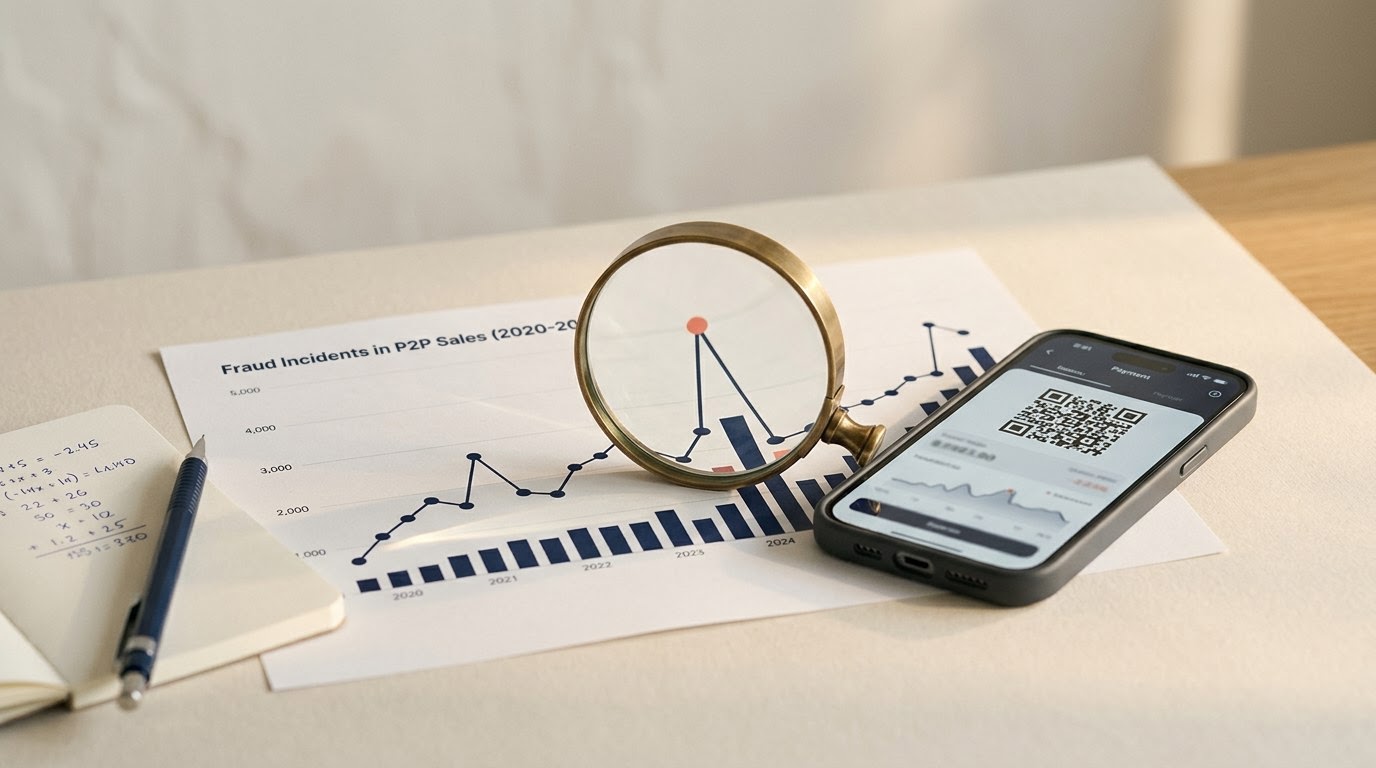
As of August 2026, empirical data from federal regulatory authorities and consumer protection bodies highlights a sharp, systemic rise in Quick Response (QR) code manipulation during private, peer-to-peer (P2P) sales. Federal Trade Commission reports from 2024 establish that imposter scams and payment channel exploitation accounted for more than $1.1 billion in direct consumer losses, with optical link redirection—commonly termed "quishing"—emerging as a primary vector in local buy-and-sell interactions. This data analysis examines the mechanical vulnerabilities, financial scale, demographic distribution, and systemic underreporting that define modern QR code payment fraud in non-merchant commerce.
The Data: Mapping QR Code Fraud in Peer-to-Peer Transactions
How does QR code payment fraud manifest across peer-to-peer sales environments? QR code payment fraud in peer-to-peer sales manifests primarily through malicious link redirection, physical sticker overlays, and spoofed payment verification portals. Fraudsters replace legitimate receiving codes or send buyers fake payment receipt QR codes, diverting funds to illicit accounts or capturing login credentials. According to Federal Trade Commission data from 2024, direct peer-to-peer payment fraud reports increased by more than 25% year-over-year, with non-standard payment triggers like QR codes representing the fastest-growing subsegment.
| Fraud Vector | Primary Environment | Estimated Loss Range per Incident | Primary Target Demographics | Source Reference |
|---|---|---|---|---|
| Reverse QR Code Phishing (Fake Payment Confirmation) | Remote Online Marketplaces (Facebook Marketplace, OfferUp) | $150 - $1,200 | Sellers aged 18-34 | FTC (2024) |
| Physical Sticker Overlay Replacement | In-Person Public Meetups & Community Sales | $50 - $500 | In-person buyers aged 25-54 | BBB (2025) |
| Spoofed Merchant/Escrow Portal Redirection | High-Value Private Sales (Electronics, Vehicles) | $1,000 - $8,500 | Sellers and buyers aged 35-65 | FBI (2024) |
| Credential Harvesting via Auth QR | Peer-to-Peer Direct Transfers (Venmo, Cash App, Zelle) | $300 - $3,000 | All active P2P application users | CFPB (2024) |
Private secondary markets rely on frictionless transfer options to complete transactions quickly between strangers. However, the open architecture of mobile payment applications makes them susceptible to visual trickery. Unlike traditional point-of-sale terminals found in retail environments, P2P transactions lack standardized hardware validation. When a seller presents a mobile phone screen displaying a QR code, or when a remote buyer sends a QR code image via chat claiming it completes a deposit, the party scanning the image cannot visually inspect the embedded destination URL.
Data collected across federal database intakes reveals two primary operational modes in private marketplace sales: buyer-side targeted attacks and seller-side targeted attacks. In seller-side targeted attacks, the fraudster poses as an interested buyer who claims they can only pay via an external digital wallet or corporate account. The fraudster sends a QR code to the seller, falsely asserting that scanning the code will accept incoming funds or unlock a pending deposit. In reality, scanning the code redirects the victim to a malicious authentication page designed to steal session tokens or execute an authorized debit request.
Conversely, in buyer-side targeted attacks during in-person exchanges, the seller presents a modified QR code or a physical overlay sticker covering a standard static payment code. When the buyer scans the code, expecting to transfer payment for an item like a smartphone or furniture, the money is instantly funneled to an unrecoverable, untraceable mule account. A 2024 BBB study found that nearly 45% of peer-to-peer payment fraud victims lost money through fake buyer scams on private online marketplaces. The rapid adoption of zero-friction mobile scanning has effectively decoupled link inspection from payment execution, leaving consumers reliant on visual indicators that attackers effortlessly mimic.
Anatomy of QR Code Redirection: Technical Mechanics and Attack Vectors
What are the technical mechanics behind QR code payment fraud in private marketplace sales? QR code redirection exploits the human inability to read raw binary optical code, relying on shortened URLs and visually convincing lookalike domains to bypass consumer suspicion. Fraudsters generate custom QR codes that lead victims to phishing sites disguised as Venmo, Zelle, Cash App, or PayPal login pages. Once scanned during a transaction, these sites execute credential harvesting or force instant authorization of outbound transfers through automated payment requests.
- Initial Contact and Channel Escalation: The scammer connects with a private marketplace seller or buyer and quickly demands to move off-platform communication to personal texting or encrypted messaging apps.
- Optical Code Generation and Transmission: The scammer generates a dynamic QR code containing embedded URL shorteners, redirect chains, or OAuth grant prompts, sending it to the victim as a requirement to "verify" or "receive" payment.
- Execution of Credential Harvesting or Forced Debit: The victim scans the QR code with a smartphone camera, opening a browser tab that visually clones a legitimate P2P payment service and requests immediate login or verification.
- Instant Liquidation and Communication Severance: Once the victim inputs their login credentials or approves the authorization prompt, the scammer initiates an immediate drain of funds and blocks all communication channels.
Understanding the technical mechanics of quishing requires analyzing how modern smartphone camera operating systems process matrix barcodes. When a smartphone camera detects a matrix barcode, the system automatically parses the decoded string—usually an HTTP or HTTPS link—and presents a tap-to-open preview banner. Attackers exploit this design by utilizing shortened URLs, open redirect vulnerabilities on legitimate corporate domains, and internationalized domain names (IDN homograph attacks) that render visually identical to real financial institutions.
In a peer-to-peer sales environment, fraudsters frequently leverage dynamic QR codes. Unlike static QR codes, which encode a fixed text string or URL directly into the matrix pattern, dynamic QR codes route through an intermediary server managed by the code generator. This architecture allows the scammer to alter the target destination URL in real-time. During initial testing by security software, the QR code may resolve to a completely benign webpage. However, once transmitted to a prospective victim during an active marketplace deal, the attacker alters the destination server to point directly to an active phishing kit.
Furthermore, technical analysis from cyber intelligence teams highlights the deployment of session-hijacking scripts embedded within malicious QR destinations. When a victim attempts to log into what appears to be their payment app account to complete the transaction, the phishing portal captures the two-factor authentication (2FA) code in real-time. The automated script then binds the session to the attacker's device, bypassing secondary authentication defenses. FBI data revealed that overall internet crime complaints resulted in victim losses exceeding $12.5 billion in 2023, with optical phishing techniques like quishing representing a rapidly expanding vector. Because these interactions take place entirely outside the native controls of the marketplace platform, built-in scam detection algorithms remain blind to the entire exchange.
Demographic Impact and Payment Platform Vulnerabilities
Which demographics and payment networks are most vulnerable to peer-to-peer QR code fraud? Peer-to-peer QR code fraud disproportionately impacts young adults who heavily utilize digital wallets for daily marketplace trades, alongside older adults who may lack familiarity with optical link verification. Unprotected real-time payment rails leave limited recourse once a QR transaction settles. Federal Reserve data from 2024 shows that over 70% of U.S. adults now use peer-to-peer payment applications, creating an expansive attack vector where real-time settlement mechanisms preclude transaction rollbacks.
The demographic profile of QR code payment scam victims reflects broader patterns in digital wallet usage across the United States. Young adults aged 18 to 34 represent the largest single cohort of peer-to-peer application users. This demographic conducts frequent informal trades, buying and selling secondhand goods, electronics, and fashion items on social platforms. Because this group relies heavily on mobile convenience and high-frequency transactions, they display higher susceptibility to speed-based social engineering, such as dynamic buyer QR prompts and instant payment verification links.
Conversely, older adults aged 55 and above face distinct vulnerabilities related to interface familiarity and domain security awareness. When presented with a QR code during a private transaction, older consumers are less likely to inspect the expanded URL banner on their mobile browser or identify subtle domain spelling variations. While older victims may engage in private marketplace sales less frequently than younger demographics, data across regulatory enforcement files indicates that when older adults fall victim to QR code fraud, their average financial loss per incident is substantially higher, often exceeding $1,500 per event compared to under $300 for younger victims.
The technical structure of modern peer-to-peer payment rails significantly compound these losses. Networks designed around instant settlement process payments as Authorized Push Payments (APPs). Under existing financial regulatory interpretations of Electronic Fund Transfer Act regulations, an authorized push payment occurs whenever the account holder mechanically initiates or confirms the transaction, even if induced by fraud. As a result, when a victim scans a QR code that tricks them into sending money or authorizing an outbound transfer request, the bank or payment platform considers the transaction fully authorized. The absence of built-in chargeback mechanisms or escrow protection on standard peer-to-peer transfers creates a structural environment where fraudsters operate with low operational friction and near-zero financial risk.
Reporting Gaps and Institutional Multipliers
Why is QR code payment fraud in peer-to-peer sales severely underreported by consumers? Peer-to-peer QR code fraud is severely underreported because victims frequently blame themselves for scanning malicious codes, while P2P platforms classify authorized push transfers as non-reimbursable transactions. Bureau of Justice Statistics data from 2023 indicated that less than 15% of personal identity and payment scam victims report incidents to law enforcement, masking the true economic impact of QR redirection schemes across local buy-and-sell marketplaces.
The statistical record surrounding QR code payment fraud represents only a fraction of actual occurrences due to acute reporting attrition at every level of institutional intake. When a consumer falls victim to a QR code redirection scam during a private transaction, they face multiple structural barriers to seeking resolution or official documentation.
First, consumer victim psychology plays a primary role in underreporting. Scams involving physical interaction or direct digital messaging often induce feelings of self-blame or embarrassment. Victims frequently decide against filing formal reports with federal law enforcement or state attorneys general when individual monetary losses fall below $500, judging the administrative burden of intake forms to outweigh potential recovery prospects.
Second, payment application user interfaces employ design structures that active consumer advocates term "dark patterns." Disputing a transaction within popular mobile wallets often routes the user through automated, decision-tree chatbots that automatically classify QR-initiated payments as "authorized transfers." When a victim receives an automated notice stating that the transaction cannot be reversed because it was initiated by the account owner, the user typically abandons further reporting attempts.
Finally, law enforcement agencies face severe jurisdictional and resource constraints when handling localized private sale fraud. Local police departments routinely categorize P2P payment disputes as civil matters or direct victims to internet crime portals without filing official criminal police reports. Consequently, federal databases aggregate only the most severe cases or those submitted by highly persistent victims. The resulting statistical gap obscures the systemic impact of optical fraud, allowing illicit networks to scale QR exploitation methods across online marketplaces without triggering proportional law enforcement interventions.
Methodology and Caveats
How is this peer-to-peer payment fraud data compiled and what are its limitations? This data analysis aggregates public intake records, enforcement actions, and consumer vulnerability surveys from federal agencies and independent consumer protection bodies. It is crucial to note that government datasets track reported complaints rather than absolute occurrence rates. Bureau of Justice Statistics analyses indicate that total financial crimes exceed reported tallies by a factor of five to ten. Furthermore, because QR codes serve merely as redirection vectors rather than distinct payment rails, financial institutions frequently categorize these losses under general account takeover or wire fraud, obscuring precise QR-specific tallies.
What This Means for You
How can buyers and sellers protect themselves against QR code payment scams in peer-to-peer sales? Protecting yourself during private transactions requires eliminating untrusted optical links and verifying the independent identity of your trading partner before exchanging goods or money. Never scan a QR code provided by a buyer or seller to confirm or receive a payment, as legitimate P2P networks never require payment reception through outbound scans. No identity check can guarantee a safe transaction. A TrustCheck tells you whether the details someone gave you are consistent with one real identity — the judgement, and the risk, stay with you.
Frequently asked
What is QR code redirection fraud in peer-to-peer sales?
QR code redirection fraud, often called quishing, occurs when a scammer replaces or sends a malicious matrix barcode during a private sale. When scanned, the code leads to a fake login page or unauthorized payment gateway designed to steal banking credentials or trick the user into sending an immediate, irreversible cash transfer.
Can you get money back if scammed through a P2P QR code?
Reimbursing funds lost to QR code scams is exceptionally difficult because major payment platforms classify transfers initiated by account owners as authorized push payments. Unless the consumer can demonstrate unauthorized account takeover, financial institutions generally do not offer chargebacks or reverse real-time transfers completed through peer-to-peer wallet networks.
Why do scammers ask sellers to scan a QR code to receive payment?
Scammers instruct sellers to scan QR codes under the false claim that it will release a pending deposit or confirm account authorization. In reality, scanning outbound codes to receive money is unnecessary on legitimate payment platforms. The scammer's code opens a phishing link or forces a direct payment request from the seller's account.
How can buyers identify a tampered physical QR code during an in-person exchange?
Buyers should physically inspect static QR codes for sticker overlays or adhesive patches placed over original printings. Additionally, when scanning any code, always inspect the expanded preview URL on your mobile browser before tapping. If the web address uses link shorteners or unexpected domain extensions, cancel the transfer immediately.
Are dynamic QR codes less safe than static QR codes?
Dynamic QR codes carry higher security risks in private sales because the underlying destination URL can be altered by the creator after the code is generated. Scammers often register dynamic codes that initially point to safe sites during initial checks, but later redirect unsuspecting victims to phishing pages during transactions.