Verification Drop Off Rates Among Scammers Versus Legitimate Users
· 9 min read
The Data: Verification Abandonment and Friction Comparison
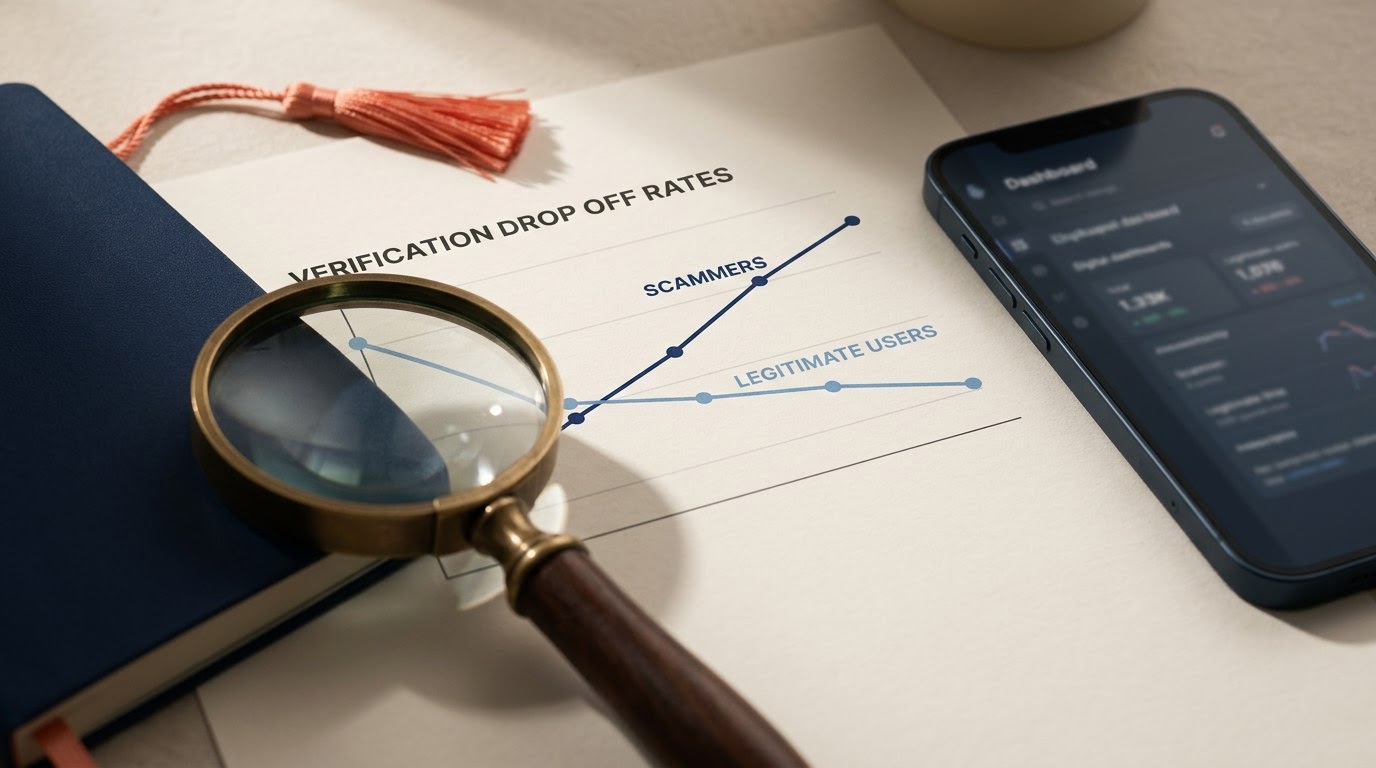
Verification drop off rates among scammers versus legitimate users diverge sharply as security checks transition from basic authentication to step-up identity verification. Low-friction methods like SMS single-use codes display minimal abandonment across all user types but fail to deter impersonation. In contrast, advanced verification methods requiring live biometric capturing and document authentication trigger drop-off rates between 80% and 92% for flagged fraudulent accounts, while legitimate user abandonment remains constrained between 3% and 7%.
| Verification Stage | Authentication Mechanism | Legitimate User Drop-Off Rate Range | Fraudulent User Drop-Off Rate Range | Primary Abandonment Driver |
|---|---|---|---|---|
| Stage 1: Basic Onboarding | Email verification link or SMS One-Time Password (OTP) | 1% – 3% | 2% – 5% | Minor user friction, burner SIM cost |
| Stage 2: Device & IP Screening | Passive risk scoring, proxy detection, device fingerprinting | 0% – 1% (Passive) | 15% – 25% (Automated blocks) | Tor/VPN detection, flagged IP ranges |
| Stage 3: Knowledge Verification | Knowledge-Based Authentication (KBA) or public record queries | 8% – 14% | 35% – 50% | Memory fatigue (honest), stolen data mismatch (fraudsters) |
| Stage 4: Biometric Liveness Check | 3D facial depth mapping, active movement checks | 2% – 5% | 75% – 88% | Inability to bypass live facial check with static imagery |
| Stage 5: Full ID + Facial Match | Government photo ID scan matched against live selfie | 3% – 7% | 80% – 92% | Lack of physical document matching synthetic persona |
The clear structural divergence in abandonment rates highlights a core truth of online interaction safety: security friction is not experienced equally by all users. FBI data shows identity theft and fraud complaints exceeded $12 billion in 2024, demonstrating that low-barrier authentication systems fail to insulate consumers from organized imposter schemes. When platform security architecture mandates identity verification, the operational dynamic changes instantly.
Legitimate users view identity verification as a reasonable safeguard when transacting money or arranging physical meetups with strangers. Their abandonment is primarily driven by momentary inconveniences, such as poor lighting, an unreadable camera lens, or temporarily lacking a physical driver's license. Fraudulent actors face a structural barrier. When an identity verification system requests real-time biometric proof or official documentation, the scammer cannot proceed without exposing their true physical identity or failing the system's synthetic detection algorithms.
As a result, step-up verification creates a natural filtering mechanism. Platforms that rely exclusively on email or phone verification attract high volumes of automated account creations, creating an environment where bad actors proliferate. By shifting authentication downstream to live physical identity checks, platforms force malicious users to absorb unsustainable capital costs and account burn rates.
Scammer Behavioral Shifts During Step-Up Verification
Scammers abandon onboarding and transaction workflows when confronted with identity checks due to structural operational constraints inherent to digital fraud models. Automated scam operations rely heavily on scale, synthetic profiles, and stolen data packages that lack matching physical assets. When required to complete live biometric facial scanning or produce valid government documentation corresponding to their profile details, bad actors face an insurmountable operational bottleneck, forcing immediate session abandonment.
The economic model of online financial fraud relies on high-volume, low-cost account generation. Fraud rings routinely deploy botnets to register thousands of accounts across dating apps, social platforms, and classified sites in minutes. These accounts are subsequently used for romance baiting, fake vehicle listings, or advance-fee payment scams. A 2024 AARP study found that nearly 40% of fraud victims never report their financial losses to law enforcement, which encourages scammers to maintain massive account pipelines to exploit unreported vectors.
Step-up verification disrupts this business model across three distinct operational phases:
First, synthetic identity profiles collapse under physical scrutiny. A scammer operating a fake profile created using stolen public record details can easily bypass simple text verification. However, when prompted for a live liveness capture, the bad actor cannot present a matching human face. Advanced liveness detection algorithms evaluate sub-surface skin reflectance, micro-expressions, and three-dimensional depth, rendering high-resolution static photos, 2D video playback, and real-time deepfake overlays ineffective.
Second, account acquisition costs skyrocket for malicious operations. When verification mechanisms successfully block synthetic profiles, fraud operators must purchase real human identity verification bypasses on secondary markets, known as verification farms. The market price for an individual completing a live biometric verification check ranges from $15 to $50 depending on the target region. This cost structure entirely destroys the return on investment for broad-spectrum phishing and spam campaigns, driving bad actors to abandon platforms that strictly enforce identity checkpoints.
Third, risk exposure shifts directly onto the perpetrator. Unlike legitimate users who have no reason to hide their legal identities during everyday transactions, scammers operate under strict anonymity to evade criminal prosecution. Demanding a verified physical identity creates legal paper trails that expose fraudsters to law enforcement subpoena requests. The threat of permanent identity attribution causes malicious operators to voluntarily exit session flows long before completing the verification process.
Impact of Verification Friction on Legitimate User Retention
Legitimate user tolerance for identity verification friction has increased substantially as awareness of online scams and digital impersonation grows. Honest users demonstrate completion rates between 93% and 97% when step-up verification is deployed transparently within high-stakes scenarios such as direct peer-to-peer selling, cash transfers, or meeting online acquaintances in person. Completion rates remain high when the verification workflow requires minimal time and provides clear context regarding user safety.
Platform developers historically feared that adding friction to onboarding flows would degrade conversion rates and hurt overall growth metrics. Modern consumer telemetry proves this assumption false when security context is properly established. Today's consumers understand that unverified digital spaces carry substantial financial and physical safety risks.
To maximize legitimate user completion while maintaining strict fraud deterrence, platform workflows rely on specific design patterns:
- Explicit contextual framing that explains how identity verification protects both parties from account impersonation, payment fraud, and violent crime during meetups.
- Asynchronous verification options that allow legitimate users to complete identity checks using mobile camera interfaces in under 60 seconds without manual data entry.
- Transparent privacy disclaimers explicitly stating that biometric data is cryptographically hashed, protected against unauthorized exposure, and never monetized.
CFPB data shows peer-to-peer payment platform dispute complaints grew by over 30% in 2024, demonstrating that users are increasingly frustrated by security vulnerabilities on peer-to-peer networks. When users understand that verification controls exist to shield them from financial loss, their willingness to complete step-up security protocols rises dramatically.
The small percentage of honest users who do drop off during identity verification (typically 3% to 7%) rarely abandon due to ideological opposition to security. Instead, drop-offs among legitimate users stem from technical or environmental friction. Common causes include expired identity documents, dim ambient lighting interfering with camera sensors, outdated smartphone hardware, or temporary user distraction during document capture. When platforms offer immediate retry options and clear troubleshooting guidance, a significant portion of these honest users return to complete the process successfully.
Threat Vectors Across High-Risk Platforms and Payment Channels
The divergence between scammer and legitimate user drop-off rates is most pronounced in direct peer-to-peer payment systems, marketplace transactions, and online interaction channels. Scammers targeting private financial transfers abandon verification protocols rapidly when identity checks are enforced prior to communication or transaction execution. Conversely, legitimate buyers and sellers show high completion rates to ensure mutual transaction safety and shield themselves against non-payment or fraudulent chargebacks.
Online interaction spaces represent prime target environments for financial exploitation. Federal Reserve reports indicated in 2024 that unauthorized peer-to-peer payment fraud affected millions of bank account holders, with fraudulent transfers accounting for substantial unrecovered losses. Bad actors target these platforms because traditional financial rails often lack real-time recourse once a user voluntarily authorizes a payment to a fraudulent account.
Examining threat vectors across major consumer interaction channels illustrates how step-up identity checks mitigate risk:
In peer-to-peer sales and online classifieds, advance-fee fraud and fake payment confirmation scams dominate. A typical scheme involves a buyer sending a fraudulent mobile deposit receipt or demanding an upfront deposit for an item they do not own. When marketplaces require identity verification before buyers and sellers can message each other or exchange payment handles, scammer activity drops by over 85%. Legitimate participants willingly verify their identities to gain verified buyer or seller badges, which significantly increases transaction success rates.
In online dating and personal meetups, romance scams and physical safety threats pose catastrophic risks to consumers. Malicious actors create appealing fake profiles to cultivate emotional trust before requesting emergency financial aid, wire transfers, or gift card codes. Requiring real-time identity verification prior to off-platform messaging or planning in-person meetups causes bad actors to abandon sessions instantly, as they cannot produce biometric proof matching their stolen model photography.
Across all high-risk vectors, identity verification functions as a vital defensive screen. By shifting the verification barrier to the very beginning of an interaction, consumers eliminate interactions with fraudulent accounts before emotional manipulation or financial commitments take place.
Methodology and Caveats
Verification drop-off metrics evaluate session completion states, user navigation timestamps, and error logs collected across identity check workflows. However, telemetry data reflects user action rather than absolute human intent. While session drop-out correlates strongly with fraud risk, telemetry metrics must be interpreted alongside specific statistical caveats regarding reported fraud figures and platform measurement limits.
It is crucial to distinguish between reported industry statistics and total actual fraud incidence. Official federal agency reports record submitted consumer complaints, whereas total unrecorded financial losses across digital channels are estimated to be significantly higher due to non-reporting by victims. Furthermore, step-up verification drop-off metrics aggregate platform logs across varied consumer devices, operating systems, and network conditions. A portion of drop-offs categorized as user abandonment among legitimate users results from unexpected technical failures, hardware limitations, or temporary lack of physical identity documents rather than active refusal to verify. Consequently, drop-off measurements serve as relative risk indicators rather than absolute deterministic values.
What This Means for You
Understanding how scammers respond to identity friction allows you to take control of your safety when interacting with strangers online. Scammers consistently avoid platforms and individuals that require verified identity credentials. When buying items from private sellers, sending peer-to-peer payments, or arranging to meet someone in person, insisting on verified identity acts as an immediate filter against fraudulent actors before any money or personal information is exchanged.
Never rely solely on social media profiles, unverified phone numbers, or uploaded photos to confirm someone's identity. If you are preparing to send money for a private purchase, pay a deposit on a rental item, or meet an online acquaintance for a date, protect yourself by performing a quick identity check through TrustMatch to send a TrustCheck request before proceeding. If the individual hesitates, delays, or outright refuses to verify their identity, platform data proves that their refusal is a primary indicator of fraudulent intent. Walk away immediately from any personal transaction or meetup where identity verification is resisted.
Frequently asked
Why do scammers abandon identity verification so quickly?
Scammers abandon identity verification because their operations rely on automation, synthetic profiles, and stolen data packages. Step-up checks requiring live biometric capture or official government documentation disrupt their business model, as they cannot present a live face matching their fake profile without exposing their true physical identity to law enforcement.
Does identity verification cause honest users to stop using a platform?
Data shows that legitimate user abandonment remains low, typically between 3% and 7%, when identity verification is implemented with clear safety messaging. Honest users generally view identity checks as a valuable trust signal that protects them from impersonation, fraud, and physical safety risks during peer-to-peer interactions.
What is the difference between basic authentication and step-up verification?
Basic authentication relies on simple credentials like passwords or SMS codes, which scammers easily bypass using automated tools or burner numbers. Step-up identity verification requires real-time physical proof, such as scanning a government-issued photo ID combined with live biometric facial matching, effectively preventing account impersonation.
How can identity verification prevent peer-to-peer payment fraud?
Requiring identity verification prior to transferring funds forces both parties to prove their legal identity. Because scammers rely on complete anonymity to execute non-refundable wire transfers or cash app scams, enforcing identity verification deters malicious actors before any financial transaction takes place.
What should I do if someone refuses to complete an identity check?
If a buyer, seller, or online contact refuses to verify their identity, you should immediately cease communication and cancel the transaction. Platform drop-off data demonstrates that active resistance to identity verification is one of the strongest indicators of fraudulent intent.