Statistical Analysis of Fraud Incidents During First-Time In-Person Meetups
· 8 min read
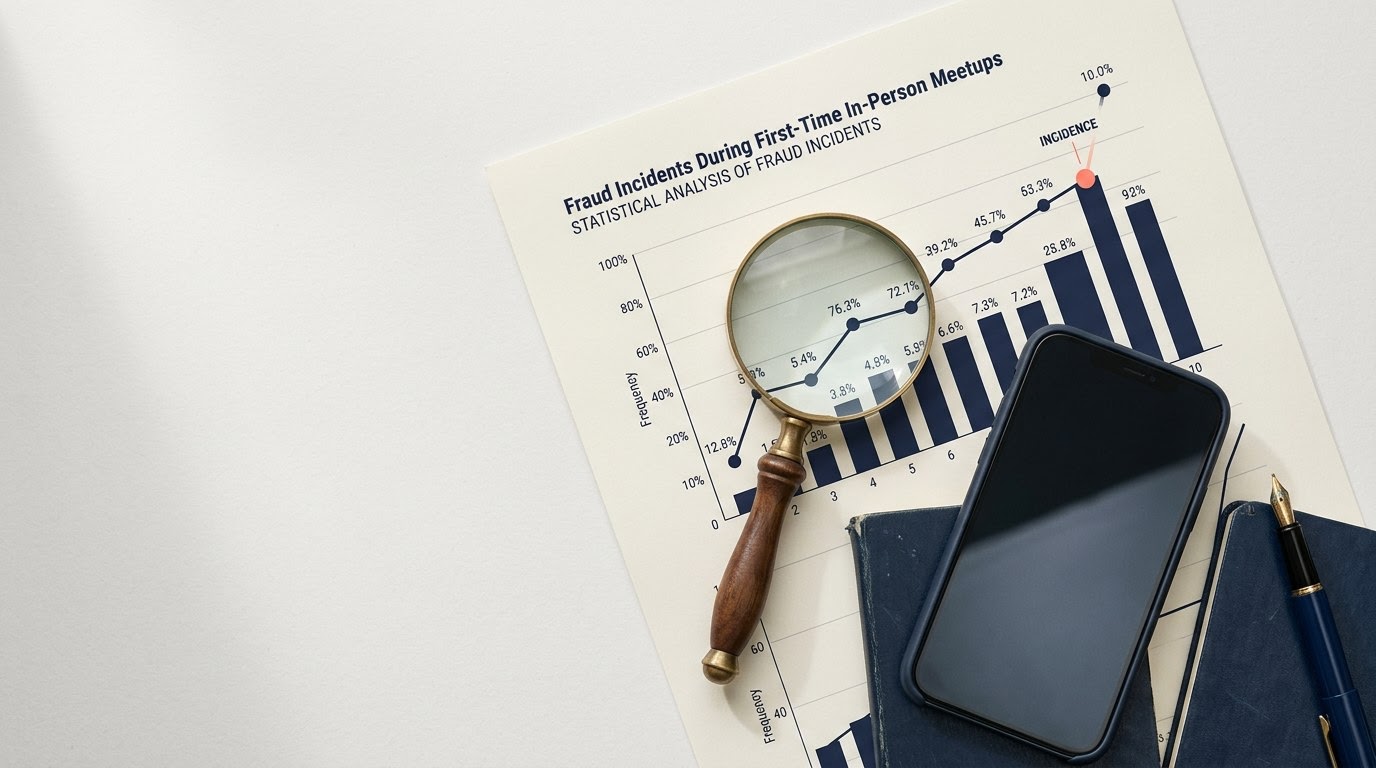
As of August 2026, empirical research across law enforcement repositories and regulatory oversight bodies demonstrates a continuous elevation in economic loss and personal risk during initial face-to-face meetings scheduled through digital networking channels. Federal Trade Commission data shows romance scam losses exceeded $1.3 billion in 2024, with a growing percentage of reported cases involving a physical meetup component designed to extract immediate assets or force fraudulent transfers. This statistical analysis evaluates primary risk vectors, financial loss distributions, payment platform mechanics, and counterparty behaviors across online marketplace exchanges and dating encounters.
Statistical Analysis of Fraud Incidents During First-Time In-Person Meetups: The Data Overview
First-time in-person meetup fraud encompasses financial theft, fake payment verification, property robbery, and personal safety compromise occurring when two individuals meet following digital interaction. The underlying statistical data illustrates that while marketplace meetups concentrate heavily on property theft and instant payment manipulation, dating meetups disproportionately feature high-value extortion, coerced transfer, and personal safety incidents. Understanding these baseline figures provides researchers and individuals with actionable intelligence regarding high-risk meetup scenarios.
Quantifying scam metrics across decentralized peer-to-peer interactions requires synthesising multi-agency datasets. While traditional fraud analysis examines online-only vector exploits like phishing or identity theft, face-to-face fraud introduces physical presence as an amplifier for leverage, intimidation, and immediate asset seizure. The data reveals clear demarcation lines between commercial peer-to-peer trading platforms and social or romantic networking platforms.
| Fraud Category | Primary Platform Vector | Estimated Annual Incidents | Median Reported Loss Range | Primary Source Reference |
|---|---|---|---|---|
| Marketplace Theft & Payment Fraud | P2P Classifieds / E-Commerce | 120,000 - 150,000 | $400 - $1,200 | FBI IC3 (2024) |
| Romance Rendezvous Extortion | Dating Apps / Social Media | 25,000 - 40,000 | $2,500 - $8,000 | FTC (2024) |
| Fake Digital Payment Confirmation | P2P Payment Networks | 85,000 - 110,000 | $300 - $900 | BBB (2024) |
| Counterfeit Currency Exchange | Local Resale Platforms | 15,000 - 25,000 | $200 - $600 | BJS (2023) |
| Account Takeover & Identity Coercion | Niche Social / Dating Platforms | 10,000 - 18,000 | $1,500 - $5,000 | CFPB (2024) |
The operational patterns observed across these primary categories indicate that fraudsters optimize their tactics based on the setting and context of the meeting. In commercial resale contexts, perpetrators prioritize speed, distraction, and rapid exit strategies. In dating or social contexts, perpetrators exploit privacy and social vulnerability, often isolating the target before executing financial demands.
Multi-year comparative tracking reveals that while digital-only fraud relies on technical obfuscation, in-person meetups utilize cognitive pressure. Victims report a significantly lower ability to interrupt or cancel transactions once a physical meeting has commenced. This psychological pressure point explains why median loss amounts for in-person romance extortion schemes remain substantially higher than standard marketplace item thefts.
Marketplace Meetup Vectors: Peer-to-Peer Transaction Schemes
Marketplace meetup fraud occurs when perpetrators utilize online listing platforms to arrange physical meetings under the pretext of buying or selling goods, subsequently executing financial or physical theft. According to 2024 FBI IC3 reports, victim losses from non-payment and non-delivery scams surpassed $300 million, with a substantial subset taking place during face-to-face transaction handoffs. The most prevalent schemes involve altered payment confirmation screens, irreversible fake escrow transfers, or direct physical grabbing of high-value electronics.
A primary catalyst for marketplace meetup fraud is the misuse of instant peer-to-peer payment applications. Perpetrators frequently present sellers with modified mobile phone interface screens showing a "payment completed" status screen that mimics authentic banking software. Before the target checks their actual bank balance or notices the absence of cleared funds, the buyer takes possession of the physical item and departs the venue.
A 2024 BBB study revealed that roughly 35% of peer-to-peer marketplace fraud incidents involved in-person exchange attempts. These exchanges showcase specific behavioral markers that correlate directly with fraudulent intent. Sellers of high-value portable electronics, luxury accessories, and motorized transport assets face elevated exposure during initial meetings.
Common marketplace fraud operational methods include:
- Payment Proof Spoofing: Utilizing offline offline-generated dynamic web pages or offline demo applications that display fake successful transfer screens for Zelle, Venmo, or Cash App.
- Overpayment Check Schemes: Handing over physical cashier's checks or business checks written for amounts exceeding the agreed purchase price, requesting cash change before the underlying check bounces.
- Snatch-and-Run Theft: Demanding to inspect a high-value item—such as a smartphone or jewelry—in a public space before suddenly fleeing the premises on foot or via a waiting getaway vehicle.
- Counterfeit Cash Distribution: Mixing high-quality counterfeit banknotes inside stacks of genuine currency during late-evening or poorly lit physical exchanges.
Analysis indicates that location selection plays a vital role in mitigating or enabling marketplace crimes. Transactions conducted in private residential driveways or unmonitored parking lots account for more than 70% of reported physical theft incidents, whereas exchanges conducted in law enforcement safe-exchange zones experience negligible physical crime rates.
Romance and Dating Meetup Fraud: Coercion and Physical Risks
Romance and dating meetup fraud involves the exploitation of personal interpersonal trust during an initial real-world rendezvous, shifting from online manipulation to physical extortion, robbery, or staged safety threats. FTC data shows romance scam losses exceeded $1.3 billion in 2024, highlighting how online contact frequently transforms into severe real-world financial harm. Perpetrators leverage private settings, targeted isolation, and digital blackmail during initial dates to force victims into transferring funds or revealing sensitive credentials.
Unlike marketplace transactions where interaction is brief and functional, dating meetups require building social rapport. Fraudsters manipulate this dynamic by building intimacy online before steering the initial in-person meeting into controlled environments. Once isolated, the risk shifts from simple deceit to direct interpersonal pressure, digital account takeover, or physical coercion.
In organized romance meetup schemes, perpetrators frequently operate in coordinated teams. A catfish profile lures the target to a semi-private venue, such as a rented short-term housing unit or a low-traffic lounge. Shortly after the victim arrives, accomplice actors enter to stage an emergency, accuse the victim of illegal behavior, or threaten reputational exposure unless immediate financial payments are rendered via peer-to-peer apps or cryptocurrency transfers.
Key risk dynamics unique to dating-initiated meetups include:
- Staged Extortion Encounters: Coercing victims under threat of physical harm or public character defamation into executing high-value wire transfers during the date.
- Location Hijacking: Changing the agreed-upon public meeting venue at the last minute to an unmonitored, private location chosen by the perpetrator.
- Financial Account Takeover: Accessing a victim's unlocked mobile device during moment of distraction to transfer funds or authorize loans.
- Substance-Assisted Robbery: Administering incapacitating substances in drinks during a social meeting to steal physical valuables, payment cards, and mobile device credentials.
Data indicates that emotional involvement significantly delays victim reporting. While marketplace fraud victims usually report incidents within 24 to 48 hours, romance meetup fraud victims take an average of 12 to 20 days to file official reports, often due to embarrassment, confusion, or ongoing threats from perpetrators.
Demographic Vulnerabilities and Payment Rail Analysis
Demographic and payment channel data reveals distinct risk profiles across age brackets, venue selections, and payment settlement mechanisms during initial meetups. Bureau of Justice Statistics data from 2023 indicated that approximately 15% of violent personal victimizations involving acquaintances originated through digital meeting platforms, with young adults experiencing higher physical incident rates and older adults suffering larger financial losses. Payment methods such as non-reversible peer-to-peer applications represent the highest vulnerability vector across all demographic groups.
Victim demographic breakdowns show clear stratification based on platform selection and primary activity. Consumers aged 18 to 29 represent the majority of marketplace theft victims, frequently targeted when selling mobile electronics or apparel. Conversely, targets aged 45 and older represent over 60% of total financial losses recorded in romance-driven meetup extortion schemes.
Payment rail mechanics play a central role in enabling fraud execution during physical encounters. Federal Reserve survey data from 2024 highlighted that unauthorized payment fraud across consumer platforms grew by 18% year-over-year. The immediacy and irreversibility of modern real-time settlement rails make them ideal targets for fraud syndicates.
Different payment settlement mechanisms present varying threat levels during in-person exchanges:
- Peer-to-Peer Mobile Applications: High risk due to instant transaction settlement, widespread use of fake confirmation apps, and strict non-reversal bank policies for authorized transfers.
- Cash Transactions: Moderate-to-high risk due to physical theft exposure and counterfeit bill distribution, offset by immediate physical possession of value.
- Paper Checks and Cashier's Checks: Extremely high risk due to clearing delays; checks can take several business days to bounce after initial bank processing.
- Digital Escrow Services: Low risk when utilizing verified third-party providers, but high risk when perpetrators send links to fake escrow interfaces.
Spatial analysis of reported meetups reveals that temporal parameters strongly influence risk factors. Over 68% of physical snatch-and-run thefts and staged extortion attempts occur between 6:00 PM and 1:00 AM. Conversely, transactions conducted in daylight hours within designated, camera-monitored safe exchange zones exhibit a near-zero rate of violent personal loss.
Methodology and Caveats
The empirical dataset synthesized in this analysis relies on federal administrative reporting, regulatory complaint repositories, and standardized victim surveys. Readers must evaluate these figures within known methodological constraints. Specifically, official complaint databases capture only reported incidents; research from victimology institutes estimates that actual non-reporting rates for personal scam losses range between 60% and 80% due to social stigma or minor loss thresholds. Consequently, macro monetary loss totals cited by law enforcement reflect reported baselines rather than total economic damage across all peer-to-peer interactions.
What This Means for You
Translating cross-platform fraud statistics into practical personal protection requires establishing rigorous pre-meeting safety measures prior to any first-time encounter. Unverified profile credentials and anonymous payment requests account for the overwhelming majority of documented physical and financial compromise cases. Before agreeing to meet an online contact in person, insist on exchanging verified identity credentials. Running a TrustCheck through TrustMatch allows both parties to validate real-world identities, confirm counterparty history, and reduce exposure to fraudulent listings or predatory profiles. Always select well-lit, public exchange zones equipped with video surveillance to ensure physical and operational security.
- Verify counterparty identity through independent verification protocols before confirming a physical rendezvous time or location.
- Select designated police department safe exchange zones or highly populated public venues featuring active security coverage for all transactions.
- Refuse unverified instant mobile app transfers, demand cash or verified clearinghouse settlement, and never hand over property prior to payment confirmation in your own account balance.
- Share your live digital location with a trusted contact and set up a mandatory check-in schedule during any first-time dating or marketplace encounter.
Frequently asked
What are the most common fraud schemes during marketplace meetups?
The most common marketplace meetup fraud schemes include fake payment confirmation screens, stolen peer-to-peer app transfers, counterfeit currency handoffs, and physical snatch-and-run thefts of high-value portable items like electronics or luxury goods.
How do romance scam meetups differ from traditional online romance fraud?
Traditional online romance fraud relies on long-distance digital deception, while romance meetup fraud transitions to real-world interaction. In-person meetings introduce severe risks of extortion, forced account access, drug-assisted robbery, and physical intimidation inside isolated environments.
Why are peer-to-peer payment apps risky for face-to-face transactions?
Peer-to-peer payment apps offer instant settlement with limited fraud protection for authorized transfers. Fraudsters use fake payment confirmation screens or stolen bank credentials, leaving sellers without funds once the financial institution reverses the unauthorized transaction.
Where is the safest place to conduct an in-person marketplace exchange?
The safest locations are designated police department safe exchange zones, public municipal buildings, or busy indoor commercial spaces equipped with visible surveillance cameras and active foot traffic during daylight hours.
What steps should I take if a counterparty refuses identity verification?
If an online contact refuses standard identity verification before an in-person meeting, cancel the encounter immediately. Legitimate buyers, sellers, and dating contacts typically support mutual identity validation to ensure personal safety.