How Counterfeit Luxury Watch Papers Scam Peer Buyers
· 10 min read
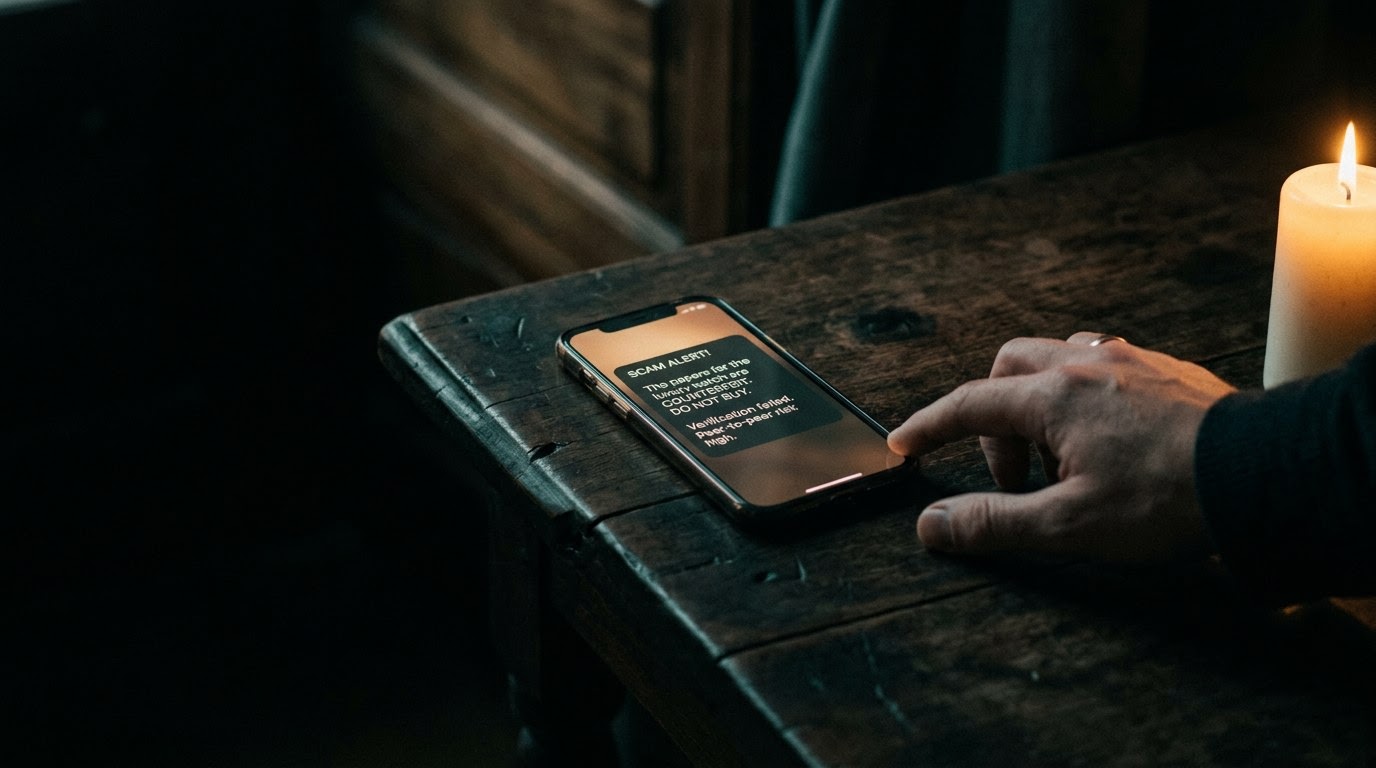
The counterfeit luxury watch papers scam targets peer buyers looking to purchase high-end timepieces like Rolex, Patek Philippe, or Audemars Piguet directly from secondary market sellers. Losses in these peer swaps typically range from $8,000 to over $45,000 per transaction, as buyers assume they are acquiring an authentic investment-grade watch supported by original box and papers. FTC reports from 2024 show that consumer losses to online marketplace imposter scams and counterfeit merchandise exceeded $2.7 billion. As of August 2026, fraudsters are increasingly exploiting advanced manufacturing technology to produce near-identical super-clone timepieces alongside cloned warranty cards, font-accurate booklets, and serialized hangtags to deceive even vigilant buyers.
How the Counterfeit Luxury Watch Papers Scam Unfolds
The counterfeit luxury watch papers scam unfolds as a multi-stage process where a scammer presents a high-grade fake watch accompanied by forged authentication documents to deceive peer buyers during face-to-face transactions. By mimicking official manufacturer packaging, serial number cards, and green guarantee tags, the fraudster systematically removes buyer hesitation. The target focuses on verifying that the serial number on the watch case matches the physical warranty card, mistakenly believing that matching paperwork guarantees the watch itself is genuine.
The secondary market for luxury timepieces relies heavily on complete sets, colloquially referred to as "box and papers." Complete sets command significant financial premiums over "watch-only" listings because original papers historically proved provenance, authorization, and legitimized ownership history. However, organized counterfeiting networks now produce high-end counterfeit papers alongside "super-clone" replica watches. These clones replicate mechanical movement weight, dial typography, casing geometry, and sapphire crystal anti-reflective coatings to within fractions of a millimeter. When combined with authentic-feeling presentation boxes, outer cardboard sleeves, green seal tags, and cloned guarantee cards, even experienced watch enthusiasts can be lulled into a false sense of security during a rushed face-to-face meeting.
To successfully execute this scheme, fraudsters follow a calculated playbook designed to limit the buyer's inspection time while maximizing emotional trust. A typical sequence unfolds through seven distinct operational phases:
- Listing the Asset on Peer Resale Channels - Scammers post listings for sought-after luxury references on peer-to-peer marketplaces, forum classifieds, and social trading groups. The listing price is set just below average market value—cheap enough to trigger buying urgency, but realistic enough to avoid immediate suspicion of fraud. High-resolution photos display impressive accessories, including authentic-looking guarantee cards, green serial hangtags, and presentation boxes.
- Fabricating Paperwork and Aligning Serial Numbers - Prior to creating the listing, the scammer orders a high-grade replica watch custom-etched with a specific serial number. Simultaneously, they procure a cloned warranty card printed with matching typography, correct country codes, and accurate authorized jeweler stamps. Some advanced counterfeit cards even contain programmed NFC tags or QR codes that redirect smartphone scanners to fraudulent manufacturer clone websites created by the scammer.
- Building Trust and Shifting to Unmonitored Channels - When prospective buyers make contact, the scammer provides additional photographs and videos showing the serial number on the watch case inner flange matching the serial number on the warranty card. The fraudster pushes to move communication away from platform messaging to private encrypted messaging apps, citing notification delays or platform fee avoidance.
- Scheduling a High-Pressure In-Person Swap - The fraudster insists on an in-person cash or instant wire transfer meeting, often framing it as a mutual safety precaution for both parties. They deliberately select busy, noisy venues, such as coffee shops, hotel lobbies, or parking garages, where dim lighting and active distractions make detailed physical examination difficult. They frequently claim tight travel schedules or competing cash offers to force a rapid transaction.
- Executing the Physical Swap and Visual Distraction - During the meeting, the seller hands over the complete box set first. They encourage the buyer to review the warranty card, instruction manuals, leather wallet, and green hangtag. This tactile distraction shifts the buyer's primary focus toward inspecting high-quality cardboard and plastic accessories rather than examining the internal mechanical movement of the watch under magnification.
- Confirming Irreversible Payment Transfer - Once the buyer verifies that the serial number etched inside the inner bezel matches the warranty card, they execute an irreversible bank wire, peer-to-peer digital payment, or cash handover. The scammer accepts the payment, verifies funds arrival on their mobile device, and quickly excuses themselves from the location under the pretext of an urgent commitment.
- Delayed Discovery at an Authorized Dealer - Days or weeks later, the buyer brings the watch to an authorized dealer or independent watchmaker for link sizing, servicing, or insurance valuation. The watchmaker removes the case back and reveals an Asian clone movement or misaligned balance bridge. By the time the counterfeit is exposed, the seller's burner phone number, social profiles, and payment handles have been deleted.
Stage Breakdown: Scammer Tactics vs. Reality
Understanding the difference between a scammer's verbal reassurances and the technical reality of counterfeit luxury watch papers requires analyzing each stage of the transaction. Fraudsters rely heavily on social engineering, tactical distraction, and physical paper accessories to obscure the fact that the underlying watch is a clone. The following breakdown compares common scammer claims against the actual mechanics of modern watch forgery.
By comparing the fraudster's pitch directly to the underlying reality of high-end counterfeiting, buyers can identify manipulation attempts before handing over cash or executing wire transfers:
| Stage of the Scam | What the Scammer Says | What's Actually Happening |
|---|---|---|
| Initial Listing | "Full set with original box and papers, priced low for a quick local sale before traveling." | The seller uses stock images of authentic accessories paired with a super-clone watch ordered from offshore replica factories. |
| Document Verification | "Look at the serial card and tag—the serial matches the rehaut perfectly, so you know it's 100% factory original." | The scammer custom-ordered a fake warranty card printed with the exact serial number laser-etched onto the counterfeit watch case. |
| NFC Tag Inspection | "Tap your phone on the warranty card; it loads the brand official warranty portal right here." | The embedded NFC chip directs the smartphone to a spoofed domain hosted by the scammer that displays a fake verification page. |
| In-Person Meeting | "I only have 15 minutes before my flight, so let's quickly count the cash and double-check the papers." | The fraudster creates artificial time pressure so you spend your limited time checking paper documents rather than technical movement details. |
| Payment Settlement | "Please send the payment via non-refundable wire or instant cash transfer so I can release the watch immediately." | The seller ensures funds cannot be reversed or recalled once you discover the timepiece is counterfeit after leaving the meeting. |
Who Gets Targeted and Why
Peer buyers targeted in counterfeit luxury watch paper scams are typically hobbyists, secondary market traders, and first-time luxury buyers seeking popular model references without waiting lists. Fraudsters exploit the buyer's strong emotional motivation to secure a rare timepiece below market value. This psychological hook relies on the false belief that physical box and paper accessories guarantee authenticity, causing buyers to lower their technical scrutiny during fast-paced in-person transactions.
Secondary market watch buyers often spend months researching specific reference numbers, market values, dial variations, and production years. Scammers understand this obsession and systematically exploit cognitive biases that affect even seasoned collectors. First, the fear of missing out (FOMO) leads buyers to overlook subtle procedural red flags when a highly desirable watch reference appears at an attractive price point. Second, buyers fall victim to confirmation bias: when they confirm that the serial number etched into the watch case matches the accompanying plastic warranty card, they mentally conclude that the watch is authentic and stop looking for mechanical flaws.
Organized criminal groups specifically target local peer-to-peer resale channels because platform security protections do not apply to off-platform cash transactions. According to 2024 FBI IC3 reports, fraudulent peer-to-peer transactions and online marketplace scams accounted for over $400 million in losses across retail merchandise categories. Counterfeiting operations invest heavily in replicating warranty cards because printing plastic cards costs pennies compared to the thousands of dollars gained in a successful fraudulent sale. Furthermore, peer buyers rarely possess specialized horological tools like loupes, timing machines (timegraphers), or case-back openers during an in-person exchange, making them ideal targets for paper-based deception.
How to Recognize It Before Money Moves
Recognizing a counterfeit luxury watch papers scam before transferring money requires shifting your focus from physical paperwork to independent technical verification and verified identity checks. Serial numbers on modern clone watches and counterfeit warranty cards match by design, making paper matching useless as an authenticity check. Evaluating the seller's verified identity and insisting on professional watchmaker authentication neutralizes the scammer's physical deception tactics entirely.
Before agreeing to meet a seller or transferring funds for a high-value watch, evaluate the transaction against these crucial questions:
- Does the paper document rely on unverified physical attributes? Modern counterfeit warranty cards feature UV light reactivities, precise fonts, and gold foil stamping that closely mirror original manufacturer cards. If you are relying on visual paper inspection alone, you are vulnerable. Genuine cards must be verified against official dealer databases or validated by an expert who understands paper grain and printing micro-dots.
- Is the digital warranty link leading to a third-party or unverified web domain? If the warranty card contains an NFC chip or QR code, examine the exact URL opened by your phone. Scammers register domains that mimic official brand websites (e.g., brandname-warranty-check.com instead of the brand's official corporate domain). Never trust a digital verification link provided on physical packaging.
- Is the seller refusing an authentication appointment at an established jeweler? A legitimate seller offering a $15,000 timepiece will readily agree to meet at an authorized dealer or reputable independent watchmaker for case-back removal and movement verification. If the seller insists that paper documents make a jeweler inspection unnecessary, walk away immediately.
- Have you confirmed the real-world identity of the person selling the watch? Anonymous social media profiles, disposable burner phone numbers, and newly created marketplace accounts are standard tools for counterfeit paper scammers. Running a TrustCheck early narrows the question to one thing: whether the details you were given describe a real, consistent identity. Plenty of scams are run by people using their own names, so treat the result as evidence about the details, not a verdict on the person.
- Is there extreme pressure to finalize payment via non-reversible methods? Scammers avoid payment methods with buyer protection, demanding cash, cryptocurrency, or direct wire transfers. If the seller rejects secure escrow services or safe transaction venues, they are actively attempting to prevent financial recourse.
If It Has Already Happened: Immediate Recovery and Reporting Steps
If you discover that you purchased a counterfeit luxury watch with fake papers, act immediately within the first 72 hours to maximize the chances of identifying the perpetrator and securing financial recovery. While retrieving cash from a private face-to-face swap is challenging, immediate documentation, police reports, and formal fraud filings build the legal paper trail necessary for law enforcement investigation and potential asset recovery.
Follow these immediate action steps if you have fallen victim to a luxury watch papers scam:
- Document All Evidence and Preserve Packaging - Keep the counterfeit watch, presentation box, forged warranty cards, hangtags, and outer packaging intact. Do not clean or modify any items. Take high-resolution photographs of all serial numbers, card fonts, NFC tags, and packaging details. Save all text messages, chat logs, listing screenshots, phone numbers, and bank transfer receipts.
- Obtain a Professional Horological Statement of Forgery - Take the watch to an authorized dealer or certified master watchmaker. Request a formal written assessment documenting that the movement, case, or warranty papers are non-authentic. This document is essential for police filings and insurance claims.
- File a Police Report with Local Law Enforcement - Contact the police department in the jurisdiction where the physical meetup occurred. Provide the written watchmaker assessment, seller communication records, physical descriptions, vehicle license plate numbers, and transaction details. Obtain an official police report number.
- Report the Fraud to Federal Authorities - Submit a detailed report to the Federal Trade Commission at reportfraud.ftc.gov. Additionally, file an internet crime complaint with the FBI Internet Crime Complaint Center at ic3.gov. Including all electronic communications, bank routing details, and fake domain URLs helps federal investigators link your case to broader counterfeiting rings. A 2024 BBB report noted that over 40% of victims who filed reports within 48 hours assisted law enforcement in tracking organized resale fraud rings.
- Run a Post-Incident Identity Check After the fact, a TrustCheck tells you only whether the contact details held together as one identity. That is context, not evidence, and investigators will not treat it as documentation. Report what happened to your bank and to the FTC at reportfraud.ftc.gov, and keep your own records of the messages and payments.
- Notify Payment Providers and Credit Institutions - If any portion of the payment involved a bank wire or digital transfer service, contact your financial institution's fraud department immediately. Request a wire recall or fraudulent transaction dispute. Place a fraud alert on your personal credit profiles if you shared sensitive personal identification during transaction negotiations.
Frequently asked
Can a watch warranty card's serial number match the watch and still be counterfeit?
Yes. Modern counterfeiters custom-order fake plastic warranty cards printed with the exact serial number laser-etched onto a clone watch case. A matching serial number only proves that the paper and watch were paired during production, not that either item originated from the genuine watchmaker.
How can I tell if a luxury watch warranty card is fake?
Inspect font sharpness under magnification, test micro-printing, and verify card weight against genuine references. Be cautious of NFC tags or QR codes that open non-official web domains. The only foolproof verification is cross-referencing the serial number with an authorized dealer or opening the case back.
Why do scammers insist on meeting in public places like coffee shops?
Scammers use public venues like coffee shops or lobbies because poor lighting, background noise, and public distractions prevent buyers from conducting a thorough technical inspection. Public places also make buyers feel secure, lowering their guard against fraudulent paperwork tricks.
Will an authorized watch dealer authenticate a watch for a peer-to-peer transaction?
Many authorized dealers will not issue formal written authentications due to liability reasons, but independent master watchmakers will gladly open the case back for an inspection fee. Insisting on a certified watchmaker inspection before handing over payment is the safest verification method.
Can bank wires or instant peer payment app transfers be recovered after a watch scam?
Reversing bank wires or peer payments after an in-person exchange is extremely difficult once funds settle. Contact your bank's fraud department within 24 hours to request a wire recall, file a police report, and report the transaction details to federal reporting agencies.
More in Scams
- How Fake Fine Wine Provenance Certificates Scam Peer Collectors
October 12, 2026
- How Fake Camera Lens Swap Scams Target Marketplace Buyers
October 10, 2026
- How Fake Exotic Car Rental Deposit Scams Target Vacationers
October 8, 2026