How Fake Driver License Requests Steal Private Seller Identities
· 10 min read
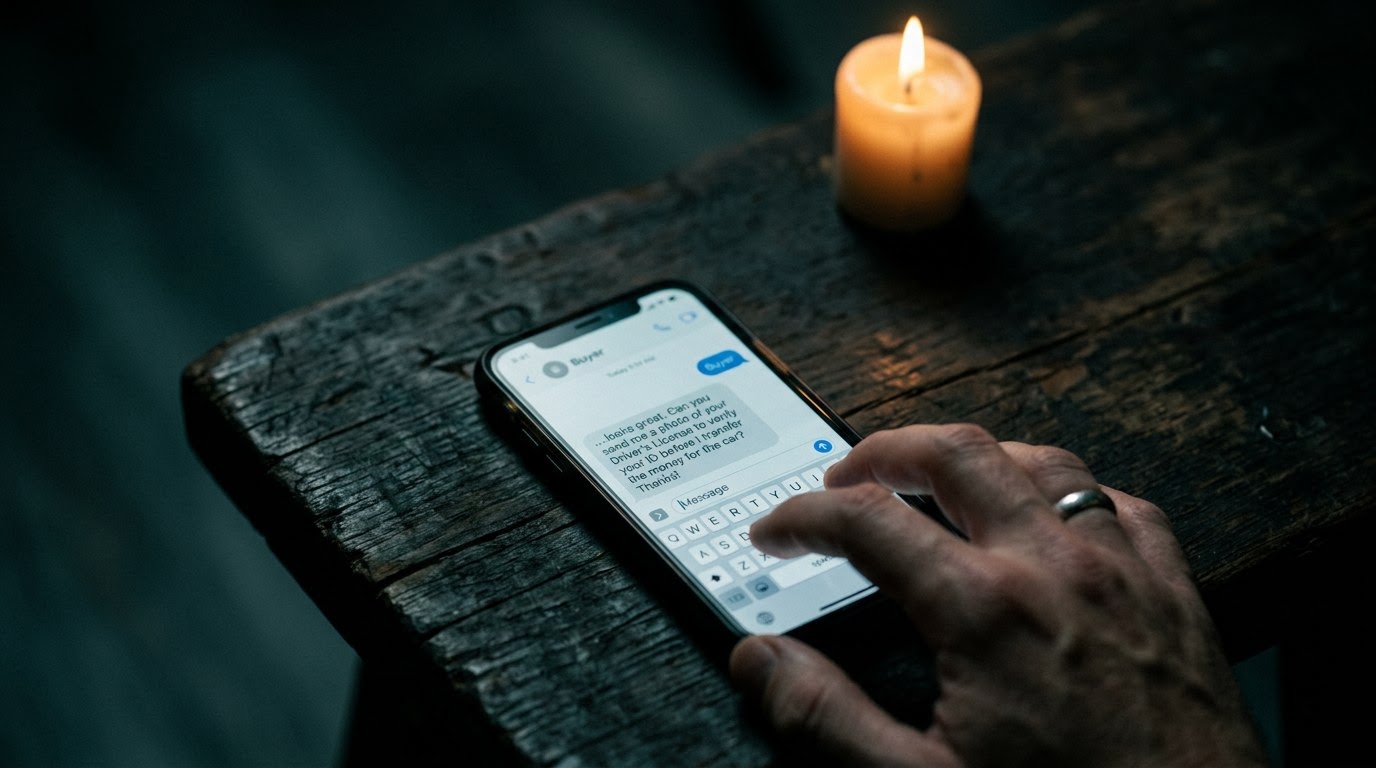
How Fake Driver License Requests Steal Private Seller Identities: Step-by-Step Playbook
Fake driver license requests steal private seller identities by tricking independent online sellers into surrendering high-resolution photos of their government IDs under the false premise of mutual safety. Scammers contact individuals selling electronics, furniture, or vehicles on peer-to-peer platforms and demand identity proof before completing payment. Once the seller transmits photos of their driver's license, the criminal harvests the document to construct stolen identity profiles, apply for fraudulent loans, and impersonate the victim in secondary scams across digital marketplaces.
To protect yourself, you must understand the exact sequence scammers use to manipulate targets. What begins as a routine inquiry about an item quickly pivots into an aggressive attempt to acquire clear photos of your official government documentation.
- The Target Listing and Immediate High-Value Contact: The scam begins when you list an item for sale on a peer-to-peer marketplace such as Craigslist, Facebook Marketplace, OfferUp, or eBay local classifieds. Scammers specifically seek out listings for high-value goods, such as smartphones, laptops, jewelry, or used vehicles. Within minutes of posting, you receive a message from an eager prospective buyer. The buyer agrees to your asking price without attempting to negotiate, offering to pay immediately via peer-to-peer payment applications or cash upon delivery.
- The Manufactured Trust Crisis: Shortly into the conversation, the buyer shifts the tone from businesslike to overly cautious. They express hesitation about completing the deal, claiming they were previously defrauded by an online seller. The scammer creates a plausible narrative: "I was scammed out of $500 last month on this platform by a fake seller, so my spouse insists that I verify the real identity of anyone I deal with before I send payment or drive over to meet you." This manipulates your empathy and sense of fairness, making you want to prove that you are an honest person.
- The Reciprocal Photo ID Trap: To make their request appear reasonable and fair, the scammer volunteers an unprompted image of a driver's license. They say, "Here is my driver's license so you know I'm real. Please send a photo of the front and back of yours so I know you're not a scammer." The ID the scammer sends does not belong to them; it is a stolen image harvested from a previous target. Because they appeared to expose their own private information first, psychological pressure compels you to reciprocate by sending photos of your own driver's license.
- Credential Escalation and Additional Requests: If you transmit the driver's license images, the scammer tests how much further they can push. They may request a "selfie holding the license next to your face" under the pretext of proving the document matches the seller. Alternatively, they may request your phone number to send a "verification code" to confirm your mobile carrier account. Once they capture your government identification photos, they abruptly stop answering questions about the item, cancel the pickup appointment, or claim their payment failed.
- Profile Fabrication and Synthetic Layering: With high-resolution images of your driver's license in hand, the scammer cataloging syndicate goes to work. They crop and edit your license photo, extracting your legal name, date of birth, document number, and residential address. They create new fake accounts across peer-to-peer selling networks, social channels, and financial platforms using your stolen name and driver's license image. They may also apply for fraudulent credit lines or bypass lower-tier identity checks on cryptocurrency exchanges.
- Weaponization Against Secondary Victims: In the final phase, the scammer uses your stolen driver's license to target other buyers and sellers. When a new victim asks the scammer for proof of identity, the criminal sends your driver's license photo. When those secondary victims are subsequently defrauded out of hundreds or thousands of dollars, all evidence points directly to you. You are left dealing with police reports, angry victims tracking down your home address, and compromised personal records.
Understanding how the scam unfolds at each operational milestone highlights the stark difference between what the scammer says and what is actually taking place behind the scenes.
| Stage of the Scam | What the Scammer Says | What's Actually Happening |
|---|---|---|
| First Contact | "I'm ready to buy this right now at your asking price. Can we meet today?" | The scammer targets your listing to establish fast rapport and prevent you from engaging with legitimate buyers. |
| Safety Pretext | "I got scammed last week, so I need to make sure you are a legitimate seller before I send a deposit." | The scammer manufactures a fake vulnerability story to exploit your empathy and lower your privacy defenses. |
| Reciprocal Exchange | "I'll send you a photo of my driver's license first so you know you can trust me. Send yours back." | The scammer sends a stolen ID from a previous victim to establish false credibility and force you into sending your real ID. |
| Document Harvesting | "Please make sure the driver's license photo is completely legible with no blurry text or missing corners." | The criminal requires high-resolution images so automated identity systems and future victims can read all personal details clearly. |
| Ghosting Phase | "My payment app is glitching, give me a few hours to fix it," followed by complete silence. | The scammer has secured your document photos and abandoned the purchase negotiation to begin harvesting new targets. |
| Secondary Exploitation | (Spoken to a new victim): "You can trust me, here is my state driver's license showing my full legal name." | Your stolen government identification is weaponized to defraud third parties, pinning criminal liability and financial loss onto you. |
Who Gets Targeted and Why
Private sellers on peer-to-peer platforms who list high-value items are the primary targets of driver license harvesting scams. Scammers exploit the seller's desire for a fast, hassle-free transaction combined with a natural instinct to appear trustworthy and cooperative. By weaponizing modern concerns about online safety, criminals manipulate well-meaning sellers into surrendering sensitive identity documentation without realizing they are handing over the keys to their digital identity.
The scam specifically singles out casual, independent sellers rather than established commercial merchants. Casual sellers who clear out home electronics, list personal vehicles, or re-sell household furniture usually lack formal transaction protocols. They are accustomed to informal messaging and are eager to complete sales quickly.
According to a 2024 BBB report, identity theft and marketplace fraud schemes targeting online transactions resulted in over $400 million in losses. Scammers focus heavily on private sellers because peer-to-peer platforms frequently warn users about scam artists. Fraudsters cleverly turn those platform warnings to their advantage: by bringing up "safety concerns" first, the scammer frames themselves as a vigilant, safety-conscious buyer while putting the seller on the defensive.
The primary psychological hook relies on the principle of reciprocity. When someone shares a personal, sensitive document—even if it is stolen—human psychology creates a strong social obligation to return the trust. When a buyer sends a photo of an ID, you feel rude or suspicious if you refuse to send yours in return. Scammers exploit this social polite habit to breach your personal privacy boundaries before you have time to analyze the risk.
How to Recognize It Before Money Moves
Recognizing a fake driver license request before money moves requires identifying specific operational red flags, such as unsolicited identity exchanges, high-pressure safety demands, and refusal to use secure in-app communication channels. Legitimate buyers evaluate the condition of an item rather than demanding unredacted government identification upfront. Spotting these patterns early allows sellers to halt interaction before sensitive credential images are exposed to identity theft syndicates.
To evaluate whether an inquiry is legitimate or a identity harvesting trap, ask yourself these diagnostic questions whenever a buyer contacts you:
- Is the buyer insisting on receiving personal identification documents before discussing basic details about the item or meetup spot? Legitimate buyers care about the condition of the item, pickup times, and payment methods. If their primary focus centers immediately on capturing your legal identity credentials, pause the transaction.
- Did the contact send an unsolicited photo of a driver's license without prompt? Normal buyers almost never send photographs of their government ID to random strangers on messaging apps. An unsolicited photo of an ID is almost always a stolen document used as psychological bait.
- Does the buyer demand a photo showing your face next to your ID card? Asking for facial verification selfies alongside official documentation is a classic marker of credential harvesting. Fraudsters use these specific image combinations to bypass biometric identity checks on financial exchanges.
- Are they refusing to communicate through official platform messaging channels? Scammers frequently request that you move off-platform to text messaging, WhatsApp, or email. They do this to avoid platform automated safety algorithms that detect credential harvesting keywords.
- Does the name on the provided driver's license fail to match the user profile or payment account? When a buyer provides an ID with one name, uses a messaging profile with a second name, and requests payment via an account with a third name, you are dealing with an impersonation chain.
Running a TrustCheck early narrows the question to one thing: whether the details you were given describe a real, consistent identity. Plenty of scams are run by people using their own names, so treat the result as evidence about the details, not a verdict on the person. Verifying the authenticity of a contact through safe, structured verification channels eliminates the need to expose raw driver's license photos to unvetted strangers online.
Never rely on a photo of an ID sent over a messaging app as proof of identity. Images can easily be edited, purchased on dark web forums, or stolen from previous marketplace sellers. If a buyer insists on identity proof before meeting, suggest meeting in person at a designated safe exchange location, such as a local police department parking lot or a well-lit public bank lobby. Scammers seeking to harvest identities will decline public meetups and disappear once they realize you will not send digital copies of your documentation.
If It's Already Happened
If you have already sent a photo of your driver's license to a suspected scammer, immediate self-protective action is required within the first 72 hours to minimize identity theft risks. Victims must document all communications, contact their local department of motor vehicles to report a compromised driver's license, file official fraud reports, and place fraud alerts on their credit files to block unauthorized credit applications.
Taking aggressive containment measures immediately limits the damage criminals can cause with your harvested information. Follow these recovery steps in order of priority:
- Document the Evidence: Take clear screenshots of all chat logs, phone numbers, email addresses, payment handle requests, and social profiles linked to the scammer. Save copies of the exact driver's license image they sent you, as this helps law enforcement connect your case to broader identity theft syndicates.
- Report to Federal Regulatory Bodies: File an official imposter scam and identity theft report with the Federal Trade Commission at reportfraud.ftc.gov. Additionally, submit a detailed report to the FBI Internet Crime Complaint Center at ic3.gov. An FBI IC3 report released in 2025 noted that internet-enabled identity fraud complaints reached an all-time high of over 880,000 reported incidents, making centralized reporting essential for law enforcement tracking.
- Notify Your State Department of Motor Vehicles: Contact your local state DMV or Bureau of Motor Vehicles (BMV) immediately to inform them that photos of your driver's license were compromised. Many states allow you to place an identity theft flag on your record or issue a replacement driver's license with a new document discriminator number to prevent unauthorized account creation.
- Freeze Your Credit Files: Place a formal credit freeze on your credit files at all three major credit bureaus: Experian, Equifax, and TransUnion. Freezing your credit prevents scammers from using your stolen driver's license and personal details to open fraudulent credit cards, personal loans, or mobile phone accounts in your name.
- Report the Profile and Alert Marketplace Platforms: File a fraud report directly with the peer-to-peer platform where the initial contact occurred. Inform support staff that a fraudulent user is harvesting driver's license images from sellers so they can terminate the bad actor's account.
After the fact, a TrustCheck tells you only whether the contact details held together as one identity. That is context, not evidence, and investigators will not treat it as documentation. Report what happened to your bank and to the FTC at reportfraud.ftc.gov, and keep your own records of the messages and payments. Taking quick verification measures helps protect both your financial assets and your identity from long-term exploitation across peer-to-peer networks.
Monitor your credit reports regularly over the following twelve months. Set up automated identity monitoring alerts and remain vigilant against secondary phishing attempts. Scammers who hold your driver's license details may attempt follow-up phishing schemes by posing as bank fraud departments or police officers investigating identity theft.
Frequently asked
Why do scammers want a photo of my driver's license?
Scammers capture high-resolution photos of driver's licenses to create synthetic identity profiles, bypass account identity checks, and impersonate you in future scams. Possessing a legitimate government ID photo allows fraudsters to build instant trust with secondary victims while shifting legal accountability for the fraud onto your name.
Can someone open bank accounts using just a photo of my driver's license?
Yes, criminals can use photos of your driver's license alongside harvested personal details to open fraudulent online bank accounts, apply for peer-to-peer loans, or set up synthetic line-of-credit accounts. Many online financial services utilize automated document scanning, which scammers bypass using clear photos of stolen IDs.
What should I do if a buyer sends me a photo of their driver's license first?
Never accept an unsolicited photo of a driver's license as proof of identity. Scammers routinely send stolen photos of previous victims to lower your guard. Do not reciprocate by sending your own identification. Insist on communicating through platform messaging and completing the transaction in a secure public meeting location.
How can I safely prove my identity to a buyer without sharing my driver's license?
You can prove your legitimacy by maintaining all messaging on the verified marketplace platform, pointing to your established account history and reviews, and offering to meet at a public safe-exchange zone, such as a local police station parking lot. Never email or text unredacted government documents to unvetted buyers.
Will my local DMV issue a new license number if my ID photo was stolen?
DMV policies vary by state, but most motor vehicle bureaus will place an identity fraud flag on your driver record upon receiving an official police or FTC report. While some states keep the same driver's license number, they can issue a replacement card with a new document system identifier to invalidate the stolen image.
More in Scams
- How Fake Fine Wine Provenance Certificates Scam Peer Collectors
October 12, 2026
- How Fake Camera Lens Swap Scams Target Marketplace Buyers
October 10, 2026
- How Fake Exotic Car Rental Deposit Scams Target Vacationers
October 8, 2026