How to Safely Rent Private Camping Land Directly From an Owner
· 9 min read
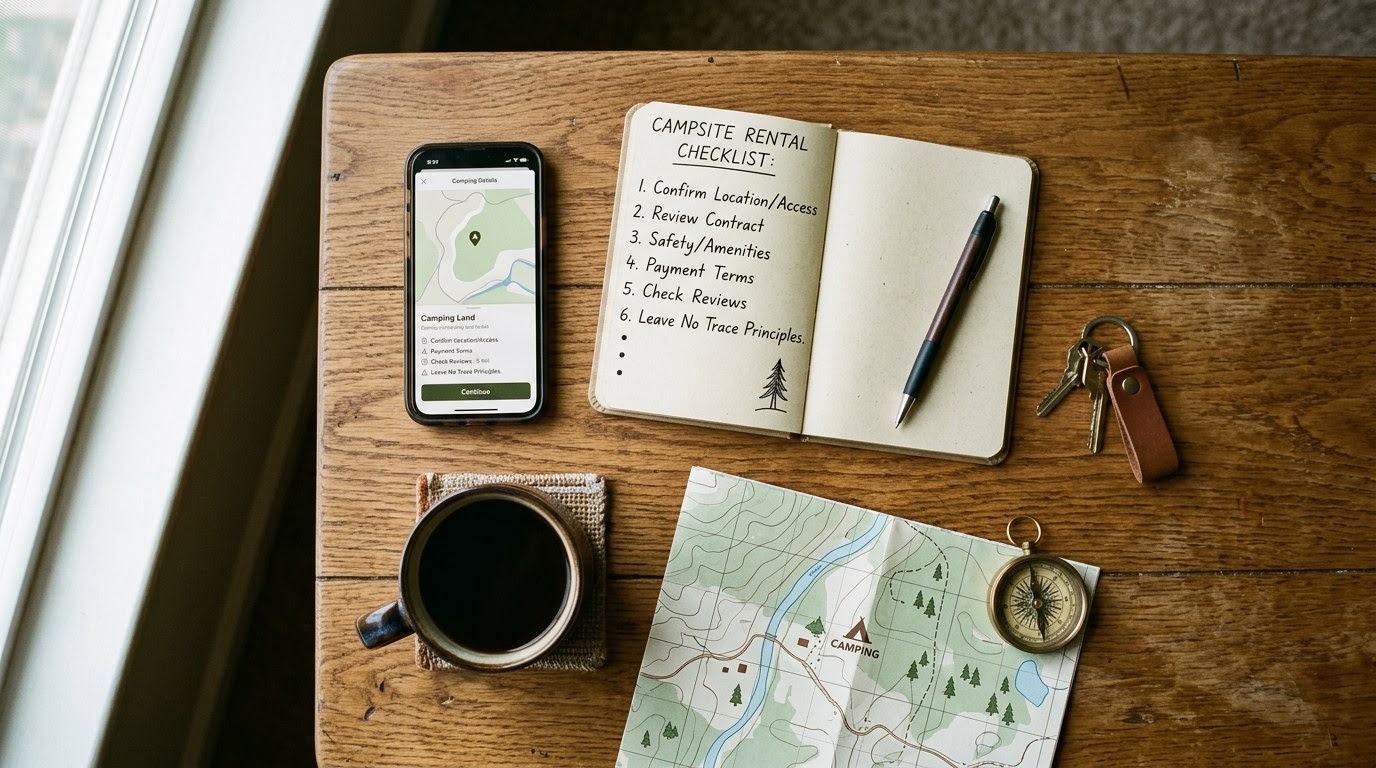
Use this playbook when booking private acreage, dry-camping land, or off-grid sites directly from individual property owners outside regulated marketplace platforms. Verifying the owner's identity through TrustMatch protects your funds and physical safety before you travel to remote, unstaffed locations.
1. Run a TrustCheck on the landowner
To run a TrustCheck on a private landowner, enter the individual's legal first name and primary phone number or email address into the TrustMatch platform. In under a minute, TrustMatch evaluates the information against validated public records and digital risk signals to produce a TrustScore and risk verdict. Successful verification confirms you are communicating with a real person whose contact details align with authentic identity records.
Direct transactions eliminate third-party service fees, but they also remove platform safety nets. Scammers frequently scrape imagery from legitimate real estate listings or remote parcel sales and post them on social media classifieds. When you express interest in a private campsite, ask the host for their full legal name and primary mobile number. Explain that you perform standard identity verification on all direct bookings to ensure mutual safety.
Input these details into the TrustMatch dashboard. The system evaluates data consistency, carrier information, phone line type, and risk indicators associated with the provided contact information. A high TrustScore indicates that the seller uses an established, verifiable communication line connected to a real identity. If the system flags disposable VoIP numbers, unverified email accounts, or recent high-risk activity, hold off on transferring funds until you complete secondary verification checks.
2. Verify parcel ownership using county GIS maps
To verify parcel ownership, search the official county tax assessor or GIS map portal for the jurisdiction where the campsite is located using the address or parcel identification number. Cross-reference the deed owner's legal name against the name provided by the host. Successful verification shows an exact match between the public property tax records and the identity of the person claiming rental rights.
Every piece of land in North America is indexed by local county government entities. Request the exact parcel identification number (PIN) or physical street address from the landowner. Access the county's public geographic information system (GIS) mapping tool, which is freely accessible online in almost all jurisdictions. Search the parcel number to view the property boundaries, official owner name, tax billing status, and land classification.
If the owner name listed in public record does not match the name given by your prospective host, ask for documentation clarifying their relationship to the legal entity or owner. Property management representatives, leaseholders, or family members operating on behalf of an owner must produce formal documentation proving authorization. If the seller claims to own the land but tax records show an unrelated private individual or corporate entity without proof of agency, terminate communications immediately.
3. Evaluate remote campsite photos with satellite and image analysis
To evaluate remote campsite photos, perform reverse image searches on all listing pictures and cross-check terrain features using satellite mapping software like Google Earth or Sentinel Hub. Look for distinctive topographic elements, tree cover, water bodies, and access roads that match the coordinates. Successful verification confirms the photos originate from the claimed location rather than copied real estate listings.
Fraudulent land listings rely heavily on stolen photography. Save the images provided in the listing or direct messages and run them through reverse image tools such as Google Lens or Tineye. According to a 2024 AARP study, over 40% of fraudulent rental listings utilized photos stolen directly from legitimate real estate databases. If the search returns active property sale listings or travel blogs located in a completely different county or state, the offer is fraudulent.
Open satellite mapping applications to evaluate the claimed site layout against public aerial photography. Pinpoint specific markers shown in the seller's photos, such as clearing shapes, tree line breaks, dirt access drives, or adjacent creek beds. Cross-referencing current satellite layers confirms that the physical characteristics described by the host exist on the designated parcel, ensuring you do not arrive at an overgrown, inaccessible, or non-existent plot.
4. Request a live video walkthrough of the site and access road
To conduct a live video walkthrough, schedule a five-minute real-time video call with the landowner while they are physically on the property or demonstrating access controls. Ask the host to show the entry gate, road conditions, fire ring, and surrounding landmarks. Successful verification proves the seller has physical access to the land and that current ground conditions match the advertised listing.
Requesting a video interaction separates genuine private property owners from remote bad actors. Schedule a brief call using video platforms like FaceTime, WhatsApp, or Google Meet. If the owner resides near the property, ask them to conduct the call on-site. Have them walk from the access road onto the camping site, highlighting practical details like vehicle turnaround space, gate locks, and cleared tent pads.
If the owner lives far from the property and cannot visit in person, use the video call to review the parcel details together while they share their screen, or ask them to show key physical items like site security keys or gate combo hardware. A legitimate landowner who regularly hosts campers will comfortably answer real-time questions about local access roads, cell coverage quality, nearby water sources, and wildlife precautions. Hesitation, generic responses, or excuses to avoid video interaction signal an unacceptable risk profile.
5. Secure a written site-use agreement before transferring funds
To secure a written site-use agreement, draft a simple contract specifying the arrival date, departure date, total fee, exact GPS coordinates, land boundaries, permitted activities, and emergency protocols. Require both parties to sign digitally before sending payment. Successful verification provides a legally binding document detailing lease terms and clear liability boundaries for both parties.
Never send money based solely on informal direct messages or verbal agreements. A written site-use agreement protects both parties and establishes legal terms for temporary access to private land. The document does not need complex legal jargon, but it must clearly define the identities of both the owner and guest, exact check-in and check-out times, total costs, refund policies, and site rules.
Ensure the agreement includes specific clauses regarding campfire regulations, trash removal, noise limits, maximum vehicle allowances, and exact geographical boundaries where camping is permitted. Specify safety protocols, including contact information for nearby emergency services and local county sheriff departments. Utilize secure digital signature tools to execute the contract, retaining signed electronic copies for your records prior to issuing any payment.
6. Use payment methods that offer built-in buyer protection
To execute a safe payment, transfer funds exclusively through credit cards or trusted payment platforms that feature buyer purchase protection and fraud dispute procedures. Avoid wire transfers, cash apps, gift cards, or direct bank deposits. Successful payment processing leaves a clear paper trail and ensures you retain dispute rights if the property proves inaccessible or fraudulent.
Scammers operating fake land rentals prefer instantaneous, non-reversible payment methods. FTC data shows that peer-to-peer payment and imposter scam losses reached $1.3 billion in 2024. Furthermore, a 2025 BBB report revealed that 38% of victims who paid for unverified vacation or private land listings used unrecoverable peer-to-peer payment applications. Refuse any request to send funds via bank wire transfers, peer-to-peer cash applications, crypto assets, or prepaid merchant gift cards.
Pay using a major credit card or a secure payment system that allows transaction disputes for undelivered services. Request an itemized digital invoice that explicitly references the signed site-use agreement and property parcel ID. If a host insists that you send money through unprotected channels due to convenience or fees, offer to cover credit card processing surcharges. If they still decline, cancel the booking immediately.
7. Verification matrix for private land bookings
A structured verification matrix simplifies the step-by-step validation process when renting direct private land listings. Use this reference guide to match each verification task with its specific required document and identify immediate red flags. Successfully utilizing this matrix ensures no critical verification step is overlooked before committing funds or traveling to a remote campsite.
| Step | What to verify | Red flag if missing |
|---|---|---|
| Landowner identity | Full legal name, phone number, and verified TrustScore | VoIP phone line, refused identity check, or name mismatches |
| Property title | County GIS record and public tax assessor deed match | Unclear parcel boundaries or listed owner differs without agency proof |
| Listing media | Reverse image search and matching satellite terrain features | Photos found on active sale listings or distant real estate sites |
| Site access | Live video walkthrough or live verification of entry points | Excuses avoiding live video or vagueness regarding access keys |
| Legal agreement | Signed written site-use agreement with clear boundaries | Refusal to execute a written contract or unclear payment terms |
| Financial transfer | Credit card payment or protected invoice system | Demands for wire transfers, peer-to-peer cash apps, or gift cards |
8. Quick checklist for direct private land rentals
Following a standardized quick checklist guarantees that every critical safety, administrative, and logistical detail is addressed before you head into remote off-grid locations. Review each item sequentially during your preparation phase to confirm identity, land title validity, site safety, emergency communications, and financial protection. Completing this checklist minimizes unexpected surprises and ensures a smooth private camping experience.
- Input the landowner's legal name and mobile phone number into TrustMatch to establish identity authenticity.
- Search the local county GIS mapping system to confirm the host holds legal title or authorized agency over the parcel.
- Run reverse image searches on all listing photos and cross-reference geographic coordinates with satellite mapping software.
- Complete a live five-minute video call to inspect the campsite terrain, gate hardware, and vehicle access points.
- Execute a written site-use agreement detailing exact entry/exit times, boundary lines, fire safety rules, and fee totals.
- Pay the agreed balance using a credit card or protected payment processor with explicit fraud protection rights.
- Confirm gate access codes, key box locations, and local emergency contact protocols 24 hours prior to departure.
9. Red flags during this process
If suspicious signals or high-risk behaviors occur during the booking routine, pause all financial transactions immediately and re-evaluate the interaction. Red flags include high pressure for quick payment, sudden claims of alternative buyers, refusal to provide precise parcel numbers, or requests for non-standard payment methods. Taking swift protective action prevents financial fraud and avoids arriving at a restricted or non-existent remote property.
Be alert to pressure tactics. Scammers often claim multiple campers are waiting to send deposits for the exact same dates, attempting to rush you past safety checks. Never skip parcel title checks or identity validation under time pressure. A legitimate landowner values clear communication and responsible guests over a rushed transaction.
Pay attention to sudden changes in payment instructions or host contact information. If a host suddenly provides a different bank account name, asks you to send money to a third party, or changes their phone number mid-conversation, stop all interaction. Re-run identity verification on any new information provided. If the details do not resolve cleanly, report the listing on the host platform or social channel and select an alternative campsite.
As of September 2026, direct land rentals offer exceptional outdoor opportunities, but they require systematic safety checks. Executing these verification steps protects your financial investment and personal safety while maintaining a respectful, transparent relationship with legitimate landowners. TrustMatch simplifies this process by providing fast, objective identity verification so both parties can proceed with complete confidence.
Frequently asked
How do I know if a landowner legitimately owns the private campsite?
Cross-reference the landowner's legal name with the official county tax assessor or GIS parcel map records. Match the property address or parcel identification number with public deed databases. Running an identity verification check ensures the person offering the rental matches the recorded property owner rather than an unauthorized third party.
What should I do if a host refuses a video call walkthrough?
Treat any refusal of a live video call as a serious warning sign. Legitimate hosts willing to rent private land direct to consumers understand the need to establish trust and clarify property access. Suggest alternative times, but if the owner consistently declines to show the property live, terminate the transaction immediately.
Are payment apps like Venmo or Zelle safe for direct land rentals?
Peer-to-peer payment applications lack buyer purchase protection for direct land rentals and treats payments like cash. If you encounter a fake listing or access issues, funds sent via these apps are generally unrecoverable. Always pay using a credit card or secure platform that supports formal fraud dispute processes.
How can I verify GPS coordinates before driving to a remote site?
Input the provided GPS coordinates into satellite mapping software like Google Maps or Gaia GPS. Check high-resolution aerial views to confirm the road access, clearing, and physical terrain match the listing photos. Verify that the coordinates land within private property boundaries rather than public parks or protected reserves.
What essential terms should be included in a direct site-use agreement?
A private land rental agreement must specify exact stay dates, total payment, GPS coordinates, arrival procedures, property boundaries, campfire policies, waste disposal rules, and emergency contact details. Both you and the property owner must sign the document digitally to establish clear mutual expectations and legal protection before payment.