How to Safely Swap Homes With Someone Met Online
· 9 min read
1. Verify Your Swap Partner's Identity With TrustMatch
To verify your swap partner's identity using TrustMatch, enter their full name and primary phone number or email address into the search tool. TrustMatch checks whether the details you were given are linked to the same identity, generating a TrustScore and a clear verdict in under one minute. This step ensures the person communicating with you online actually owns the contact details provided and is not operating under an imposter profile or burner identity.
Do not rely on profile pictures, casual chat history, or positive comments in social media groups. Ask your prospective swap partner for their full legal name, primary mobile phone number, and personal email address. Open the TrustMatch tool on your mobile device or computer, input these details, and evaluate the risk assessment report immediately. A high TrustScore verifies that the digital footprint matches official owner records without compromising either party's sensitive personal banking details.
If your swap partner makes excuses, offers a temporary VoIP number, or refuses to provide basic contact details, treat it as a major security warning. FTC data from 2024 shows that imposter scams and online marketplace fraud resulted in over $10 billion in losses for consumers. Verifying identity upfront isolates bad actors before you disclose your private street address, alarm codes, or travel dates.
2. Schedule a Live Video Property Walkthrough
Schedule a live video call via Zoom, FaceTime, or WhatsApp to conduct a real-time walkthrough of both homes before confirming exchange dates. Require the host to walk through key rooms, show exterior street views, and address you by name during the stream. A live video tour verifies that the physical space matches online photos, proves the host has physical access to the property, and eliminates scammers who rely on stolen listing photos.
Treat this video walkthrough as a mutual safety requirement rather than an informal catch-up. Ask your swap partner to start the video stream outside near the street sign or house number. Compare the real-time video feed against Google Street View or satellite imagery to verify the physical structure and neighborhood layout. Have the host walk through the living areas, kitchen, bedrooms, and primary bathrooms while answering questions on camera.
Test the authenticity of the live stream by making simple, unexpected requests during the call. Ask the host to turn on a specific light fixture, open a kitchen drawer, or look out a specific window on camera. Scammers relying on pre-recorded video loops or stolen virtual tours will fail these interactive tests instantly. End communications if the person refuses to appear on camera or claims their camera is permanently broken.
3. Cross-Check Address Details and Local Public Records
Cross-check your swap partner's home address against local public land records, tax assessor databases, or utility bill documentation to confirm physical residence. Search county property records online using the street address to verify the owner's name matches your partner's verified legal identity. Confirming address ownership ensures you exchange homes with an authorized occupant rather than an unauthorized subtenant or a scammer attempting a vacant property takeover.
As of August 2026, county tax assessors and land registry offices across North America and Europe offer searchable public online databases. Search the provided property address in the local county recorder's directory to verify legal ownership. If your swap partner rents the property or lives in a condominium with strict rules, ask for documented proof that short-term guest exchanges are permitted by the building management or property owner.
Request a redacted copy of a recent utility bill or home internet statement showing the partner's name and property address. According to BBB findings from 2023, fake property listings and unauthorized subletting account for roughly 30% of home exchange disputes online. Verifying property rights protects you against unexpected lockouts, security interventions, or legal disputes during your stay.
4. Execute a Written Mutual Home Exchange Agreement
Draft and sign a written mutual home exchange agreement that explicitly states swap dates, house rules, liability terms, and emergency procedures. Outline specific conditions regarding guest limits, smoking policies, pet responsibilities, cleaning expectations, and utility usage caps. Executing a signed contract provides clear legal boundaries, confirms mutual accountability, and ensures both parties agree on property protocols before key transfers occur.
Avoid relying on verbal promises, informal messaging threads, or loose forum agreements. Draft a clear document that details exact arrival and departure times down to the hour. Specify who pays for routine utilities, who covers emergency repairs up to a defined dollar amount, and how non-refundable costs like professional cleaning services are allocated if damage occurs.
Use an electronic signature platform to send, sign, and archive the completed agreement. Require both parties to provide emergency contact phone numbers for local friends or family members who hold physical spare keys. Retain a digital copy of the signed contract on your smartphone and cloud storage so you can access property rules and emergency protocols at any point during your trip.
5. Secure Your Valuables and Sensitive Documents
Secure all personal documents, high-value electronics, financial records, and irreplaceable heirlooms inside a locked room or heavy fireproof safe prior to your swap partner's arrival. Remove passport books, birth certificates, credit card statements, and spare vehicle keys from drawers and closets. Protecting your personal data and physical property prevents identity theft, opportunistic looting, and unauthorized access to private files while you are away.
Conduct a room-by-room audit of your residence before leaving for the airport. Collect all private financial papers, tax filings, bank statements, checkbooks, and medical documents. Place these items inside a locked filing cabinet, safe deposit box, or locked storage closet that remains off-limits to your swap guest during their stay.
Password-protect all home desktop computers, smart TVs, router administration panels, and connected IoT devices. Log out of streaming platforms, online shopping accounts, and cloud storage systems on shared smart devices. Experian research published in 2024 revealed that physical document theft inside residential settings accounts for over 15% of identity theft cases. Storing sensitive paperwork securely protects your identity while hosting strangers.
6. Establish Key Collection Protocols and Emergency Contacts
Establish a secure key collection system using a smart lock code or a lockbox with a custom combination that you reset after every exchange. Provide your guest with a comprehensive home manual alongside a local emergency contact tree featuring a trusted neighbor or property manager. Setting up clear entry procedures and local support contacts guarantees your home remains secure and your guest can resolve unexpected issues quickly without disturbing your trip.
Never place physical keys under doormats, inside unlocked mailboxes, or hidden beneath fake garden rocks near the entryway. Install a commercial-grade lockbox on the property or use a smart door lock that supports temporary access codes. Issue a unique digital entry code to your guest that activates strictly at the agreed check-in hour and expires automatically upon departure.
Create a detailed physical or digital home guide covering circuit breaker locations, main water shut-off valves, trash collection schedules, and Wi-Fi access codes. Assign a trusted local neighbor or family member as your designated property contact while you are away. Provide this contact person with your guest's verified details so they can assist with lockouts, plumbing emergencies, or property questions.
Home Swap Verification Protocols
Review this protocol table to match each verification step with its critical security target and corresponding red flag. Verifying these checkpoints systematically protects your physical property and personal information throughout the entire exchange process.
| Step | What to verify | Red flag if missing |
|---|---|---|
| Identity Check | Legal name, primary mobile number, email, TrustScore verdict | VoIP burner numbers, refusal to share legal name, low TrustScore |
| Video Tour | Real-time property interior, exterior street views, host face match | Refusal to turn on camera, pre-recorded video, mismatched features |
| Property Ownership | Public tax records, utility statements, HOA compliance terms | Name missing from property registry, unwillingness to show utility bills |
| Exchange Agreement | Signed contract, arrival times, liability terms, house rules | Pushback against signing a written contract, insistence on verbal deals |
| Home Preparation | Valuables locked, financial papers removed, devices secured | Open filing cabinets, unlocked personal storage rooms, exposed records |
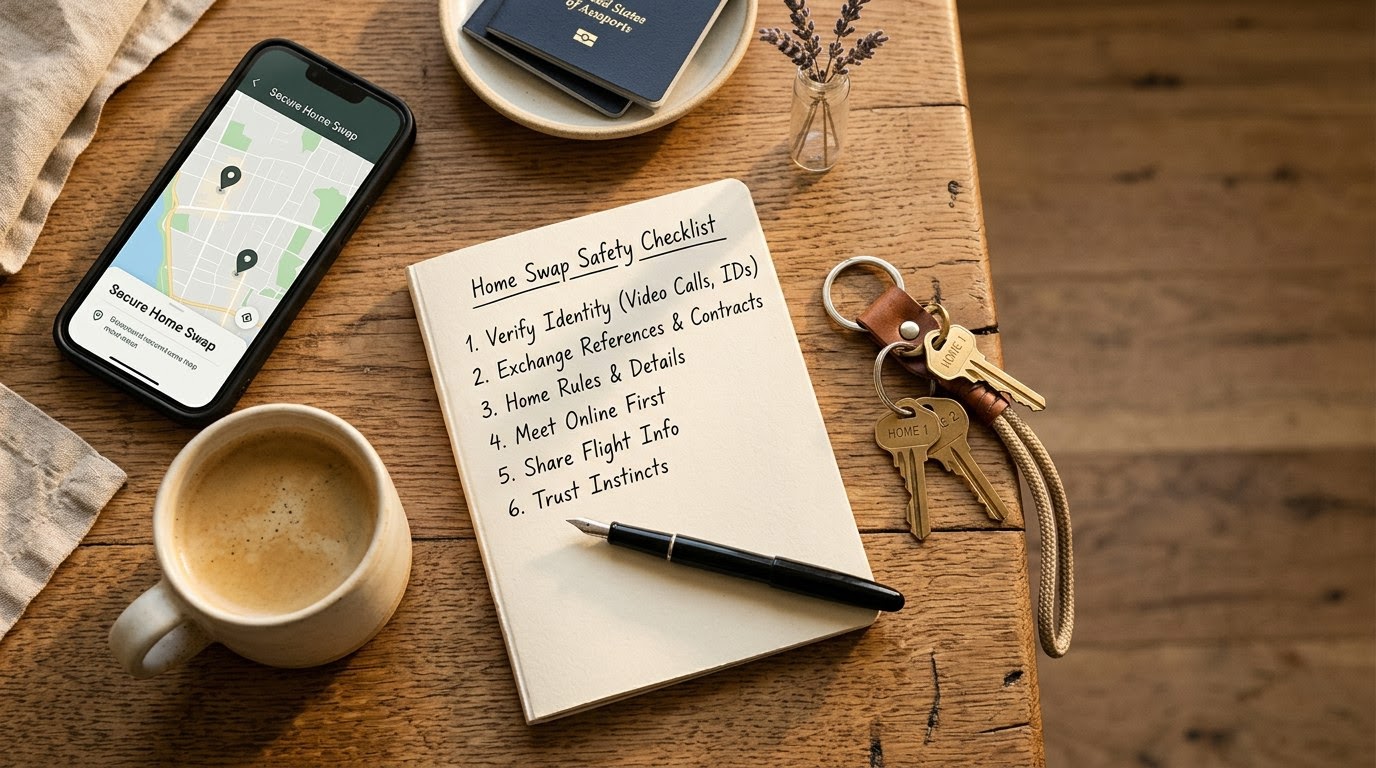
Quick Checklist for Safe Home Swapping
Follow this sequential checklist from initial contact to post-swap review to ensure complete safety when trading residences with someone met online. Complete each action item before advancing to the next stage of your agreement.
- Request the full legal name, phone number, and email address of your prospective home swap partner.
- Run a TrustMatch search using their contact details to confirm their digital identity and verify risk scores.
- Schedule a live interactive video call to tour both properties and verify real-time physical ownership.
- Check public land registry or tax assessor databases to confirm the host is authorized to occupy the residence.
- Draft, finalize, and electronically sign a non-rental mutual home exchange agreement detailing liability rules.
- Lock away all physical financial documents, passports, vehicle titles, spare keys, and high-value items in a secure safe.
- Set up a temporary lockbox code or smart lock access credential that activates on arrival day and expires on departure day.
- Brief a trusted neighbor or local contact and provide them with your swap partner's verified contact details.
Red Flags During This Process
Recognize warning signs during your communications to prevent property loss, financial fraud, or sudden cancellations. Abort the exchange immediately if your swap partner displays any of these problematic behaviors mid-routine.
Be alert if your swap partner pressures you to skip verification steps or hurry the agreement. Scammers frequently create artificial urgency by claiming they have alternative travel arrangements or urgent family matters that require immediate approval. If an individual pushes you to finalize key hand-offs before completing identity checks or video walkthroughs, pause the exchange process immediately.
Watch out for demands involving cash payments, security deposits paid via wire transfers, or gift card requests outside a structured arrangement. Genuine home exchanges operate on equal non-monetary reciprocity, where each party hosts the other without cash rental charges. Demands for upfront wire transfers under the guise of holding deposits or cleaning fees are classic indicators of rental listing scams.
Pay close attention to inconsistent details across communication channels. If the host's social media profile lists a different city than their stated home address, or if their live voice on phone calls does not match their claimed identity, step back. Terminate contact and report suspicious user profiles to the community platform or group administrators immediately if details fail to align.
These verification steps and TrustMatch checks are designed to protect your physical home and personal security while establishing mutual respect with a legitimate swap partner.Frequently asked
Why should I run an identity check before a home swap?
Running an identity check verifies that the person you met online is using their real legal name and authentic contact details. It prevents imposter scams, protects your real estate property from unauthorized occupants, and ensures clear legal accountability before exchanging home access codes.
Is a written agreement legally necessary for a free home swap?
Yes, a written agreement is essential even when no money changes hands. It formalizes house rules, establishes departure schedules, dictates liability for accidental property damage, and provides clear legal protection if disputes or unexpected emergency repairs arise while you are away.
How can I prove property ownership without sharing sensitive data?
You can prove property ownership by providing a copy of a utility bill or tax assessment with sensitive account numbers blacked out. Combining this document with public registry checks and a live video walkthrough confirms your host status safely.
What should I do if a swap partner refuses a live video call?
If a swap partner refuses a live video call, cancel the exchange immediately. Legitimate home exchangers welcome live walkthroughs to establish trust. Refusals typically indicate fake listing photos, pre-recorded media scams, or unverified individuals operating under false identities.
How do I secure physical keys for a peer-to-peer home swap?
Secure physical keys by using a heavy-duty mechanical lockbox or a smart keypad lock. Issue a unique entry code that activates strictly at check-in time and reset or revoke the access code immediately after your exchange guest departs.