How Fake Roommate Sublet Deposit Scams Target Local Apartment Hunters
· 10 min read
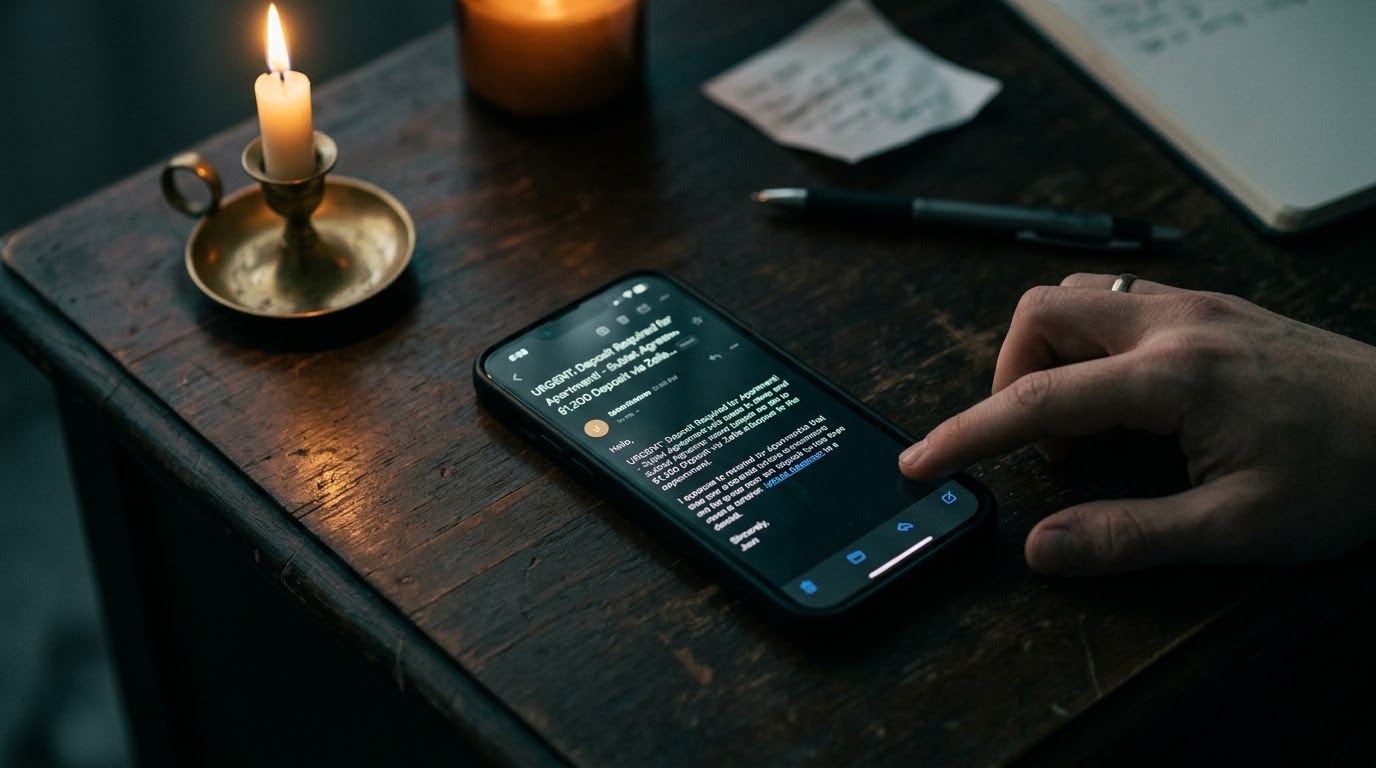
As of September 2026, finding an affordable room share in a dense urban rental market feels like a full-time job. Fake roommate sublet deposit scams exploit this pressure by creating convincing listings for apartments that the scammer does not own, lease, or have access to, draining initial security deposits and holding fees ranging from $500 to over $2,500. FTC reports from 2025 indicated that rental and real estate scams generated over $420 million in reported consumer losses across the United States. Fraudsters hijack authentic property photos, draft professional-looking rental contracts, and engineer artificial high-urgency timelines to trick apartment hunters into wiring cash before stepping foot inside the front door.
How Fake Roommate Sublet Deposit Scams Work Step by Step
Fake roommate sublet deposit scams follow a standardized playbook where scammers pose as leaseholders offering an urgent, below-market room share. The fraud begins with hijacked property photos on local online marketplaces, transitions to private messaging apps, and uses fake lease documents to demand immediate holding fees or security deposits via irreversible payment methods before a physical walkthrough ever occurs.
-
The Hijacked Listing and Below-Market Bait
The scam begins on popular digital message boards, social media groups, or classified sites. A fraudster posts an advertisement for a private bedroom in a high-end apartment complex located in a desirable neighborhood. The listing price is set roughly 20% to 30% below the local market median—cheap enough to generate immediate interest, but not so low that it triggers obvious alarm bells.
To create the listing, the scammer scrapes photos and descriptions from legitimate real estate sites, Airbnb listings, or past rental ads. A typical sequence involves posting pristine images of a sunlit living room, modern kitchen, and furnished bedroom. The text emphasizes that the current tenant needs someone to take over a room immediately due to a sudden job relocation or family emergency.
-
Shifting Communication Off-Platform
When an apartment hunter messages the listing account, the fraudster responds almost immediately. Within two or three messages, the scammer insists on moving the conversation off the marketplace platform and onto a private, unmonitored channel like WhatsApp, Signal, or personal SMS texting.
By removing the conversation from the host platform, the scammer bypasses automated moderation algorithms designed to detect suspicious links, duplicate image uploads, or blacklisted phone numbers. They may claim that they do not check marketplace notifications frequently or that their phone battery is low, directing the victim to text them directly at a provided phone number.
-
The Compelling "Out-of-Town" Backstory
Once private communication is established, the fraudster introduces an elaborate backstory explaining why an immediate in-person walkthrough is impossible. Common personas include a traveling nurse on a six-month deployment, a software contractor working overseas, a missionary, or an out-of-state military officer.
For example, a scammer posing as an out-of-town medical worker might explain that they left the city abruptly last week, taking the unit keys with them. They express extreme anxiety about paying double rent on an empty room and promise that if the target can prove their financial reliability, they will mail the keys via express courier or arrange for a building manager to let them in on move-in day.
-
The Fake Lease Agreement and Virtual Tour
To establish credibility and ease doubts, the scammer sends realistic documentation. They might share a pre-recorded video tour of the apartment—often stolen from a luxury building's public marketing page—or direct the victim to a real estate listing website to verify that the address exists.
Next, the scammer emails a custom-edited "Sublet and Room Share Agreement" in PDF format. The document includes official legal terminology, stolen landlord logos, and fields for personal details, signatures, and emergency contacts. Receiving a formal contract reassures the target that the transaction is legitimate, lowering their psychological defenses right before the financial demand is made.
-
The Urgent Security Deposit Demand
After the victim signs and returns the digital agreement, the scammer creates an artificial deadline. They state that three other candidates are currently competing for the room, but they prefer the victim's profile. To secure the room and initiate the key delivery process, the victim must send a "refundable holding deposit" or the first month's rent immediately.
The scammer explicitly requests payment through peer-to-peer mobile apps like Zelle, Venmo, Cash App, or Apple Cash, or asks for digital gift cards or wire transfers. They explain that bank transfers take too long and that funds must clear within two hours to hold the unit. If the victim hesitates, the scammer becomes pushy, claiming they will offer the room to the next person on the waiting list.
-
The Ghosting and Follow-Up Advance Fee Scams
Once the victim transfers the funds, the scammer executes one of two final moves. In a direct ghosting scenario, the fraudster immediately blocks the target's phone number and deletes the original listing, leaving the victim stranded when they arrive at the address on move-in day only to find actual residents who have no knowledge of the sublet.
In a double-dip scenario, the scammer claims the original payment failed, was placed on hold by the bank, or requires an additional "courier insurance fee" or "building move-in deposit" before keys can be shipped. The fraudster continues extracting smaller payments until the victim realizes the deception and stops sending money.
Who Gets Targeted by Sublet Scams and Why
Sublet deposit scams primarily target college students, recent graduates, temporary workers, and newly relocated professionals searching for short-term housing in high-density, expensive urban rental markets. Fraudsters exploit the psychological pressure of tight moving deadlines, high rent burdens, and remote housing searches, using artificially low prices and sympathetic backstories to bypass a target's standard healthy skepticism.
The success of a roommate sublet scam relies heavily on psychological manipulation rather than technical sophistication. Scammers exploit several key psychological triggers to keep victims from verifying property records:
- Scarcity and FOMO (Fear of Missing Out): In competitive housing markets where rooms are snatched up within hours, targets are conditioned to act quickly. Scammers leverage this environment by pretending that multiple suitors are waiting in line.
- Remote Relocation Friction: Moving to a new city makes physical walkthroughs difficult. Victims searching for housing from two states away naturally rely on digital communication, making them far more willing to accept video tours and remote key handoffs.
- Authority and Professional Personas: By adopting respected professions—such as healthcare workers, academic researchers, or military personnel—scammers cultivate unearned trust. Targets assume a professional with a respectable career would not steal a $1,000 security deposit.
- Sunk Cost Fallacy: Once an apartment hunter spends hours messaging, reviewing documents, and filling out a fake lease, they become emotionally invested in closing the deal. They overlook minor inconsistencies because they want their housing search to be finished.
Deconstructing the Scammer Playbook
Recognizing the specific phrases and tactics used at each stage of a sublet scam allows apartment hunters to interrupt the fraud scheme before sending money. Scammers rely on scripted responses designed to deflect requests for in-person meetings, justify immediate digital money transfers, and explain away discrepancies in ownership records or property access.
| Stage of the Scam | What the Scammer Says | What's Actually Happening |
|---|---|---|
| First Contact | "I have had over twenty people message me today, but I like your profile the best. Let's text on WhatsApp so I can save your spot." | The scammer creates instant intimacy while moving off the platform to avoid automated scam detection filters. |
| Scheduling a Viewing | "I had to leave the city unexpectedly for a work emergency, so I can't show you the room in person until move-in day." | The scammer does not live in the city, does not own the property, and has no physical access or keys to the unit. |
| Verification Request | "Here is a video walkthrough of the apartment, along with a copy of my driver's license and the lease contract to prove I am real." | The video is scraped from a public listing, and the driver's license belongs to a previous identity theft victim. |
| Payment Demand | "Send the $1,000 holding deposit via Zelle right now to lock it in. My bank account is tied to my cousin's name because my account is frozen." | The scammer uses a money mule or stolen account on a peer-to-peer payment app to make funds instant and non-refundable. |
| Post-Payment Delay | "The delivery service needs a refundable $200 key holding fee before they can dispatch the courier with your keys." | The scammer is executing a secondary advance-fee extraction to drain extra money before cutting off contact. |
How to Recognize a Fake Roommate Scam Before Money Moves
Recognizing a fake roommate sublet scam requires spotting key operational red flags, such as refusals to conduct live video walkthroughs, demands for peer-to-peer digital payments, and pressure to pay before signing a verifiable lease. Apartment hunters should evaluate listing prices against local market medians, cross-reference property ownership, and verify the identity of the person requesting funds prior to making financial commitments.
Before transferring any money or sharing sensitive personal information with a potential roommate or leaseholder, evaluate your interaction using these essential diagnostic questions:
- Is the landlord or current leaseholder refusing a live video call? A pre-recorded video tour proves nothing. If a potential roommate cannot meet you at the property or hop on a live video call where they walk through the space while answering real-time questions (like opening a specific cabinet or stepping out onto the balcony), the listing is almost certainly fake.
- Is the recipient name on the payment app different from the person's claimed identity? Scammers frequently use third-party accounts, money mules, or stolen payment profiles. If you are communicating with someone named "Sarah" but their Zelle or Venmo handle resolves to "Mark" or an unknown business entity, halt all communication immediately.
- Are you being asked to pay via non-reversible methods? Peer-to-peer payment apps treat cash transfers like physical bills; once sent, your bank cannot reverse the transaction if the person turns out to be an imposter. Legitimate property managers and roommates accept trackable payments, bank checks, or portal transfers.
- Does the price seem unrealistically generous for the neighborhood? If a private room in a luxury high-rise includes free utilities, parking, and high-end furnishings for half the price of comparable studio apartments nearby, high demand is being artificially simulated to entice quick action.
- Can you verify the property ownership online? Most legal jurisdictions offer public tax assessor or property deed lookup tools. Search the property address on county assessor websites to see who legally owns the unit. If the claimed leaseholder or landlord name does not match public records, ask for written authorization proving sublet rights.
When searching for housing remotely or coordinating with unknown room leaseholders online, identity uncertainty is the scammer's greatest advantage. A TrustCheck is one input, and it is not a promise of safety. It tells you whether a name, phone, email and address hold together as one person; it cannot tell you what that person intends to do.
What to Do If You Already Sent Money to a Sublet Scammer
If you have already transferred money to a fake roommate sublet scammer, immediately contact your financial institution or payment platform to request a fraud chargeback or wire recall. Within the first 72 hours, preserve all message histories, file reports with official consumer protection agencies, notify local police, and secure your personal online accounts against further unauthorized activity or secondary scams.
Navigating the aftermath of a rental scam requires quick, decisive action. Follow these immediate recovery steps within the first 72 hours:
- Contact Your Bank and Payment Platform Immediately: Call your bank's fraud department and the support teams for Zelle, Venmo, Cash App, or your wire provider. State clearly that you were the victim of an online fraud scheme and request a transaction recall or chargeback. While peer-to-peer apps rarely guarantee refunds for authorized transfers, formal fraud reports initiate official account reviews that can freeze the scammer's wallet.
- Document All Evidence: Take high-resolution screenshots of the original sublet ad, the conversation thread (including phone numbers, email addresses, and messaging handles), fake lease documents, and payment receipts showing exact timestamps and account handles.
- Report the Fraud to Federal Authorities: File an official complaint with the Federal Trade Commission at reportfraud.ftc.gov and submit an internet crime report to the FBI's Internet Crime Complaint Center at ic3.gov. According to 2024 FBI IC3 data, online real estate and rental fraud accounted for more than 9,500 individual complaints nationwide, emphasizing the critical need for rapid intervention and central logging.
- File a Local Police Report: Visit your local police station to file an official report for financial theft. Having an official police report number is often a mandatory requirement when submitting formal fraud claims to banks or credit reporting agencies.
- Protect Your Identity and Accounts: If you filled out a fake lease agreement containing your Social Security Number, date of birth, or banking information, place an immediate security freeze on your credit files with Equifax, Experian, and TransUnion. Change passwords on your email and financial accounts, and activate multi-factor authentication.
Running a TrustCheck afterwards can show you that the name, phone and email you were given never resolved to one consistent person — useful for your own notes, but not proof of anything. It does not identify whoever was actually on the other end. The reports that matter go to your bank, the platform, and the FTC at reportfraud.ftc.gov.
Frequently asked
What is a fake roommate sublet deposit scam?
A fake roommate sublet deposit scam occurs when a fraudster posts stolen photos of an apartment they do not own or lease, offering a room share below market value. They pressure prospective renters into sending holding deposits or first month's rent remotely before vanishing without providing key access.
How can I tell if a sublet listing is fake?
Key indicators of a fake sublet include prices significantly below local market rates, a leaseholder who refuses live video calls or in-person viewings, demands for urgent payment via peer-to-peer payment apps, and mismatches between the contact's name and property records.
Are payments sent via Zelle or Venmo recoverable if scammed?
Peer-to-peer payment apps generally treat transactions like cash transfers, making funds difficult to recover once processed. However, reporting the fraud to your bank immediately and providing a police report can occasionally lead to account freezes or partial reimbursement through bank dispute resolution channels.
Can a scammer send a fake lease agreement?
Yes, scammers routinely download generic rental contract templates online, add stolen property logos, and fill in fake landlord details to make the offer appear legally binding. Receiving a PDF contract is not proof that the listing or leaseholder is legitimate.
What should I do if I gave my identity details on a fake rental application?
If you shared your Social Security number, driver's license photo, or banking details on a fake lease form, freeze your credit reports with all three major credit bureaus immediately, place a fraud alert on your identity files, and monitor your bank statements for unauthorized activity.
More in Scams
- How Fake Bar Tab Scams Exploit Victims During In-Person Dates
September 19, 2026
- How Fake Peer Boat Charter Deposit Scams Target Vacationers
September 17, 2026
- How Spoofed Bank Text Alerts Steal Access to Peer Payment Apps
September 14, 2026