How to Safely Verify an International Dating Partner Before Meeting In Person
· 11 min read
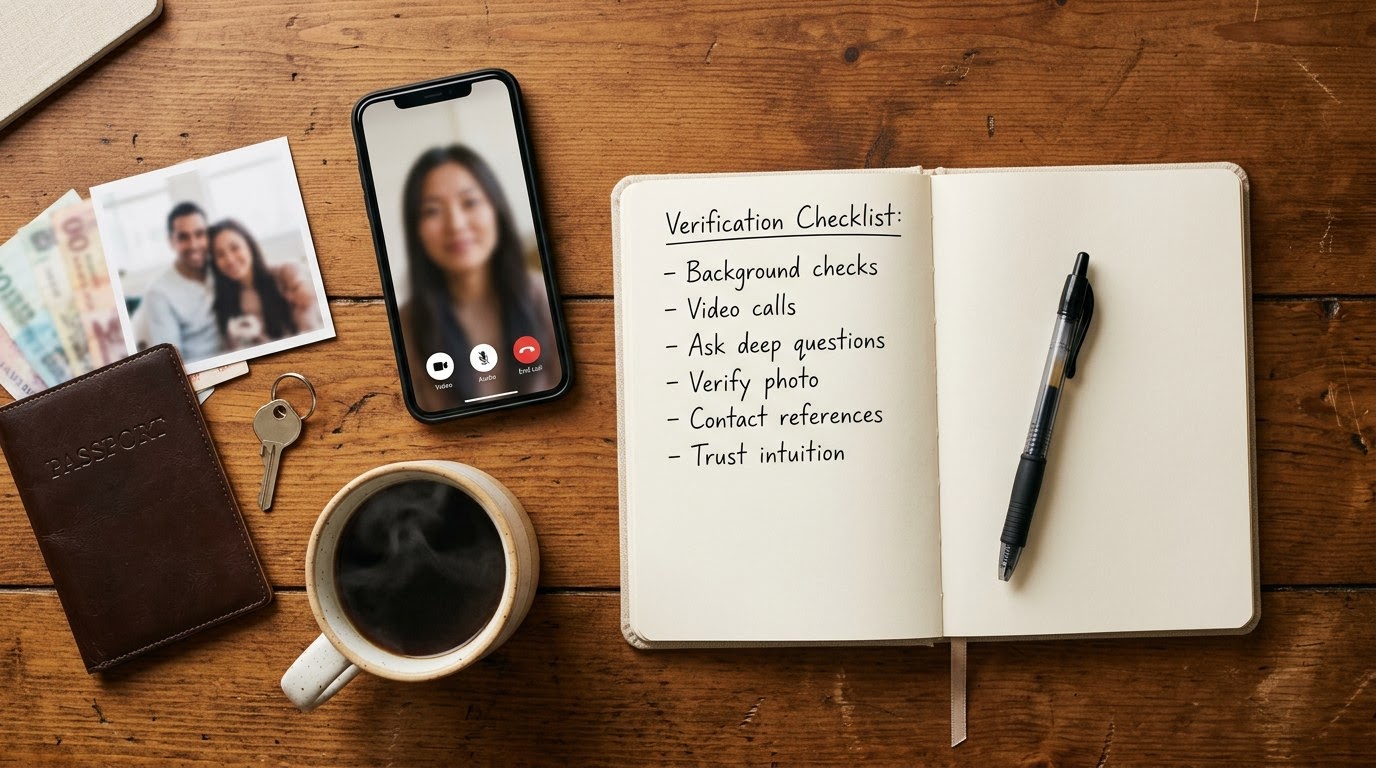
Use this playbook when you are preparing to meet an overseas dating partner in person, booking international travel, or evaluating a long-distance relationship that developed online. Before spending money on flights or stepping onto a plane, run an identity check through TrustMatch to verify that your match is authentic, located where they claim, and safe to meet.
1. Run a TrustCheck on your match
To run a TrustCheck on your match, enter their first name alongside their phone number or primary email address into the TrustMatch verification system. Within under a minute, the platform aggregates public records, digital footprint markers, and phone carrier data to generate a TrustScore and risk verdict. This rapid verification confirms whether the phone number belongs to a legitimate mobile carrier or a disposable VOIP line, verifying their real name and primary location.
International dating scams rely heavily on anonymity. Fraudulent actors routinely use disposable virtual phone numbers created through web-based communication apps. These virtual numbers allow scammers operating in one country to mimic local area codes in another, creating a false impression of proximity or nationality.
As of September 2026, identity verification systems analyze the underlying carrier metadata of any phone number provided. Real individuals maintaining legitimate long-distance relationships utilize standard cellular contracts or established landlines linked to verified billing records. If your partner uses a fresh email address created three weeks ago paired with an unallocated Internet protocol telephony line, your risk profile spikes immediately.
Pay close attention to the TrustScore breakdown. A high score indicates consistent digital footprint history across multiple online platforms, matched name registries, and long-standing communication accounts. A low score or critical warning flag highlights mismatched geographic data, recent account creation dates, or known fraudulent contact details.
2. Demand a live video call before booking travel
To safely verify an international dating partner via video call, schedule a live conversation on an established platform like WhatsApp, FaceTime, or Zoom before arranging travel. Require your partner to turn on their camera, speak in real-time, and perform specific dynamic actions like waving or turning their head. An authentic video interaction confirms their visual identity matches their profile photos and eliminates the possibility of communicating with a deepfake or pre-recorded video feed.
Never accept excuses for avoiding video calls. Scammers frequently claim their smartphone camera is broken, their local internet connection is too weak for video, or their cultural background forbids appearing on camera before marriage. These excuses are tactical delays designed to maintain the romance narrative while protecting the scammer's real identity.
Watch for technical anomalies during the call. Advanced bad actors sometimes route pre-recorded video files through virtual webcam software or apply real-time AI face-swapping filters. Test for live synchronization by asking unscripted questions or requesting spontaneous gestures, such as holding up three fingers or adjusting their lighting.
According to FTC data released in 2024, romance scam losses topped $1.3 billion nationwide, with a vast majority of cases originating from contacts who refused live video confirmation.
If the video freezes frequently, audio fails to sync with lip movements, or the video feed abruptly disconnects whenever you ask a direct question, terminate the call and pause all travel plans immediately.
3. Reverse-image search every profile photo
To reverse-image search your partner's photos, upload every portrait image from their dating profile or social media accounts into visual search engines like Google Lens, Yandex Images, and TinEye. Examine the results to see if those images appear on stock photo websites, modeling portfolios, or social profiles belonging to different individuals. Finding identical photos under multiple names confirms that the profile is fraudulent and uses stolen pictures.
Scammers select attractive photos stolen from micro-influencers, adult performers, or military personnel to build appealing fake profiles. They crop, mirror, or alter color filters on stolen images to evade basic visual search algorithms. Using multiple reverse-image search engines increases your detection rate because each index crawls different regional databases.
A 2025 BBB report revealed that 68% of fraudulent overseas dating profiles used stolen photographs from real individuals. Pay special attention to secondary details in photos, such as localized vehicle license plates, storefront signage, street signs, and seasonal clothing patterns. If your match claims to reside in London but their background photos display North American electrical outlets or right-side steering wheel vehicles, their profile details are false.
Inspect metadata when receiving uncompressed image files directly through chat applications. EXIF data embedded inside digital files reveals the exact camera model, GPS coordinates, and timestamp of creation. Discrepancies between claimed locations and image creation metadata indicate deceptive behavior.
4. Cross-verify social media history and digital footprints
To cross-verify a partner's social media history, inspect their active profiles on networks such as LinkedIn, Instagram, Facebook, and professional directories. Look for long-term posting timelines, organic interaction from real friends, tagged family photos, and consistent career claims. An authentic digital footprint features years of continuous updates, whereas scam accounts display sparse connection lists, recently created profiles, and superficial comment histories.
Analyze profile creation dates and post cadence across all discovered platforms. Fake profiles are often constructed in batches shortly before starting a campaign. An account showing five posts uploaded within forty-eight hours followed by complete silence indicates a manufactured identity constructed solely to deceive targets.
Evaluate the quality of social interactions on their public posts. Real accounts contain contextual comments from long-term friends, co-workers, and family members referencing past experiences. Fraudulent profiles display generic comments from other newly created accounts or bot networks consisting entirely of simple compliments and emojis.
FBI Internet Crime Complaint Center reports from 2025 showed over 19,000 victims targeted by international online dating fraud schemes, with scammers overwhelmingly using minimalist social media presence to dodge cross-referencing. Verify professional affiliations by searching official company registries or professional membership boards in their home country.
5. Audit geographic consistency using time zones and local context
To audit geographic consistency, observe whether your partner's messaging patterns, sleep schedules, and daily routines match the local time zone of their claimed location. Ask specific, casual questions about local ambient weather, current news events, regional holidays, or neighborhood landmarks. Immediate discrepancies between their reported environment and real-time physical conditions signal that your partner is operating from an entirely different country.
Time zone discrepancies frequently expose international impostors. If your match claims to live in Tokyo but regularly sends immediate responses during midnight local time while staying silent during normal Japanese business hours, track their active hours closely. Their true physical location likely corresponds to a completely different continent.
Test ambient local knowledge without sounding like an interrogator. Ask what the weather is like outside their window right now, or mention a major local event that occurred in their city that morning. Scammers managing dozens of target conversations across various time zones routinely make errors when answering questions regarding local environment details.
Pay attention to language nuances, regional idioms, and currency references. A person who claims to have lived in Sydney, Australia their entire life should naturally use Australian spelling conventions, local slang, and correct regional terminology rather than generic translated phrases.
6. Establish strict financial boundaries before discussing meetups
To establish financial boundaries, refuse all requests to send funds, purchase airline tickets, pay customs fees, or transfer cryptocurrency regardless of the emergency presented. Require both parties to cover their own travel expenses independently throughout the courtship. A legitimate partner respects clear personal boundaries and will never make financial assistance a prerequisite for continuing the relationship or arranging a physical meeting.
The transition from casual long-distance romance to organizing an in-person meeting is the exact moment romance scammers attempt monetization. Common tactics include claiming a sudden visa processing fee, requesting money for airport clearance taxes, or reporting a sudden medical crisis right before boarding their flight.
Never agree to buy travel tickets directly through unverified online travel agents suggested by your partner. Scammers provide fake booking confirmation receipts or purchase refundable tickets, cancel them immediately after receiving your funds, and pocket the cash while providing excuses for why they failed to arrive.
Refuse any request to accept packages, transfer funds through your personal bank account, or convert cash into digital assets. Participating in unverified money transfers exposes you to criminal liability as an unwitting money mule for international syndicate networks.
7. Plan meeting logistics in a neutral public location
To plan a safe international meeting, arrange your encounter in a busy, neutral public location such as a major city hotel lobby, popular restaurant, or central tourist landmark. Book your accommodation independently and handle your own local transportation arrangements without relying on your host. Maintaining control over your lodgings, transit, and emergency funds guarantees personal security throughout your trip.
Never agree to stay at a private residence or isolated property during your first cross-border meeting. Remaining in a major commercial hotel provides staff oversight, security infrastructure, and easy access to public transit if you need to end the meeting early.
Share your full itinerary, hotel details, local phone numbers, and emergency contact protocols with a trusted friend or family member before leaving home. Establish a mandatory daily check-in schedule via voice message or secure text app. Ensure your phone carries international roaming capabilities and local emergency service numbers saved in speed dial.
Keep your passport, payment cards, secondary identification, and emergency return flight funds inside a secure hotel room safe at all times. Never surrender your travel documents to anyone other than official border control officers.
International verification summary table
This verification summary table details each action step required to validate an overseas partner, outlining the specific data points to verify and the immediate red flags that indicate deception. Reviewing these verification benchmarks ensures systematic evaluation of an international match before committing time, money, or personal travel to a meeting.
| Step | What to verify | Red flag if missing |
|---|---|---|
| 1. Identity Check | Name, phone carrier type, primary email age, and location registration. | VOIP virtual phone line, freshly created email address, or unverified identity score. |
| 2. Live Video Call | Real-time visual identity, dynamic movement, lip synchronization, and unscripted responses. | Repeated camera excuses, static video freezes, lip-sync delay, or refusal to show face. |
| 3. Reverse Image Search | Original source of profile photos across major search indexes. | Photos linked to stock image sites, modeling profiles, or different names online. |
| 4. Social Media Audit | Multi-year account history, tagged posts from friends, and consistent employment history. | Minimalist account created recently, zero tagged photos, or generic bot comments. |
| 5. Location Consistency | Time zone messaging alignment, ambient weather awareness, and regional dialect. | Active messaging during expected sleep hours or unfamiliarity with local surroundings. |
| 6. Financial Boundary Test | Willingness to fund personal travel and respect zero-money-transfer boundaries. | Requests for flight money, emergency wire transfers, visa fees, or crypto payments. |
| 7. Neutral Meetup Logistics | Independent hotel bookings, public meet locations, and autonomous travel arrangements. | Pressure to stay at private remote locations or reliance on partner for transit. |
Red flags during this process
When implementing this identity verification routine, watch for defensive behaviors, aggressive emotional guilt, or sudden shifts in communication tone when asking reasonable security questions. A genuine dating partner welcomes transparency and understands your need for safety before traveling across borders. If your match becomes angry, accuses you of lacking trust, or rushes your travel timeline, step back immediately.
Recognize the common psychological tactics bad actors use when subjected to simple verification checks. Understanding these behaviors helps you halt interactions before financial loss or safety compromises occur.
Emotional manipulation is the primary shield used by international scammers. When you request a video call or identity verification, fraudulent individuals frequently turn the situation around, claiming that asking for proof hurts their feelings or demonstrates a heartless lack of affection. They attempt to make you feel guilty for exercising basic personal security.
Another prominent warning sign is artificial urgency. Scammers frequently invent artificial deadlines, claiming they are about to be deployed overseas, facing an immediate visa cancellation, or leaving your region permanently unless you book a flight or send money right away. Real relationships develop at a manageable pace without forced deadlines.
If you observe any of these warning signs mid-routine, terminate contact immediately, block all communication channels, and report the profile to the dating platform where you originally connected.
Quick checklist before stepping on a plane
Use this pre-travel checklist to confirm that every essential safety verification step is completed before departing on an international trip to meet a dating partner. Reviewing each item guarantees that you maintain total independence, verified identity proof, and secure emergency protocols throughout your trip. Completing these checklist actions ensures your cross-border meetup remains secure, predictable, and safe.
- Run a final identity check on TrustMatch to verify that all phone numbers, email addresses, and location indicators remain consistent and unflagged.
- Complete at least two live, multi-minute video calls where your partner answers unscripted questions and demonstrates real-time physical movement on camera.
- Book your hotel room and airport transportation independently using your own credit card and under your legal name.
- Establish a daily safety check-in protocol with a trusted friend or family member, including a pre-arranged code word to signal distress.
- Store copies of your passport, travel insurance policy, hotel confirmation, and return flight ticket securely in cloud storage accessible from any device.
- Confirm that your primary mobile phone has active international roaming, data connectivity, and local emergency contact numbers pre-saved.
- Pack sufficient emergency cash and credit cards in separate bags to cover unscheduled hotel stays or immediate early flight changes.
Balancing personal safety with mutual respect
Adopting systematic verification procedures protects your physical and financial well-being while allowing real romantic connections to flourish safely across borders. Communicating your security needs directly and calmly demonstrates maturity and self-respect. Real international partners welcome clear verification practices because safety is a mutual priority for both individuals when meeting someone new.
Verifying an overseas match does not require invasive behavior or awkward accusations. Simply frame your verification requests as standard, common-sense steps that ensure both people feel completely comfortable before spending time and resources on international travel. When both partners prioritize safety, the foundation for a genuine connection becomes significantly stronger.
Running a TrustCheck early narrows the question to one thing: whether the details you were given describe a real, consistent identity. Plenty of scams are run by people using their own names, so treat the result as evidence about the details, not a verdict on the person.
These steps protect you AND respect a real person; they are not surveillance.
Frequently asked
Why should I verify an international dating partner before meeting in person?
Verifying an international partner before meeting prevents romance fraud, identity theft, and physical safety risks. Cross-border travel requires substantial financial and personal investment, making it critical to confirm that your match is authentic, located where they claim, and communicating in good faith before you embark on travel.
How can I tell if a video call with my match is a deepfake or pre-recorded video?
To detect deepfakes or pre-recorded feeds, ask your partner to perform spontaneous, physical gestures in real-time, such as waving a hand across their face, holding up specific numbers of fingers, or turning side to side. Watch for visual glitches around the edges of their face or audio synchronization lag.
What should I do if my international match refuses to do a video call?
If an international partner repeatedly refuses video calls citing broken cameras, poor internet, or personal modesty, halt all travel plans and refuse any financial requests. Persistent refusal to engage in live video interaction is one of the strongest indicators of an online dating scam.
Is it safe to send money for visa fees or flight tickets to an overseas match?
Never send money, cryptocurrency, or wire transfers to an international dating partner for visa fees, travel tickets, or unexpected emergencies. Legitimate dating partners arrange and fund their own travel independently. Requests for money prior to meeting in person are almost universally fraudulent.
How does TrustMatch help verify someone living in another country?
TrustMatch analyzes global digital footprint indicators, phone carrier metadata, email account age, and public records associated with contact details provided by your match. Entering their first name and phone number or email generates a TrustScore and risk evaluation in under a minute, confirming identity authenticity.
More in Guide
- How to Safely Buy a Used Jet Ski From a Private Seller
September 18, 2026
- How to Safely Buy a Used Drone From a Private Seller Online
September 16, 2026
- How to Safely Verify a Cashier's Check Before a Private Sale
September 13, 2026